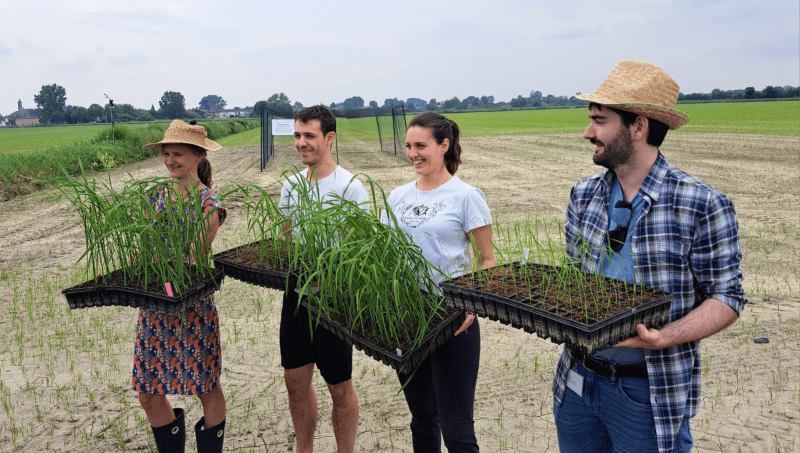
Protestors attempting to stamp out Italy’s research into gene-edited crops unintentionally sparked an outpouring of support

Credit: fornaralab/ X

Rice blast is caused by the fungus Pyricularia oryzae, which evolves rapidly and gains resistance to fungicides…. Blast infections reduce up to 50 percent of the rice produced worldwide, according to [Vittoria Brambilla, a plant scientist at the University of Milan]. So she and her team set out to help using gene editing.

Her team submitted a hefty application this year in January to begin the field trials, and they had approval in time to plant the rice, in May….

The plants grew for more than a month. And then on June 21st, two people came in and destroyed the field overnight.…

Follow the latest news and policy debates on sustainable agriculture, biomedicine, and other ‘disruptive’ innovations. Subscribe to our newsletter.

In better news, the destruction convinced the politicians to extend permission for field trials in gene editing through 2025….

“When the plants were destroyed,” she says, “we went to prime time news on TV, which reached people normally not interested in science. In a way it was good to disseminate the importance of the technology and reach the public we could have never reached. As a scientist I would have preferred my field untouched, but as a professor and my role in society with dissemination, this was a success because we could really reach many more people.”

The rice fields will be cultivated this month to try to get results of the experiment.

At the very least, they are allowed to try again next year with a new gene-edited rice crop, possibly in a secret location.


This is an excerpt. Read the original post here

{{ reviewsTotal }}{{ options.labels.singularReviewCountLabel }}
{{ reviewsTotal }}{{ options.labels.pluralReviewCountLabel }}
{{ options.labels.noReviewsLabel }}
{{ options.labels.newReviewButton }}
{{ userData.canReview.message }}

Related Articles

Infographic: Global regulatory and health research agencies on whether glyphosate causes cancer

Infographic: Global regulatory and health research agencies on whether glyphosate causes cancer

Does glyphosate—the world's most heavily-used herbicide—pose serious harm to humans? Is it carcinogenic? Those issues are of both legal and ...

Most Popular

ChatGPT-Image-Mar-10-2026-01_39_01-PM
Viewpoint—“Miracle molecule” debunked: Why acemannan supplements don’t work
ChatGPT-Image-Jun-25-2026-12_23_17-PM
No, Bill Gates did not secretly engineer ticks to promote veganism
ChatGPT-Image-Jul-22-2026-09_13_07-AM
Viewpoint—The Strategic Litigation boom: Understanding the tightening coalition among NGOs, foundations, journalists, and tort lawyers
How to Include More Strawberries in Your Diet
Strawberries are berries—and 35 other surprising food and drink myths
ChatGPT-Image-May-22-2026-10_26_09-AM
Trump-RFK, Jr. National Science Board firings: Accountability vs. partisan meddling
Screenshot 2026-07-11 094410
Growing animal muscle and fat cells inside rice grains and calling it beef: One of numerous genetically engineered products shaking up our ecosystem

Sorry. No data so far.

glp menu logo outlined

Get news on human & agricultural genetics and biotechnology delivered to your inbox.