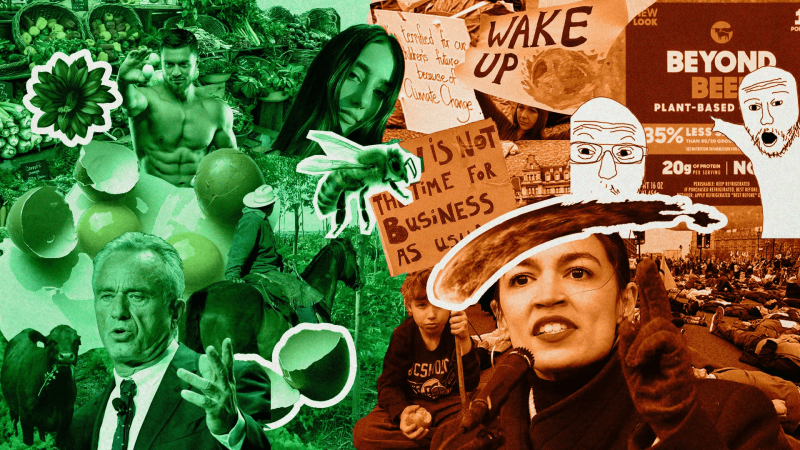
Virtue over impact: Greens environmentalist policy likely to backfire

Credit: Sofia Oaks
Credit: Sofia Oaks
[There is] a particular kind of increasingly common environmental regulation: one that is short on impact but big on virtue signaling.

Consider [some] examples from the past few years:

  • Some American states have banned cafés and restaurants from offering their customers single-use plastic straws.
  • Many jurisdictions around the world now require grocery stores to charge their customers for plastic bags.
  • The EU has phased out incandescent light bulbs.
  • The EU has also banned plastic bottles with removable caps, leading to the introduction of bottles that don’t always properly close once they have been opened.
  • Though not yet implemented, some prominent organizations and activists have called for gas stoves to be banned.

These … examples share an important commonality: They are a form of policy intervention that achieves small improvements for the environment at the cost of a salient deterioration in quality of life or a large loss of political goodwill. For that reason, each of these interventions is likely to backfire.

Follow the latest news and policy debates on sustainable agriculture, biomedicine, and other ‘disruptive’ innovations. Subscribe to our newsletter.

Environmentalist policies don’t just need to be well-intentioned or feel virtuous; they need to be effective in accomplishing their stated goals. It’s time for a new paradigm. Call it “effective environmentalism.”


This is an excerpt. Read the original post here

{{ reviewsTotal }}{{ options.labels.singularReviewCountLabel }}
{{ reviewsTotal }}{{ options.labels.pluralReviewCountLabel }}
{{ options.labels.newReviewButton }}
{{ userData.canReview.message }}

Related Articles

Infographic: Global regulatory and health research agencies on whether glyphosate causes cancer

Infographic: Global regulatory and health research agencies on whether glyphosate causes cancer

Does glyphosate—the world's most heavily-used herbicide—pose serious harm to humans? Is it carcinogenic? Those issues are of both legal and ...

Most Popular

Screenshot 2026-05-26 at 10.15
Viewpoint: Double standard—Why does the wellness industry get a free pass while Big Healthcare is treated as morally suspect?
ChatGPT-Image-Jun-4-2026-01_27_58-PM
Viewpoint—N.A.D.+: Why Gwenyth Paltrow’s heralded anti-aging supplement doesn’t work
ChatGPT-Image-Mar-10-2026-01_39_01-PM
Viewpoint—“Miracle molecule” debunked: Why acemannan supplements don’t work
Screenshot 2025-07-30 at 10.48
Can gene editing eliminate Down syndrome? Scientists have done it in lab-grown cells
tick-DNA
GLP podcast: Spread meat allergy with gene-edited ticks? Bioethicists pose vile ‘thought experiment’
Screenshot-2026-06-03-at-1.24.46-PM
Challenging anti-GMO disinformation: Why genetically-tweaked crops offer bushels of benefits
ChatGPT-Image-Jun-4-2026-11_49_36-AM-2
‘You don’t understand Tolkien’: Skeptic Pope trolls tech giants about the exaggerated, risk-less benefits of AI
downsyndrome_compilation_MID_1
CRISPR breakthrough that can remove the chromosome responsible for Down syndrome raises ethical questions
Screenshot-2026-06-04-at-12.05.08-PM
Cases of brain inflammation surge as U.S. measles pandemic approaches 2000
ChatGPT-Image-May-26-2026-07_51_21-AM-2
Viewpoint: There are more than 1,000 chemicals in a cup of coffee—including many substances that can cause cancer. Why isn’t it banned?

Sorry. No data so far.

glp menu logo outlined

Get news on human & agricultural genetics and biotechnology delivered to your inbox.