Carbon labeling for food? App helps shoppers choose climate-friendly options in the grocery store

Credit: George Institute for Global Health

โ€œConsumers are willing to make more sustainable food choices, but lack reliable information to identify the more environmentally-friendly options,โ€ said [The George Institute for Global Health and Imperial College London researcher Allison] Gaines. She and her co-authors are calling for on-pack carbon labelsย on all packaged food products to help consumers make informed choices.

โ€œThe results of our study show the potential to significantly reduce our environmental impact by switching like-for-like products,โ€ she added.

The study proves thatย incorporating sustainability targets inย national food policiesย could directly help reach global climate goals, without burdening consumers, according to Paraskevi Seferidi, a research fellow at the School of Public Health. โ€œThis is why we are urgently calling for robust legislation that targets high-emission food products,โ€ she said.

Follow the latest news and policy debates on sustainable agriculture, biomedicine, and other ‘disruptive’ innovations. Subscribe to our newsletter.

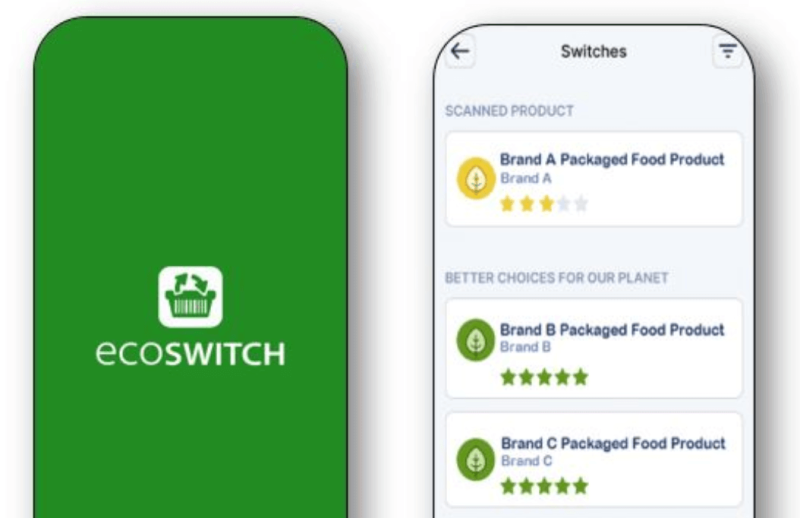
Based on the research, the George Institute has developed a free app called ecoSwitch, which is currently available in Australia. โ€œShoppers can use their device to scan a product barcode and check its Planetary Health Rating, a measure of its emissions shown as a score between half a star (high emissions) to five stars (low emissions),โ€ explained Neal.

He added: โ€œEcoSwitch is a much-needed first step, but our vision is for mandatory display of a single, standardised sustainability rating system, on all supermarket products.โ€

This is an excerpt. Read the original post here

{{ reviewsTotal }}{{ options.labels.singularReviewCountLabel }}
{{ reviewsTotal }}{{ options.labels.pluralReviewCountLabel }}
{{ options.labels.newReviewButton }}
{{ userData.canReview.message }}

Related Articles

Infographic: Global regulatory and health research agencies on whether glyphosate causes cancer

Infographic: Global regulatory and health research agencies on whether glyphosate causes cancer

Does glyphosateโ€”the world's most heavily-used herbicideโ€”pose serious harm to humans? Is it carcinogenic? Those issues are of both legal and ...

Most Popular

Screenshot-2026-04-13-at-1.39.26-PM
Viewpoint: โ€˜Safer for children?โ€™ Stonyfield yogurt under fire for deceptive organic marketing
Screenshot-2026-04-22-at-10.46.29-AM
Viewpoint: How to counter science disinformation? Science journalist offers 12 practical tips
ChatGPT-Image-May-7-2026-12_16_37-PM-2
Viewpoint: Are cancer rates โ€˜skyrocketingโ€™ as RFK, Jr. and MAHA claim? The evidence says mostly the opposite
Picture1-14
When superbugs threaten vulnerable children: Can AI help solve antibiotic resistance?
Screenshot-2026-04-23-at-11.00.36-AM
Regulators' dilemma: Thalidomide, Metformin, and the cost of getting drug approvals wrong
ChatGPT-Image-May-12-2026-08_39_41-PM
GLP podcast: Big Pharma, Big Ag, Big Foodโ€”health harming industries or life-saving innovators?
Picture1-1
Cooling the planet with balloons: Could a geoengineering gamble slow global warming?
png-pill-omega-Supp-fish-oil
Millions take omega-3 fish oil for brain health. New research suggests it may do the opposite.
ChatGPT-Image-May-7-2026-12_32_36-PM
Viewpoint: The state of U.S. vaccine policy? Dismal nationally, but some states are stepping up.
glp menu logo outlined

Get news on human & agricultural genetics and biotechnology delivered to your inbox.