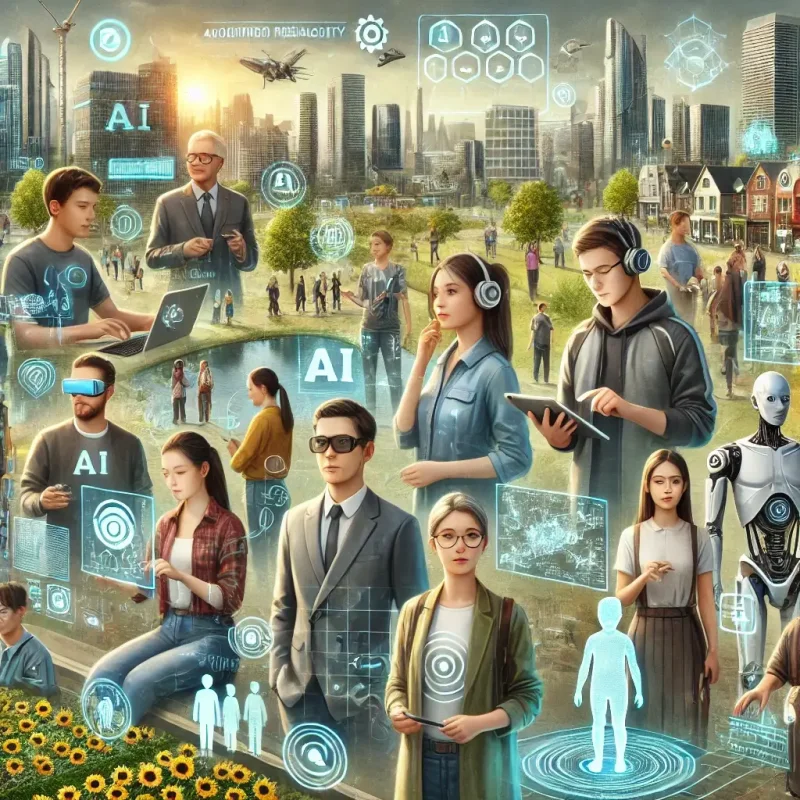
They have conjured dramatic scenarios, like AI-driven extinction of humans (and many other species), or our assimilation into human-AI cyborgs. The predictions are generally grim, pitting the fate of all humans against a unitary (or unified) AI opponent.
What if the AI future doesn’t stretch to these sci-fi dystopias? For an evolutionary biologist, seeing AI technologies diversify into all manner of applications looks a lot like the proliferation of microbes, plants, and animals in an ecological landscape.
[This] led me to ask: how might human evolution be altered by interactions with a world of rich AI diversity? In a paper [published] in The Quarterly Review of Biology, I considered the many ways AI might alter physical, biological, and social environments, and how that might influence natural selection.Predicting evolution is a mug’s game
Natural selection – the mechanism behind evolution – is an inevitable consequence of genetic differences in reproduction among individuals.
Those differences arise as a result of interactions with physical features of the environment (like minimum temperatures), with other species (like predators or parasites) and with other members of the same species (like mates, allies or hostile outsiders).
When Asian gray wolves started hanging around humans around 30,000 years ago, the more reactive wolves were chased away or killed. This whittled away genes for skittishness and aggression, beginning the process of dog domestication. The inadvertent selection that turned wolves into dogs turns out to be instructive in how AI might inadvertently shape the evolution of human brains and behaviour.
“Trying to predict the future is a mug’s game,” said English author Douglas Adams. This is especially true of technologies like AI.
But predicting evolution is, if anything, even more precarious. Combining the two involves considerable speculation, and the very strong possibility of being wrong.
At the risk of being wrong, my intention is to start a conversation about how human evolution, and traits that we most value in one another, might be altered by AI.
Mutual or parasitic?
It might be informative to think of the AI-human relationship as a mutualism – two species each providing the other with something they need.
Computers are beasts of computational burden that benefit their human users. Those benefits will grow with developments in AI. There is already evidence that cultural sharing of knowledge and writing lightened the load on individuals to remember everything. As a result, human brains have shrunk over recent millennia.
Perhaps AI, online searchable knowledge and social media posts that “remember” who-did-what-to-whom will carry more of our memory burden. If so, perhaps human brains will evolve to become even smaller, with less stand-alone memory.
Don’t panic. The benefits of smaller brains include safer births for both mother and newborn. And with computers and AI holding ever-growing records and stores of knowledge, humanity will still be able to do remarkable intelligence-driven things… as long as they can access the AI.
However, mutualists can take another path. They can evolve into harmful parasites – organisms that live at the expense of another organism, their host.



You could think of social media platforms as parasitic. They started out providing useful ways to stay connected (mutualism) but so captured our attention that many users no longer have the time they need for human-human social interactions and sleep (parasitism).
If AI learns to capture user attention ever more effectively, stoking anger and fomenting social comparison, the consequences for who lives, dies and reproduces will affect evolution. In the best of a series of bleak scenarios, the ability to resist social media or remain unmoved by rage-bait might evolve to be stronger.
Intimacy with computers
Important as other species were to human evolution, interactions with other humans were even more formative. Now AIs are sliding into our social lives.
The growth of “artificial intimacy” – technologies that emulate our social behaviours like making friends and forming intimate relationships – is among the most astounding areas of AI progress.
Humans haven’t evolved a social capacity for dealing with computers. So, we apply our “tools” for dealing with other humans to machines. Especially when those machines converse with us via text, voice or video.
In our interactions with people, we keep an eye on the possibility the other person is not being genuine. An AI “virtual friend” doesn’t have feelings, but users treat them as if they do.
Artificial intimacy could make us more wary of interactions over phones or screens. Or perhaps our descendants will feel less lonely without human company and humans will become more solitary creatures.
The question is not trivial
Speculating about genetic evolution might seem trivial compared with AI’s direct effects on individual lives. Brilliant AI researchers and writers are already focused on the way AI will improve or diminish the lives of people who are alive right now.
It’s not as immediate a concern, then, to worry about distant gene changes AI might influence many generations from now. But it certainly bears thinking about.
The pioneering ecologist Robert MacArthur said “there are worse things for a scientist than to be wrong. One is to be trivial”.
Evolutionary changes over many generations could well change or even diminish some of the human traits we cherish most, including friendship, intimacy, communication, trust and intelligence, because these are the traits AI engages most profoundly.
In a non-trivial way, that could alter what it means to be human.
Rob Brooks is a Scientia Professor of Evolution at UNSW Sydney and former director of the Evolution and Ecology Research Centre. Follow him on X @Brooks_Rob.
A version of this article was originally posted at Conversation and has been reposted here with permission. Any reposting should credit the original author and provide links to both the GLP and the original article. Find Conversation on X @ConversationUS