Two new polls reveal cracks in both US and global trust in medicine, with one showing erosion in Americans’ belief that the measles vaccine is safe for children and another finding that just over half of people in 13 countries say that, given conflicting information, they always follow their physician’s recommendations.
Just 1 in 5 approve of Trump’s handling of measles outbreaks
As measles cases and deaths mount from multiple outbreaks across the United States, a four-day Reuters/Ipsos poll shows declining trust in the safety of the measles, mumps, and rubella (MMR) vaccine for children (76%, down from 84% in 2020). The deteriorating trust was most apparent among Republicans.
But just 19% of all 1,143 adult respondents said they approve of President Donald Trump’s handling of the measles outbreaks, while 52% disapprove, and the rest said they didn’t have an opinion or didn’t answer the question.
Registered voters in the poll chose Democrats over Republicans by 45% to 25% when asked which party has a better approach to stopping infectious diseases such as measles. About 31% of voters said they were very worried about measles outbreaks, compared with 58% who said the same about their cost of living.
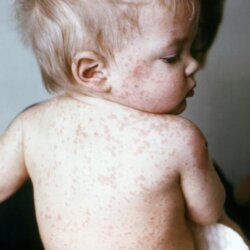
Measles was declared eradicated in the United States in 2000, but declining vaccination rates have enabled the virus to re-emerge in recent years. As of September 11, the country had logged 3,294 cases—a 35-year high—compared with 2,289 cases in all of 2025. Nearly 700 of those cases (693) have been reported in Pennsylvania, as the state experiences its worst outbreak in 35 years.
In addition, the Pennsylvania Department of Health confirmed another measles-related death, in addition to one reported over the weekend and two infants reported previously, bringing the state’s 2026 measles-related death tally to four. (See related CIDRAP News story.) No deaths have been reported in other states so far this year.
Two doses of the MMR vaccine confer 97% lifetime protection, but in 2025, average US vaccination uptake among kindergarteners declined to 92.5%, below the 95% experts say is needed for herd immunity, which can protect people in the community who, for health reasons, can’t get the vaccine.
The poll had a margin of error of plus or minus 3 percentage points.
Half say AI can make health decisions as well as a doctor
A poll of nearly 13,000 people in 13 countries by the Edelman Trust Institute and Yale School of Public Health shows that, when given conflicting information from physicians and other sources, only 51% say they always went with the doctor’s advice, 34% say it depends on the situation, and 15% say they always follow the other sources.



The findings point to a clear imperative for healthcare providers and communicators: move beyond persuasion and invest in the experiences, relationships, and community presence that build trust and ultimately shape health decisions.
The authors used the survey and unpublished data from a previous poll on trust and health to delve into how people make healthcare decisions when faced with complex and often-conflicting information.
Participating countries were Australia, Brazil, Canada, France, Germany, India, Indonesia, Japan, Mexico, South Africa, South Korea, the United Kingdom, and the United States.
Other key poll findings:
- Nearly half of participants said they believe that consumers fluent in artificial intelligence (AI) can address health problems as well as, or better than, a physician.
- Seven in 10 respondents said they believed at least one of six disproven health claims (eg, acetaminophen [Tylenol] use during pregnancy causes autism).
- Respondents cited personal experience, online scientific information, and healthcare providers as the top influences on their views of vaccines, regardless of whether they were vaccine-hesitant or vaccine-willing.
- When evaluating controversial health claims about food, vaccines, and drugs, only 3% viewed the claims as entirely true, and only 5% regarded them as wholly false.
- Relative to participants who reported having had little or no interaction with the healthcare system, those who regularly engaged had a 1.5 times higher odds of believing divisive claims.
- Among respondents with many controversial health beliefs, 71% say they received at least one conflicting health recommendation from a physician and another trusted source in the past year. But only 29% of those with no such beliefs said they got conflicting advice.
- Participants with many contentious health beliefs (and a smaller proportion of respondents with few such convictions) worried that online misinformation can lead them to make bad medical decisions, are concerned about experiencing discrimination in their healthcare, and think medical experts are politically biased.
- More than half of respondents said they need their physician to understand their individual situation (58%), to welcome questions and answer them without judgment (57%), and to address their concerns (55%).
- Half of participants indicated that, to overcome doubts about their physician’s recommendations, the doctor would have to have clinical experience with other patients of their demographic background (53%), respect their values instead of trying to change them (51%), and consider their lifestyle and resource constraints (50%).
- People with many controversial beliefs indicated the importance of having physicians acknowledge that they don’t have all the answers (56%) and not trying to prove patients wrong (51%) if they want to overcome patient doubt.
- Half of people with many contentious health beliefs regularly engage with a group or community that shares health information, recommendations, and experiences and are five times more likely to share such information than those with no such convictions. This same group is much more likely to say that only physicians who have a presence in their community can influence their consideration of a recommendation they regard with skepticism.
“The findings point to a clear imperative for healthcare providers and communicators: move beyond persuasion and invest in the experiences, relationships, and community presence that build trust and ultimately shape health decisions,” the authors wrote.
The poll’s 13-country data had a margin of error of plus or minus 1.1 percentage points, while the country-specific data’s margin of error was plus or minus 4.1 percentage points.
Mary Van Beusekom is a reporter and editor for CIDRAP News. Find Mary on LinkedIn
A version of this article was originally posted at the Center for Infectious Disease Research and Policy (CIDRAP) at the University of Minnesota and is reposted here. Any reposting should credit both the GLP and original article. Find CIDRAP on X @CIDRAP