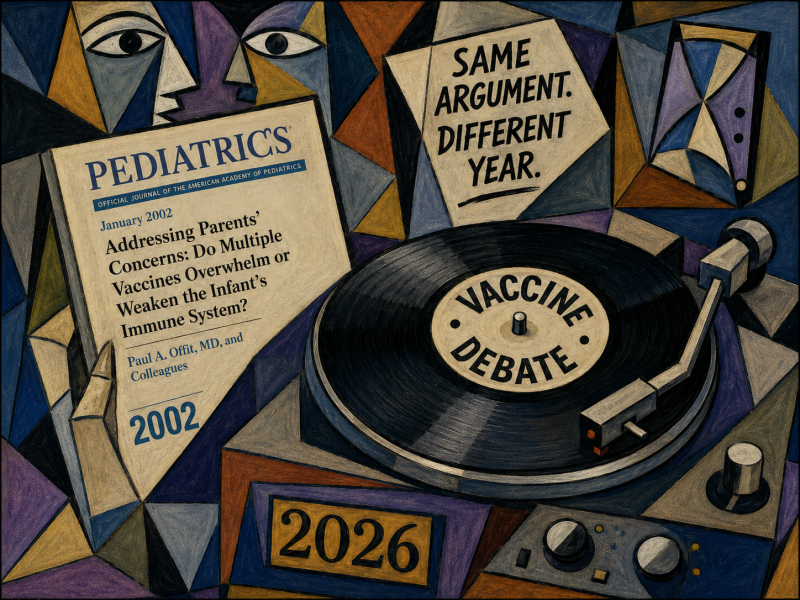

For inexplicable reasons, the vaccine spacing debate has popped up yet again, courtesy of President Trump’s executive order revisiting childhood vaccine policy. But this isn’t a new question. It was addressed 25 years ago in a Pediatrics paper by Paul Offit and colleagues. Here we go again.
In matters of vaccine science, immunology, and virology, there are several schools of thought. For convenience, I’ll divide them into two categories: “Paul Offit” and “wrong.”
That’s only partly tongue-in-cheek. I spent much of my career in antiviral drug discovery, and I’ve known Offit and his work for decades. And if I had to ask a single person for vaccine advice (I did just that during COVID), it would be him.
That said, I don’t want to get into the current argument; others have already done so. Instead, let’s go back 25 years and look at this very same issue. It’s rather eye-opening how little has changed on both sides of the vaccine “debate.”
Of particular interest is the January 2002 article in Pediatrics by Offit and colleagues entitled “Addressing Parents’ Concerns: Do Multiple Vaccines Overwhelm or Weaken the Infant’s Immune System?”
Its opening sentence is chronologically ironic:
Recent surveys found that an increasing number of parents are concerned that infants receive too many vaccines.
Offit et al., Pediatrics 2002
So, what did Offit and his colleagues report 25 years ago? Here’s a summary.
- Immature ≠ incompetent
For starters, an infant’s immune system is immature, but hardly incompetent. Newborns already have a functioning immune system, including the ability to produce antibodies, and young infants can respond to multiple vaccines at the same time.
But could too many vaccines overwhelm that system? The authors did the math. Using conservative assumptions about the number of B cells (white blood cells that produce antibodies) available and the number needed to respond to vaccine antigens (the parts of a vaccine that trigger an immune response), they calculated that an infant could theoretically respond to about 10,000 vaccines at once. Even eleven vaccines given simultaneously would require only about 0.1% of the immune system’s capacity. And since these immune cells are continually replenished, vaccines don’t “use up” the immune system.
2. More = less
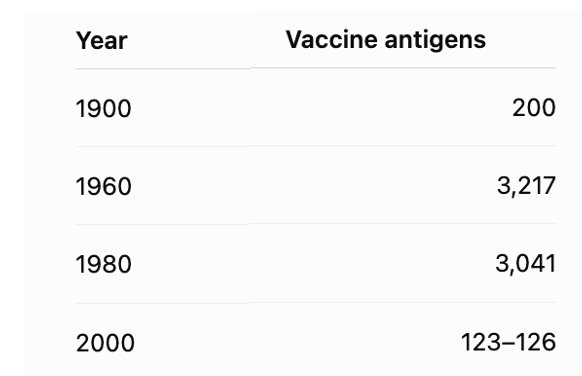
More vaccines don’t necessarily mean more antigen exposure. In fact, the opposite was true (Table 1). In 1960, childhood vaccines contained an estimated 3,217 antigens, about 3,000 of them from the old whole-cell pertussis vaccine alone. By 2000, children were being vaccinated against more diseases, yet the total had fallen to about 125.
3. Together ≠ overwhelmed





Most relevant to today’s argument about vaccine spacing is that this question has already been put to the test.
Offit and his colleagues reviewed various combinations of MMR, varicella, DTP, Hib, polio, hepatitis B, influenza, and pneumococcal vaccines. The result was straightforward: antibody responses were similar whether the vaccines were given together or at different times.
Why is this important? Because the “overwhelmed immune system” hypothesis makes a testable prediction:
If vaccines overwhelmed or weakened the immune system, then one would expect lesser immune responses when vaccines are given at the same time as compared with when they are given at different times.
That didn’t happen.
That was January 2002.
Where are we now?
Twenty-five years later, we’re once again debating whether giving children multiple vaccines at the same time somehow overwhelms their immune systems and whether spacing them out would be safer. There may be new vaccines and new schedules, but there’s nothing new about the argument.
Science is always open to new evidence. But endlessly reopening an old question isn’t the same thing as producing new evidence. Until someone shows that spacing vaccines provides a benefit that the recommended schedule does not, we’re not advancing vaccine science, just spinning our syringes.
Enough already.
Josh Bloom is ACSH’s Director of Chemical and Pharmaceutical Science. Josh earned his Ph.D. in organic chemistry at the University of Virginia, followed by postdoctoral training at the University of Pennsylvania. Find Josh on X @JoshBloomACSH
A version of this article was originally posted at American Council on Science and Health and has been reposted here with permission. Any reposting should credit the original author and provide links to both the GLP and the original article. Find American Council on Science and Health on X @ACSHorg