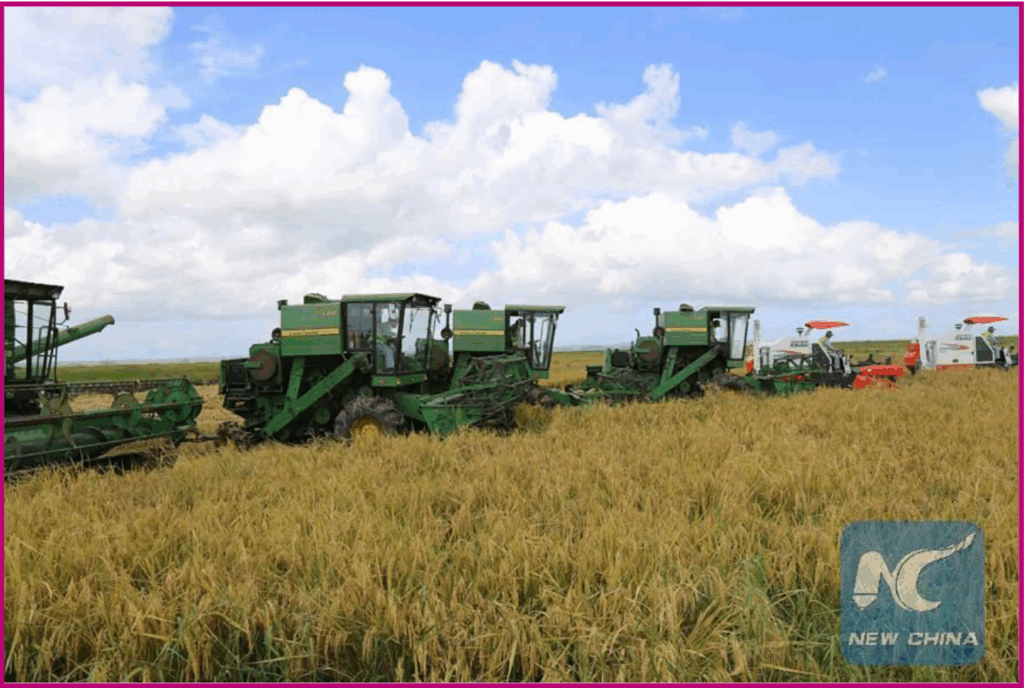
In the heart of Mozambique’s Gaza Province, rice fields stretch across the landscape, a testament to a quiet but powerful agricultural transformation. Just a few years ago, farmers here harvested an average of 1.5 tons of rice per hectare.
Today, that figure has soared to 7 tons, thanks to a partnership with China through the Wanbao Rice Project. This initiative, backed by the China-Africa Development Fund, introduces Chinese hybrid rice varieties, mechanization, and agronomic training to local farmers, dramatically improving productivity and incomes.
Matilde Filomone Mariquele, a farmer in the project, shared the impact on her life: “I benefited from the rice technology transfer program and learned to produce rice using Chinese technologies on one hectare of land. With the money, I have improved a lot my life. I have built my house, and my children are going to school.”
China’s growing influence in Africa’s agricultural sector is being quietly cemented through such projects that blend technology, training, and diplomacy. In various African countries – — from Mozambique to Uganda, Kenya, Ethiopia, and Nigeria – — China has introduced new crop varieties, supported research institutions, and established demonstration farms to promote genetically improved seeds.
In Uganda, Chinese support has brought forward a high-yielding, drought-resistant rice variety known as WDR-73, developed jointly by Uganda’s National Agricultural Research Organization and China’s Shanghai Agrobiological Gene Center. Nearly 5,000 households have benefited, producing more than 15,000 tons of rice. Further, Uganda’s farmers are now experimenting with perennial rice, a variety that can regrow and be harvested multiple times from a single planting, a biotechnology breakthrough with origins in China.
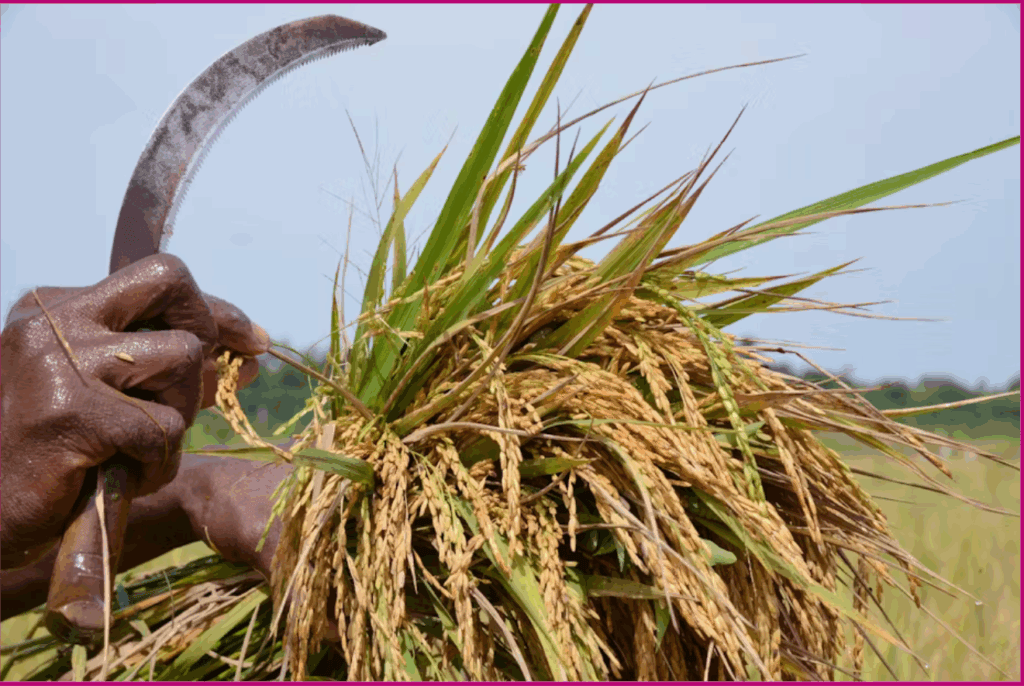
Luo Tingyue, a Chinese agronomist involved in the project, said perennial rice can be harvested several times after planting, saving a great deal in labor costs and farmers’ time, making it a superior species for use in African countries.
But beyond the seeds and harvests lies the bigger story of China’s systematic export of its biotechnology-driven model of agricultural modernization.
In many parts of Africa, China has established more than agricultural technology demonstration centers (ATDCs), often with a strong focus on biotechnology, pest-resistant crops, and high-yield seed varieties. These centers serve not just as training grounds for local farmers and scientists but as platforms to normalize biotech innovations.
Andrew Cox, Chief of Staff and Strategy at the Alliance for a Green Revolution in Africa (AGRA), believes there is real potential in this collaboration. “Because of China’s experience in transforming the entire country around agriculture, we want to see China’s experience, its knowledge, its investment, its technical expertise to come through everywhere,” he said.
“Using Chinese know-how combined with African partners made it possible to double the rice yields over a fairly short period of time and that is the kind of thing that we want to see.”
Such transformations have deep policy support. In late 2023, China rolled out its “Plan for Supporting Africa’s Agricultural Modernization,” which outlines funding, training, and tech transfer strategies focused heavily on improving agricultural output in Africa. In Kenya, one of China’s key partners, Egerton University has long collaborated with Nanjing Agricultural University to develop resilient crop varieties suited to local conditions.


“The whole plan is good,” said Richard Mulwa, Deputy Vice-Chancellor at Egerton. “For long, Africa has lagged behind in innovation, but with cooperation with China in research and development, value addition and cooperation on agro-ecological parks, there are so many benefits to be realized. We know where we are going with the Chinese, and as we keep on cooperating with them, we also see ripple benefits to our farmers.”

This alignment between African institutions and Chinese technology is being further reinforced by international development bodies. Peter Anaadumba, a Program Officer at the FAO’s Africa Regional Office, highlighted the significance of China’s support: “I think the most successful aspect over the last decade has been China’s introduction of small mechanization tools to support agriculture in Africa. The most tremendous contribution is capacity building.”
Biotechnology remains at the heart of this capacity building. In 2024, China approved the commercial planting of its first gene-edited crops, such as soybeans and corn, paving the way for faster development of new crop varieties. With mounting food security pressures and climate-related crop failures in Africa, some experts believe that biotech tools could soon become mainstream across the continent, guided by Chinese support and scientific collaboration.
Wandile Sihlobo, Chief Economist at Agbiz in South Africa, argues that African policymakers should pay attention to China’s pivot. “China is advancing seed breeding in maize, soybeans, and other staple crops. They are embracing science to boost their agricultural development. Our primary focus in Africa should be seed breeding or improving agricultural productivity.”
Yet, this growing reliance on China raises important questions. Will Africa adopt Chinese-style biosafety regulations that prioritize productivity over public skepticism of GMOs? Will dependency on Chinese seed companies and biotech platforms stifle Africa’s own innovation?
Critics caution that while China’s approach may bring rapid gains, it risks creating new forms of dependency, especially as many African countries lack strong regulatory systems and local seed industries.
“While some agricultural projects are being successful in Africa, many are reported to lack responsiveness to local demand and the effect is not ideal. It implies that the sustainable benefits of technical cooperation projects are yet to be traced after several years of the technical project period,” noted a study that explored how agricultural technology transfer projects led by China and Japan in Tanzania and Kenya have performed. The study focused on the effectiveness, alignment with local needs, and long-term sustainability of these programs.
There’s also the geopolitical dimension: as Western countries grow more hesitant to back biotech abroad, China is filling the gap and possibly redefining global standards around agricultural innovation.
Globally, China’s biotech push in Africa is happening in the shadow of declining Western influence. While the European Union remains skeptical about GMOs and the U.S. scales back some overseas development initiatives, China is positioning itself as a trusted and consistent partner in agricultural modernization. This is especially significant as African countries draft new biosafety laws and reconsider outdated GMO bans.
Whether this is a boon for Africa’s food sovereignty or a subtle consolidation of foreign influence remains to be seen. What is clear, however, is that China’s biotech seeds are already planted, and they are beginning to bear fruit.
Dr. Joseph Maina is a Senior Lecturer in the Department of Earth and Environmental Sciences at Macquarie University, Sydney. His work integrates diverse disciplines including macro-ecology, climate science, oceanography, remote sensing, hydrology, fisheries management, and decision science.