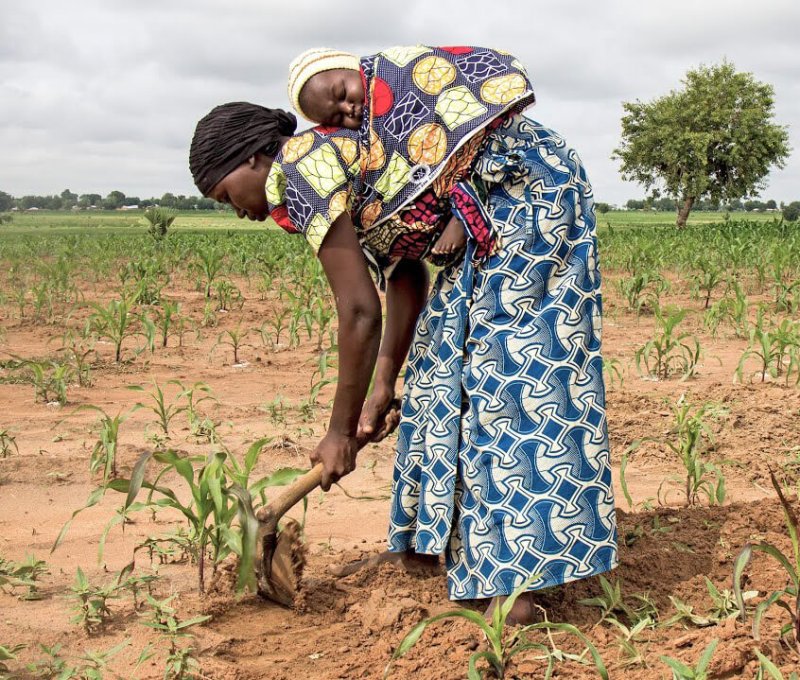
His secret? He had gradually replaced maize (known in much of the world as “corn”), Kenya’s staple crop, with drought-resistant alternatives such as sorghum and protein-rich legumes like pigeon pea and mung bean (also known as “green gram”). These crops required fewer inputs and offered better yields in arid conditions.
Mutua’s story reflects the broader challenges faced across sub-Saharan Africa, where hunger has surged in recent years. According to the United Nations’ Food and Agriculture Organization (FAO), more than 700 million people worldwide were undernourished in 2023 (1), with the highest prevalence in sub-Saharan Africa. Conflict, economic shocks, and climate change have all contributed to this crisis, but a critical, often overlooked factor is the reliance on crops like maize that are ill-suited to the region’s climate and soil conditions.
The Maize Dilemma
Maize, introduced to Africa after 1500, quickly became a dietary staple. Its popularity soared in the colonial era, as European settlers promoted high-yielding varieties. By the late 20th century, maize accounted for more than half of all calories consumed in countries like Malawi and Zambia. Today, it is a dietary mainstay, consumed as flour, porridge, or in fermented dishes.
However, maize has significant limitations. It requires nutrient-rich soils and ample water at specific stages of growth. Many of Africa’s soils lack key nutrients, and fertilizers used to boost yields often deplete the land further. Additionally, maize is highly vulnerable to climate extremes. In Kenya, a recent two-year drought linked to global warming led to a 22% drop in maize production (2) and displaced a million people across eastern Africa. Climate models predict that maize yields in tropical regions will decline by 5% for every degree Celsius of warming, with eastern Africa particularly at risk.
Rediscovering Indigenous Crops
In contrast to maize, many of Africa’s traditional crops are better adapted to the continent’s diverse climates. Sorghum, millet, pigeon peas, and native legumes are drought-tolerant and nutrient-rich, making them ideal for arid regions. Yet, these crops have been historically neglected by agronomic research, earning them the moniker “orphan crops.” Their yields are often lower than their potential due to vulnerabilities to pests and diseases.
Efforts to improve these crops are gaining momentum, however. In 2023, the U.S. Department of State partnered with the African Union, the FAO, and global agricultural institutions to launch the Vision for Adapted Crops and Soils (3) (VACS). This initiative aims to accelerate research and development for traditional crops and restore Africa’s depleted soils. With funding pledges totaling $200 million, VACS represents a significant shift in agricultural policy, moving away from promoting monoculture systems dominated by maize toward embracing crop diversity.
“One of the things our community has always cried for is how to raise the profile of these crops and get them on the global agenda,” says Tafadzwa Mabhaudhi (4), a professor of climate change, food systems, and health at the London School of Hygiene and Tropical Medicine.
Science and Innovation to the Rescue
Scientific advances are key to unlocking the potential of indigenous crops. The African Orphan Crops Consortium (5) (AOCC), a collaboration involving CGIAR (6) (a global partnership among organizations doing research on food security) and the University of California, Davis, has been sequencing the genomes of understudied crops and training African scientists in plant breeding. These efforts are enabling researchers to develop drought-resistant and pest-resistant varieties faster. Modern tools like CRISPR gene editing offer additional promise, allowing scientists to enhance disease resistance by mimicking traits found in wild plants.
For example, egusi (7), (the protein-rich seeds of certain cucurbitaceous (8) plants such as squash, melon, and gourd), which is popular in West Africa, has the potential to combat malnutrition and thrive in dry regions. Breeding varieties with shorter growth cycles could make this crop more viable in arid areas. Similarly, pigeon peas and millet could play a significant role in addressing dietary deficiencies and reducing reliance on maize.
Overcoming Cultural and Market Barriers
Despite their advantages, reintroducing indigenous crops into African diets poses challenges. The cultural significance of maize has become deeply entrenched, and many farmers are reluctant to switch to alternatives. As Florence Wambugu (9), CEO of Africa Harvest, observes, “People plant maize, harvest nothing, and still plant maize the next season.”
Urbanization also complicates efforts to revive traditional foods. Sub-Saharan Africa’s population is projected to double by 2050, with many young people gravitating toward Westernized diets. To succeed, proponents of indigenous crops must find ways to market them to urban populations and integrate them into modern supply chains.
A Path Forward
The push to revive Africa’s orphan crops is about more than food security; it is about resilience and sustainability. By reducing dependence on maize and other climate-vulnerable staples, Africa will be better able to withstand the impacts of climate change. Diversifying crops also has the potential to improve nutrition, combat malnutrition, and empower smallholder farmers by opening new markets.
Programs like VACS and AOCC are steps in the right direction, but success will require collaboration among governments, researchers, and farmers. Policymakers must invest in infrastructure and education to make traditional crops viable options for both rural and urban communities. Scientists must continue to innovate, and farmers will need support to transition to more sustainable practices.


As the world faces an uncertain future, Africa’s past may hold the key to a more secure and sustainable food system. By embracing its agricultural heritage, the continent can chart a path toward greater resilience in economic and food security.
(1) https://www.who.int/news/item/24-07-2024-hunger-numbers-stubbornly-high-for-three-consecutive-years-as-global-crises-deepen–un-report
(2) https://www.technologyreview.com/2024/10/14/1105070/africa-crops-maize-kenya-climate-change-agriculture/
(3) https://www.state.gov/the-vision-for-adapted-crops-and-soils/
(4) https://www.technologyreview.com/2024/10/14/1105070/africa-crops-maize-kenya-climate-change-agriculture/
(5) https://africanorphancrops.org/
(6) https://www.cgiar.org/
(7) https://en.wikipedia.org/wiki/Egusi
(8) https://en.wikipedia.org/wiki/Cucurbitaceous
(9) https://www.google.com/url?sa=t&source=web&rct=j&opi=89978449&url=https://www.linknovate.com/search/?query=nairobi%252520restaurant%252520specializing&ved=2ahUKEwiPusS-3JGLAxWqMDQIHS6LBtwQFnoECCwQAQ&usg=AOvVaw0NUUUZ-nkcyQKo0TEfaCsH
Henry I. Miller is a physician and molecular biologist and the Glenn Swogger Distinguished Fellow at the American Council on Science and Health. He was the founding director of the U.S. FDA’s Office of Biotechnology. Follow Henry on X @henryimiller
A version of this article was posted in European Scientist. Follow European Scientist on X @EuropeanScientist