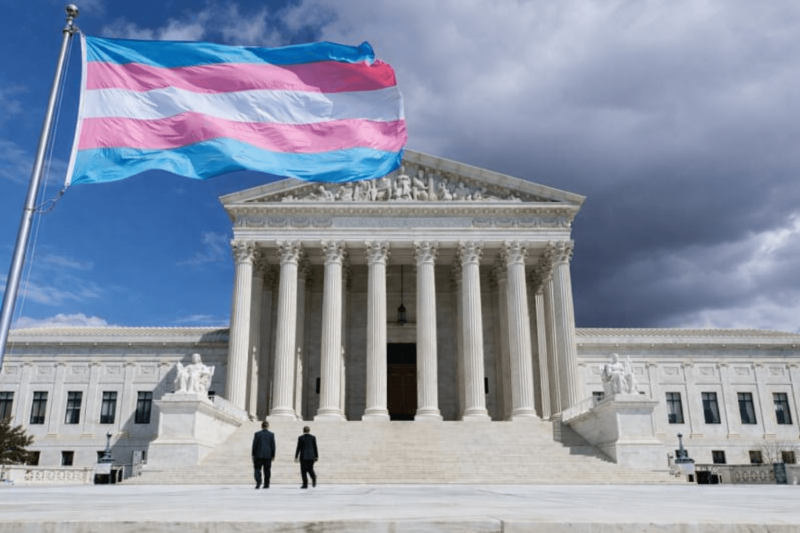
The Supreme Court on [June 30, 2026] ruled that states can exclude transgender athletes from women’s and girls’ sports teams. The justices ruled unanimously that laws enacted by Idaho and West Virginia do not violate federal civil rights laws, but they divided over whether the West Virginia law violates the Constitution, at least with regard to the athlete in the case before the court.
In his 29-page opinion, Justice Brett Kavanaugh wrote that “[c]onsistent with Title IX and the Equal Protection Clause, we hold that the States may maintain women’s and girls’ sports for biological females. They may determine eligibility for women’s and girls’ sports based on biological sex. The Constitution and Title IX do not require an overhaul of women’s and girls’ sports throughout America.”
Justice Sonia Sotomayor, in an opinion joined by Justices Elena Kagan and Ketanji Brown Jackson, contended that “the majority extends great sympathy to those it favors: the young cisgender girls and women who play sports. I share that sympathy. Playing sports can lead to benefits that are immeasurable, and many are understandably invested in ensuring that competition stays fair and safe. Because the majority, however, inflicts a hardship on those it disfavors without giving them the fair and full opportunity the Constitution requires to litigate their contentions, I respectfully dissent.”
The court’s decision in West Virginia v. B.P.J. and Little v. Hecox came just over a year after the Supreme Court, also by a vote of 6-3, upheld a Tennessee law banning the use of puberty blockers and hormone therapy by transgender teenagers.
Tuesday’s ruling centers on two laws that limit participation on women’s and girls’ teams. Idaho enacted the Fairness in Women’s Sports Act in 2020. The law bars transgender women and girls from participating on any women’s and girls’ sports teams in public schools, from elementary school through college. Idaho was the first state to pass such a law; since then, 25 other states have enacted similar bans.
The West Virginia Legislature passed that state’s law, known as the Save Women’s Sports Act, in 2022. The law prohibits transgender women and girls from participating on women’s and girls’ sports team in public secondary schools and colleges.
There are two challengers in two separate cases, which were argued on the same day in January. One challenger is Lindsay Hecox, who filed this lawsuit because she wanted to try out for the women’s track and cross-country teams at Boise State University in Idaho. Hecox did not make the NCAA teams at BSU but competed in women’s soccer at the club level.
The other challenger is Becky Pepper-Jackson, identified in court filings only as B.P.J., a 15-year-old high school student who has publicly identified as female since the third grade. Pepper-Jackson takes medicine to stave off the onset of male puberty and has also begun to receive hormone therapy with estrogen. Pepper-Jackson’s mother, Heather Jackson, went to federal court in West Virginia when she learned that her state’s law would bar Pepper-Jackson from participating on the girls’ middle school sports teams.
The U.S. Court of Appeals for the 9th Circuit agreed with Hecox that the Idaho law violates the 14th Amendment’s guarantee of equal treatment and prohibited Idaho from enforcing the ban. The court of appeals reasoned that the Idaho law was intended “to categorically ban transgender women and girls from public school sports teams that correspond with their gender identity.” The law also discriminates on the basis of sex, the lower court ruled, because athletes on girls’ and women’s teams are subject “to invasive sex verification procedures to implement that policy,” while athletes on boys’ and men’s teams are not.
A federal appeals court in Richmond also barred West Virginia from enforcing its law. Specifically, the U.S. Court of Appeals for the 4th Circuit ruled that West Virginia’s law violates Title IX, a federal civil rights law that prohibits sex discrimination in educational programs and activities that receive federal funding, because it discriminates against Pepper-Jackson on the basis of sex.
Writing for the court, Kavanaugh made several overarching points. First, he emphasized, men and women have “inherent physical differences” that are “relevant to athletic performance” – for example, “height, weight, strength, speed, endurance, and jumping ability.” As a result of these differences, “forcing female athletes to compete against males can create significant safety risks” in contact sports. Moreover, he added, “in virtually all competitive sports, forcing female athletes to compete against males can undermine competitive fairness.” As a result, he said, “schools therefore typically maintain separate women’s and men’s sports teams.”
These points provided the underpinning for Kavanaugh’s conclusion that the Idaho and West Virginia laws do not violate Title IX or the Constitution. First, he explained, Title IX bars “discrimination on the basis of sex,” and the regulations that implement the law “expressly permit schools to maintain separate teams for ‘members of each sex.’” When both the law and the regulations refer to “sex,” he wrote, they mean “biological sex,” because that was the “ordinary meaning” of the word when they were enacted in the 1970s. Indeed, he continued, “the Title IX regulations allowed separate sports teams precisely because of the biological differences between the sexes.”
Kavanaugh pushed back against Pepper-Jackson’s suggestion that interpreting the regulations to bar transgender women and girls from women’s and girls’ sports teams would not be “reasonable” and would therefore violate such a requirement imposed by a 1974 amendment to Title IX. “Separate sports teams for biological males and biological females are reasonable” in light of the differences between men and women and the effects of those differences, Kavanaugh wrote. And as evidence of that reasonableness, he noted that “27 States, the NCAA, the” U.S. Olympic and Paralympic Committee, and the International Olympic Committee “have all drawn the same line.”




“Whether biological males may participate on women’s and girls’ sports teams may be a debated policy question. But the legal question for Title IX purposes is whether West Virginia may limit women’s and girls’ sports teams to biological females. As a matter of text and history, West Virginia may do so,” Kavanaugh concluded.
Kavanaugh relied on many of the same points in determining that the Idaho and West Virginia laws do not violate the Constitution’s guarantee of equal treatment. Because “the laws limit women’s and girls’ sports teams to biological females,” Kavanaugh explained, they are subject to a constitutional test known as “intermediate scrutiny,” which requires the states to show that a classification based on sex “is ‘substantially related’ to achieving an ‘important’ government objective.”
Both states’ laws do this, Kavanaugh wrote: the states have “interests in safety and competitive fairness,” which they promote by “limiting women’s and girls’ sports to biological females.” This is true, Kavanaugh continued, even when the effect of the classification is to exclude transgender athletes who “have taken puberty blockers or hormones” and therefore may not pose the same risks to fairness and safety. “Especially in the sports context,” Kavanaugh wrote, “an enormous practical and administrability problem would arise if courts suddenly had to make such individualized exemptions.” “The legislatures and the schools are better equipped—and under the Constitution, are the more appropriate entities—to assess the competing medical and scientific considerations and draw appropriate lines,” Kavanaugh stressed.
More broadly, Kavanaugh stated that “the underlying medical and scientific premise of” that argument is “the subject of ongoing medical and scientific debate.” “States and leading athletic organizations disagree with the plaintiffs,” Kavanaugh said, “and have concluded that biological males still retain a physical advantage after taking puberty blockers and hormones.”
Kavanaugh concluded with a paean to sports and, in particular, women’s sports. “Sports,” he wrote, “are highly competitive and generally zero sum. At almost every turn, someone wins and someone loses. Every athlete who makes a team takes a roster spot from another athlete. Every player who earns playing time reduces the playing time of a teammate.” Female athletes, he contended, “care deeply about all of those things.”
Justice Clarence Thomas joined the Kavanaugh opinion but also penned a brief solo concurring opinion. “Men and boys with gender dysphoria are not women or girls,” Thomas wrote, “even if they believe that they are. Sex is an immutable, ‘biological’ characteristic; it is binary; and ‘man’ and ‘woman,’ ‘boy’ and ‘girl,’ are the terms that correspond to adults and children of each sex. To use language to obscure reality—to show ‘indifference regarding the truth’—is to lie to the public and cease to treat our fellow citizens ‘as equal[s].’”
Justice Neil Gorsuch concentrated on Congress’ enactment of Title IX using its powers under the Constitution’s spending clause, which gives it the power to spend money to provide for the “general Welfare of the United States.” Although that provision allows Congress to put conditions on the funds that it allocates to others, Gorsuch explained, the recipient of those funds “must ‘”voluntarily and knowingly”’ assent to those conditions for them to bear any legal force.” Moreover, Gorsuch continued, “Congress must ‘clearly and unambiguously’ specify the conditions it expects the funding recipient to follow.” In this case, Gorsuch said, “[n]othing in Title IX clearly and unambiguously alerts funding recipients that they are prohibited from restricting a school-sponsored sports team to biological women or girls.”
In her dissenting opinion, Sotomayor agreed that West Virginia’s ban does not violate Title IX. She explained that, when Pepper-Jackson has agreed with the state that “sex” means “‘biological sex’ or sex identified at birth,’” there is no violation because the state can create sports teams based on sex. But she would have upheld the lower court’s ruling and sent the case back for more fact-finding related to Pepper-Jackson’s constitutional claim. That “unresolved factual dispute” over whether athletes like Pepper-Jackson, who have never gone through puberty, are “similarly situated to cisgender girls” is actually an important part of whether excluding them from participating in sports advances the state’s interests and therefore whether the state’s ban can pass constitutional muster.
“Because of the Court’s decision today,” Sotomayor concluded, “West Virginia, and any other state actor, can deny B. P. J. and others like her” the benefits of playing sports “simply because it thinks they have an inherent athletic advantage, even if the facts show that they do not. In the end, to the Court,” Sotomayor argued, “the facts do not matter, even though the consequences are serious.”
Amy Howe is the co-founder of SCOTUSblog and its primary reporter. Find Amy on X @AHoweBlogger
A version of this article was originally posted at SCOTUSblog and is reposted here. Any reposting should credit both the GLP and original article. Find SCOTUSblog on X @SCOTUSblog