‘Quite advanced’: Scientists are close to perfecting biotech African potato variety that is free of killer late blight disease 

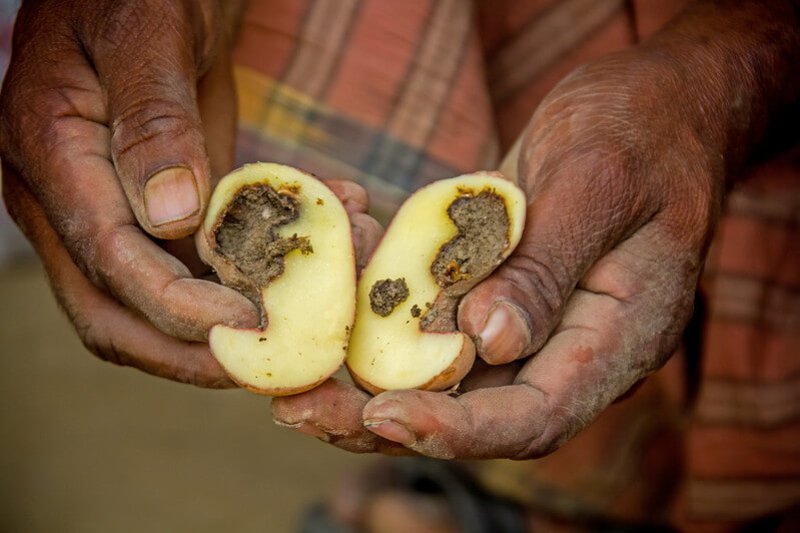
A close-up of a potato ruined by late blight disease. Credit: Alliance for Science

[Researchers] at the Kenya Agricultural and Livestock Research Organization have used genetic modification to create potatoes that are resistant to late blight, a disease that can attack entire crop fields if left untreated.

Late blight is caused by the fungus-like pathogen Phytophthora infestans, and it attacks the leaves, stems, and potato tubers, making the potato inedible, and it can spread incredibly fast.

As researcher Dr. Moses Nyongesa noted, without control measures in place, late blight can lead to a 30% yield loss.

Follow the latest news and policy debates on sustainable agriculture, biomedicine, and other ‘disruptive’ innovations. Subscribe to our newsletter.

The solution is a strain of potatoes resistant to late blight …. To achieve this, the researchers harvested genes from wild potatoes that are resistant to late blight and introduced those genes into varieties grown in Kenya.

“We now have the biotechnology potato variety that is under development at quite advanced stages now,” Nyongesa said.

The modified potatoes have been tested over two growing seasons in three separate locations and have proven to be resistant to late blight. Testing also showed that the modification did not change the nutritional composition of the potatoes.


This is an excerpt. Read the original post here

{{ reviewsTotal }}{{ options.labels.singularReviewCountLabel }}
{{ reviewsTotal }}{{ options.labels.pluralReviewCountLabel }}
{{ options.labels.newReviewButton }}
{{ userData.canReview.message }}

Related Articles

Infographic: Global regulatory and health research agencies on whether glyphosate causes cancer

Infographic: Global regulatory and health research agencies on whether glyphosate causes cancer

Does glyphosate—the world's most heavily-used herbicide—pose serious harm to humans? Is it carcinogenic? Those issues are of both legal and ...

Most Popular

Screenshot-2026-04-22-at-12.21.32-PM
Viewpoint: Why the retracted Monsanto glyphosate study doesn’t change the science—the world’s most popular herbicide is safe 
Picture1
The FDA couldn’t find a vaccine safety crisis, so it buried its own research
ChatGPT-Image-May-1-2026-11_42_59-AM-2
Viewpoint: NAD is the wellness grifters latest evidence-lite longevity fad. At least the mice are impressed.
global warming
‘Implausible’: Top climate scientists reject worst-case scenario—soaring temperatures and fast-rising sea levels
Screenshot-2026-05-21-at-12.15.17-PM
UK gene-editing milestone: Livestock barley that increases ruminant value and reduces methane emissions is first-approved CRISPR crop
vax-misinformation-main
Facts & Fallacies Podcast: Limit free speech to blunt social media misinfo?
ChatGPT-Image-Apr-16-2026-02_56_53-PM
Financial incentives, over diagnosis, and weak oversight: Autism claims are driving up Medicare costs
Screenshot-2026-05-21-at-3.15.53-PM
Chiropractors may no longer be modern-day snake oil salesmen, but the benefits of their therapy are limited–at best
ChatGPT-Image-May-12-2026-11_27_01-AM-2
AI likely to improve health care, research shows—but not for blacks and ethnic minorities
Screenshot-2026-05-20-at-5.11.17-PM
Viewpoint: No, sugar doesn’t ‘feed’ cancer — common cancer myths, debunked

Sorry. No data so far.

glp menu logo outlined

Get news on human & agricultural genetics and biotechnology delivered to your inbox.