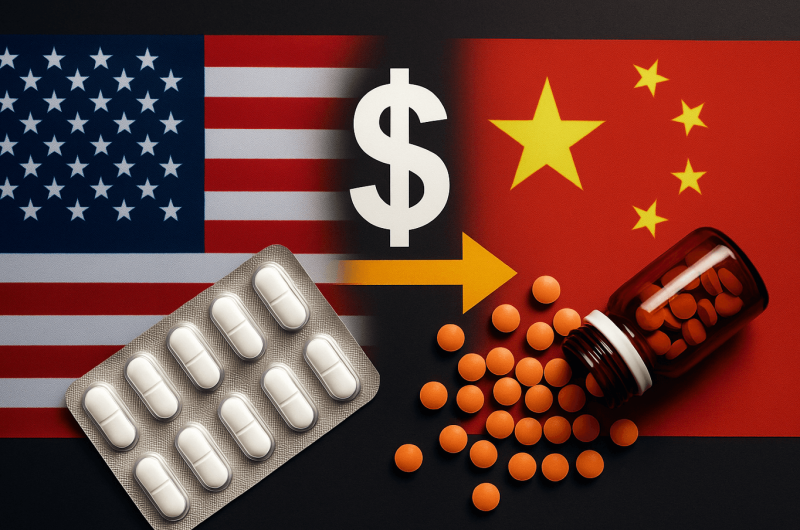
The U.S.–China trade conflict reignited this past week when Beijing announced it would expand export controls on rare earth minerals — elements critical to American innovation in consumer electronics and defense. President Trump quickly threatened 100 percent tariffs on all Chinese imports, sending markets tumbling.
Fearing a deeper selloff, Trump has since toned down his rhetoric, but tensions over trade remain a defining economic and strategic fault line between the two superpowers.
While potential shortages of components vital to high-tech electronics, clean energy, and defense systems dominate headlines, there is a lower profile but equally consequential risk: the nation’s growing dependence on Chinese active pharmaceutical ingredients (APIs) and other drug intermediates — a weakness already tied to ongoing shortages and mounting national-security concerns.
As the name suggests, APIs are the critical active ingredients in many of the pills and injectable drugs sold in the U.S. — from antibiotics and blood pressure medications to cancer treatments. And a staggering share of them comes from one place: China.
This dependency has far-reaching implications for the U.S. economy, national security, and public health – implications magnified by renewed trade turmoil. Although finished pharmaceutical products are largely protected from tariffs by World Trade Organization rules, the bulk chemicals and APIs used to make them are explicitly exempted under U.S. trade measures. That omission leaves the generic drug market—which accounts for about 90% of all U.S. prescriptions — highly exposed.
If China were to impose an export restriction on any key ingredients, it would be hard to make up that gap,” warned Tom Kraus, vice president of government relations at the American Society of Health-System Pharmacists.
That prospect has become more plausible in view of recent developments. On October 6, President Trump posted that “starting November 1st, 2025 (or sooner, depending on any further actions or changes taken by China), the United States of America will impose a Tariff of 100% on China, over and above any Tariff that they are currently paying.
That threat, which came in response to Chinese export restrictions on rare earths and other inputs that are critical to the U.S., applies broadly, with the drug sector among many parts of the supply chain that could be affected. That would potentially escalate tariff rates close to levels that in April fanned fears of a global recession.
However, given President Trump’s notorious to-ing and fro-ing on tariff threats, broader shifts in U.S.–China tariff levels (e.g. recent mutual reductions in base tariff rates under trade “truce” efforts) could either soften or complicate the implementation timeline.
In addition, external pressure from domestic health policy stakeholders, such as lobbying by pharma companies and possible supply chain backlash, might influence how aggressive the tariffs become.
China responded to Trump’s recently announced tariffs with equal force, threatening to levy its own huge retaliatory tariffs on U.S. goods. In the shadow of this escalating trade war, the specter of a supply chain disruption has become alarmingly real.




The risks of dependency
Even without overt trade retaliation, the sheer scale of U.S. dependence on China for pharmaceutical inputs is cause for concern. A report from the U.S.-China Economic and Security Review Commission described the risks. Some of its most significant conclusions:
- China is the world’s largest producer of APIs, and the U.S. relies heavily on drugs either made in China or derived from Chinese-sourced ingredients.
- Drug companies are not required to disclose the country of origin for their APIs, leaving U.S. unaware of the risks.
- Beijing promotes and protects its domestic pharmaceutical sector to the disadvantage of foreign competitors.
- Should China weaponize this dependence by cutting API exports, the effect on the health of U.S. consumers could be severe.
China’s dominance, coupled with spotty regulatory oversight, has already led to quality control scandals, including the distribution of contaminated or substandard drug ingredients. Because labeling laws disclose only the final place of assembly, most Americans have no idea their daily medications may contain materials sourced from poorly regulated Chinese factories.
But safety is only one piece of the risk; strategic vulnerability is the other. If China were to restrict API exports during a geopolitical crisis — over Taiwan, trade disputes, or another flashpoint — the health consequences could be catastrophic.
Chronic conditions like hypertension, diabetes, infections, and heart disease rely on continuous access to a broad range of generic drugs depend on a steady flow of generic drugs. A sudden shortage could leave hospitals scrambling and patients without treatment options. In extreme cases, lives could be lost—not due to a lack of medical knowledge, but because of a lack of drugs.
This is no hypothetical scenario. As of October 10, the U.S. Food and Drug Administration listed 76 active drug shortages — including chemotherapy agents, antibiotics, and other lifesaving medicines. These disruptions stem not from surging demand, but from supply-chain bottlenecks — precisely the kind of vulnerability worsened by dependence on a single foreign supplier.
What should be done?
First, Congress must quantify the nation’s exposure by auditing the pharmaceutical supply chain and identifying alternative suppliers.
Second, Congress should empower the FDA to expand its inspection capacity in China to ensure compliance with U.S. safety standards.
Third, transparency must improve. Manufacturers should be required to disclose not only where a drug is assembled, but also where its ingredients originate.
Fourth, Congress can incentivize domestic production by requiring Medicare, Medicaid, and the Department of Veterans Affairs to prioritize drug purchases from certified domestic or FDA-inspected sources abroad.
Fifth, the Trump administration must weigh carefully any tariff policies that could inadvertently disrupt critical drug supplies.
Globalization has delivered tremendous benefits — lower costs, greater competition, and broader access. But that same interdependence becomes a liability when it rests on a single, fragile pillar. China’s control of the API market gives it powerful economic leverage and creates unacceptable risks for American health security.
There is additional, ominous context relevant to China’s ability — and, perhaps, its willingness — to compromise the supply of pharmaceuticals in the U.S.: As described on CBS’ “60 Minutes” on October 12th, China has already penetrated, and is attempting to penetrate further, vital U.S. infrastructure: water treatment facilities, the electrical grid, telecommunications, transportation networks, and more.
In an extensive interview, retired Air Force four-star General Timothy Haugh, who until April headed both the U.S. Cyber Command and National Security Agency, argued that there is no clear economic or intelligence-collection advantage to many of these hacks.
Rather, they are preparing “pre-positioning” access so that, in a geopolitical crisis or war, the attackers can inflict damage or exert leverage on the U.S. He suggests that even attacking small, rural utilities may present a distraction and sow fear and confusion.
The intentional interruption of the U.S. pharmaceutical supply would constitute another possible Chinese diversion of the public’s and government’s attention, as well as injury to the health of many Americans. Threats or the actual imposition of punitive tariffs on China should, therefore, be applied with great caution.
Henry I. Miller, a physician and molecular biologist, is the Glenn Swogger Distinguished Fellow at the Science Literacy Project. A veteran of the NIH and FDA, he was the founding director of the FDA’s Office of Biotechnology. Find him on his website: henrymillermd.org