Based on only eleven rain collections, researchers from Tokyo and Hokkaido Universities detected five neonicotinoids in Japanese rainwater at sub-nanogram-per-liter levels — concentrations so low they were beyond routine detection just a few years ago. Scientifically, the finding is hardly unexpected; had the team searched for dozens of other common chemicals, most would also be detectable at such micro-trace levels. Yet this single class of compounds has been seized on by anti-pesticide campaigners as fresh evidence of the ‘dangers’ of modern farming, stoking concern about agricultural chemicals despite the vanishingly small amounts involved.
In France, a fierce battle erupted in Parliament this summer over the future of neonicotinoids — a class of synthetic insecticides, five of which are banned nationally. Often called neonics, these products protect a wide range of crops — especially cereals, corn, sugar beets, soybeans, cotton, fruits, and vegetables — from sap-sucking and leaf-chewing pests such as aphids, whiteflies, leafhoppers, and beetles. Applied as seed coatings or foliar sprays, neonics are prized because alternatives are generally less effective and often more toxic to applicators, plants, and non-target animals.
Many countries — including the U.K. and most EU member states — have banned four of the five major neonics; France bans all five. In contrast, the United States, Brazil, Japan, and Australia continue to allow their use after weighing costs and benefits.
When serious pest outbreaks hit — for example, on sugar beets over the last decade — and alternative chemicals fail, some countries (post-Brexit U.K., Poland, Finland, and, until recently, France) have issued what’s called derogations: an emergency, time-limited waiver. England was granted one in 2024. France last issued such derogations in 2021 and 2022 for the seed treatments imidacloprid and thiamethoxam; those four-month waivers were credited with saving as much as 30 % of France’s sugar beet crop. A planned 2023 derogation was abandoned after a European Court of Justice ruling closed that legal path.
With no derogations allowed, the past few years have been punishing for France’s sugar beet growers. Average losses have hovered around 25 %, and some fields have seen 50–70 % losses from virus yellows spread by aphids. Crop failures that could have been largely prevented with safe but banned insecticides helped spark the summer 2025 farmer protests, when tractors converged on Paris to demand relief from pesticide restrictions — especially France’s unique ban on acetamiprid, a neonicotinoid still permitted in most other EU countries.
Fearing another disastrous harvest, Senator Laurent Duplomb, backed by powerful farm unions, introduced early-2025 legislation to overhaul agricultural rules. A key provision (Article 2) would have restored emergency derogations for banned pesticides — specifically naming acetamiprid — when no effective alternative exists. Although this was only one part of a broader deregulatory farm package, the pesticide clause quickly became the political and media flashpoint of the spring and summer, with farmers arguing it was essential to save crops such as sugar beets and hazelnuts, and environmentalists mobilizing to block its return.
A political and environmental war erupted. Farmers pressed their case while green groups framed the fight as “industry versus the people.” Even though nearly every major scientific body evaluating acetamiprid has found it safe when used as approved, activists treated it as a red line. The left-leaning media — led by Stéphane Foucart at Le Monde — cast the issue as the environmental battle of the moment.
June marked a turning point. Just days after final parliamentary negotiations began, Le Monde splashed on its front page a series of Foucart articles about a Japanese study, “Neonicotinoid detection in rainwater in Japan.” The findings were scientifically unremarkable: five neonics detected at 1–2 nanograms per liter — concentrations so low they were beyond routine detection until recently.
Scientists pushed back, noting that if you run modern high-resolution mass spectrometry on rainwater, you’ll routinely find dozens of natural organics, salts, and synthetic residues — from cleaning agents and food additives to caffeine and mild solvents — at similar trace levels. The Japanese team simply chose to look for neonicotinoids; had they searched for other compounds, many would have appeared at comparable or higher concentrations. Presence at parts-per-trillion does not imply hazard — it only shows how sensitive detection has become.
For perspective: the study’s mean acetamiprid level (0.36 ng/L) is roughly one-third of a billionth of a gram per liter— about one milligram in an Olympic-size swimming pool. A 10 mm rainfall on a hectare would deposit only 36 nanograms (≈37 ng per acre for a 1-inch rain). The scare argument built around such vanishingly small amounts is, scientifically, indefensible.
Nevertheless, Foucart’s framing, amplified by Pollinis, Générations Futures, France Nature Environnement, and other NGOs, drove a viral anti-Duplomb petition that surged past one million, then nearly two million signatures. The campaign worked. By late June, centrists in Parliament who had leaned toward supporting the bill shifted to join the left-green bloc opponents.



The measure limped forward. It barely passed in July, but by then the public narrative had shifted against the derogations. By early August, facing a public relations disaster and a constitutional challenge, the Constitutional Council struck down Article 2 of the Duplomb law, in effect killing the effort to restore neonicotinoid derogations.
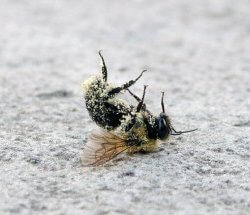
The measure hung by a thread through much of the summer, and in fact passed by a razor-thin majority in July with a final pending. But Le Monde intensified its campaign. It interviewed an activist French toxicologist who said, incorrectly, that “just two or three liters of rainwater could kill a bee.”
“Based on the acute toxicity of most of these substances, this means that it only takes what is contained in two or three liters of rainwater to kill a bee […]. But the situation is actually much more worrying, not only because thousands of cubic meters of rainwater fall, but also because these substances produce chronic effects on insects at much lower doses.”
The chemophobic media and the greens weaponized the “new” evidence “bee-killing pesticides returning despite new contamination evidence.” Non-political toxicologists pushed back, calling the comments misleading. Bees do not drink liters of water, and spreading nanograms of diluted chemical on an insect’s body is biologically irrelevant, they noted. To state the obvious, you can’t make a bee drink two or three liters of water or spread nanograms of this diluted chemical over its body.
But, as the French saying goes, “il suffit de faire peur”; The argument might work if you can scare the public — and that’s exactly what transpired. Facing a media-stirred public relations disaster, in early August, the Constitutional Council struck down Daubert. Farmers are now on their own, facing a grim fall.
One thing is certain: our environment is far less contaminated by pesticides than the scientific discourse is by activist researchers, environmental NGOs, and agenda-driven journalists.
André Heitz is an agronomist by training and a former United Nations system civil servant with the International Union for the Protection of New Varieties of Plants (UPOV) and the World Intellectual Property Organization (WIPO). He blogs in French.