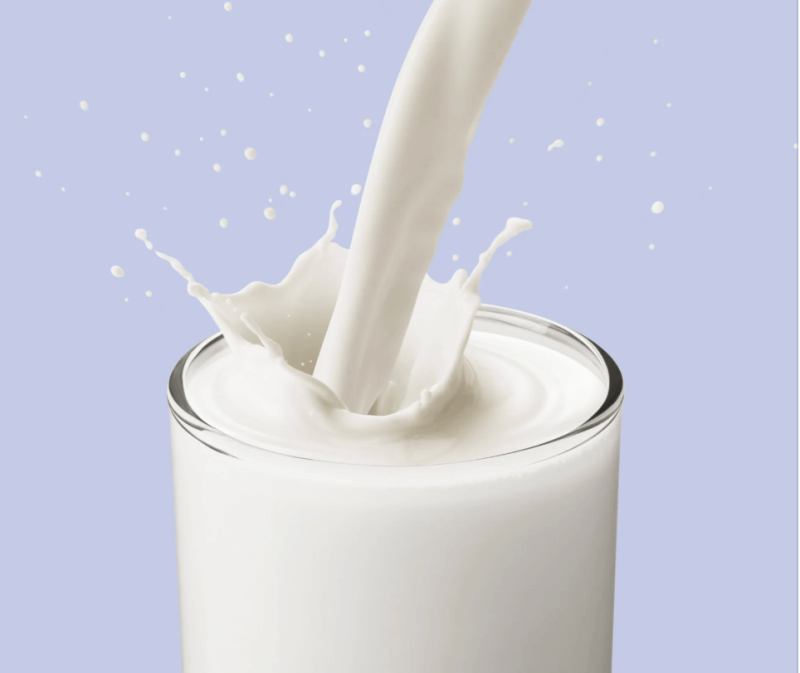
Milk is one of the most familiar things in the world – comforting, wholesome, ordinary. But beneath this common perception lies something far more complicated.
Examining the UK and Kenya, our project Milking It! explores the deep cultural, historical and emotional attachments to milk, and how these collide with the realities of industrialised production, environmental pressure and its colonial past.
We’ve spoken with dairy farmers caught between economic survival and public expectation, traced milk’s heritage through museum collections and archives, and listened to personal stories where milk evokes intimacy, memory and loss.
We’ve found that milk is never just milk. It’s saturated with meaning, emotion and contradiction. People can feel intensely about it: it stirs strong responses, its history is revealing, and it helps us rethink care, identity and sustainability.
Milk is a powerful subject for thinking about the politics of food; a near-universal food shared across cultures, landscapes and histories. It carries with it ideas about who belongs, who provides care, and what constitutes a good life.
In times of climate anxiety and shifting food politics, milk helps reveal how personal our relationship with food really is, and how these relationships are shaped by histories of power, production and belief.
As our research has progressed, we have found that milk is emotionally charged, politically loaded, and, at times, profoundly symbolic of how people understand themselves and the world they live in. Important to these politics is the tension between the idea of milk as home – part of our intimate everyday – and milk as global industry.
Dairy and its colonial past
Understanding global dairy means reckoning with its colonial past. From the late 19th century, European colonial administrations promoted dairy not just as a foodstuff, but as a marker of civilisation, symbolising perfect nutrition, purity and modernity.
Cattle breeds were imported, dairy farms established and milk consumption encouraged among settler and indigenous populations alike, often through coercive propaganda. These efforts laid the groundwork for globalised industrial food systems, where milk became both a commodity and a cultural ideal.
These histories still shape the modern dairy landscape. Smallholder farmers in both the UK and Kenya operate within systems that were designed to favour large-scale, export-oriented production. Despite their radically different contexts, both face strikingly similar pressures: the need to intensify, standardise and compete in volatile markets.
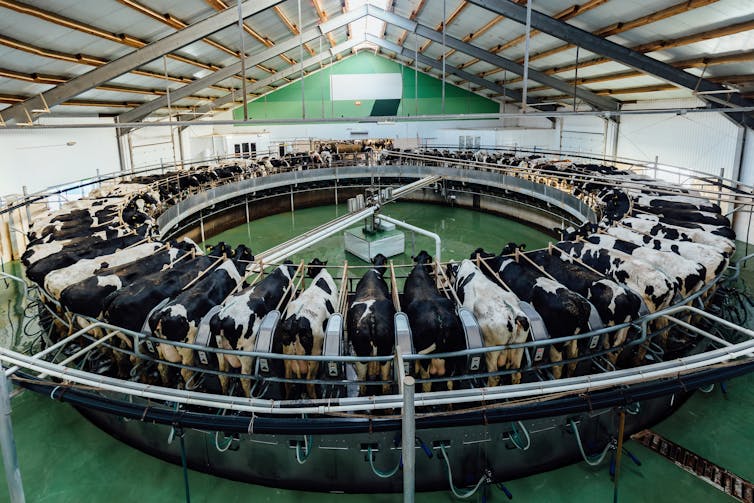
While global dairy is pushing farmers towards highly technical and mechanised systems, these are largely hidden from consumers. Milk advertising has played a crucial role in this, summoning a pastoral ideal. Black and white Daisy in her field of fresh green grass: clean air, contented cows, local milk. It arrives in our homes as reliable nourishment and familiar care.
Milk’s paradox
But here lies the paradox: in the minds of many, milk continues to symbolise home, rural heritage and connectedness, even as the conditions of its production become more alienated from those very values. But milk has also been co-opted into much larger political and economic projects.
From state-run free school milk schemes in both Kenya and the UK, to British Home Front campaigns promoting milk as a national duty during the second world war, this everyday drink has long played a role in shaping ideas of citizenship, health and belonging.
Today, farmers struggle to survive on the prices they’re paid. Processing and distribution are increasingly controlled by large conglomerates, with ever less of the final profit reaching those who care for the animals and land.
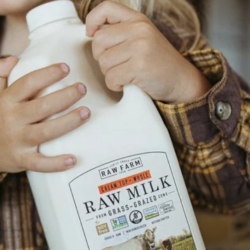
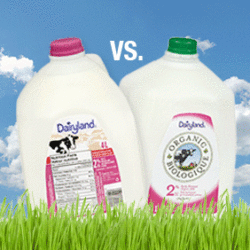

Maintaining the idea that milk is a necessary staple – part of our national and natural heritage – is unavoidably political. In contexts where having a cow in your backyard is common, a glass of milk is but a squeeze away. Having a two-litre carton of disposable fridge milk is, however, an entirely different thing; keeping milk available and cheap is hard work.
The gap between how milk is imagined and how it is made is widening. Once the milk leaves the cow, it moves through an industrial chain that involves rapid cooling, bulk transport, pasteurisation, homogenisation, packaging and refrigerated distribution. Our ordinary pint arrives in our fridges through a complex, but hidden, energy-intensive system.
While domestic production of milk in the UK has grown by 14% since 1975, there are significantly fewer cows. This is because the amount of milk you can get from a single cow has grown by 100%, from an average of 4,100 litres to 8,200 litres over her lifetime.
These cows are no Daisys. They are part of a global industrial system with high levels of intervention (antibiotics, artificial feed, keeping cows indoors) to ensure reliable year-round yield, at low cost.
By looking at milk as a cultural and political idea, as much as it is a natural product, we are beginning to understand and trace the logics that underpin global dairy today. That past helped entrench large-scale, standardised dairy systems, from the UK to Kenya. These competitive systems reward intensification and scale, over knowing where milk comes from.
However, farmers who work with cows are party to an intimacy that we, as consumers, do not often see. Many are seeking systems of their own. Whether through processing milk on-site by making cheese, or using local networks to establish consumer trust, dairy producers are adapting old logics that meet modern needs.
In Milking It! we explore how everyday foods can hold much larger stories: about changing food systems, colonialism, identity, loss of tradition and survival. We’re continuing these conversations through our podcast Milk on the Move, and we invite others to join us in rethinking what milk is as a cultural force.
JC Niala is the Head of Research of Teaching and Collections at the History of Science Museum, University of Oxford. Find JC on X @jcniala
Johanna Zetterström-Sharp is an Associate Professor in Heritage and Museum Studies at University College London. Find Johanna on Linkedin
A version of this article was originally posted at Conversation and has been reposted here with permission. Any reposting should credit the original author and provide links to both the GLP and the original article. Find Conversation on X @ConversationUS