Few issues reveal the corrosion of scientific reasoning in contemporary politics more clearly than the escalating fight over the alleged public-health dangers of everyday chemical exposures. What should be a technical debate about dose–response effects, uncertainty, and risk analysis has morphed into a media-fueled culture war. Instead of emerging from new breakthroughs, the controversy has been driven by its migration from peer-reviewed science into partisan journalism, litigation narratives, influencer culture, advocacy groups, and political branding campaigns.
At the center of this shift are increasingly prominent actors such as environmental tort lawyer and vaccine skeptic Robert F. Kennedy Jr., his acolytes — including Trump administration surgeon-general nominee Casey Means — and MAHA “naturalist-activists” like Zen Honeycutt. More unsettling still is the convergence between these fringe voices and establishment scientists on the political left, most notably Linda Birnbaum, former director of NIEHS. Birnbaum’s admission that she is “partnering with the devil” to advance her view that environmental chemicals represent a growing global threat is emblematic of this new coalition — even as extensive evidence contradicts that narrative.
This unusual coalition marks a disquieting turning point: chemical risk has become a political and cultural weapon rather than a subject for sober scientific debate and deliberative policy-making. Increasingly, environmental health functions less as a field of toxicology and more as a marker of identity. Anxious parents, anti-establishment activists, wellness entrepreneurs, litigators, advocacy-minded scientists, and partisan media outlets all claim to speak “for the children” while portraying chemical exposures as existential threats. Meanwhile, regulators and methodologists who insist on stronger evidence are caricatured as industry stooges. Alarmism is monetized, skepticism is stigmatized, and politics overtakes science — not only in the vaccine debate but across the entire domain of chemical risk.
Three recent essays offer an unusually clear window into how this shift unfolded.
- Undark’s Michael Schulson’s: A “Cultural Awakening”
Journalist Michael Schulson illustrates how advocacy-aligned reporting conveys anxiety into narrative momentum. The brouhaha was touched off by a feature that ran on November 6, 2025, in MIT’s Undark Magazine, “The Cultural and Political Moment for Toxins Research” (November 6, 2025), exemplifies advocacy-inflected reporting. He portrays rising concern over plastics, pesticides, and “toxins” as a cultural awakening rather than a hypothesis requiring validation. He highlights MAHA figures, scientist-activists, and wellness entrepreneurs while downplaying the methodological weaknesses underlying their claims. Schulson accurately identifies that activists are manufacturing a “toxins moment,” but he presents calls for sweeping policy change as morally and scientifically necessary — despite weak supporting evidence, contested trends, and evident ideological and financial entanglements among his quoted experts. It is reporting that treats activism as consensus and skepticism as obstruction. Schulson argues that exposures to plastics, pesticides, and other industrial chemicals are not merely scientific concerns but signal a larger cultural awakening. That claim is dubious; the epidemiological data do not support a clear, worsening trend.
Schulson’s narrative reflects the views of a coterie of about 50 activist scientists, a majority of which maintain financial or ideological ties to the anti-chemical tort ecosystem — connections that are well documented but largely unacknowledged in Schulson’s whitewashed treatment. By contrast, those who challenge the supposed “rising cultural consensus” — the independent scientists Schulson quotes — are mainstream, globally respected researchers with no financial ties to either industry or the plaintiff-side tort complex. Yet Schulson’s sympathies lean toward the financially compromised chemical critics rather than toward these independent experts. He does accurately observe that the proliferation of alleged health problems is being framed as part of a “toxins moment,” propelled by activist scientists, advocacy networks, and the growing MAHA movement. Within this narrative, Schulson treats demands for sweeping regulatory overhaul as not just scientifically plausible, but politically and morally urgent.
- Geoffrey Kabat: Turning Ambiguity Into Panic
Independent epidemiologist, science author, and former Genetic Literacy Project board member Geoffrey Kabat’s contrasting perspective appears in “The BPA Panic and the Distortion of Science” (Quillette, November 26, 2025). Kabat’s critique is not of chemical-risk research per se, but of how Schulson and aligned scientists elevate ambiguous, low-dose findings (e.g., on BPA) into public hysteria. He describes a pattern of selective citation, confirmation bias, and narrative-driven amplification — where conjecture masquerades as consensus and activist credibility substitutes for methodological strength.
Kabat frames the “BPA panic” as emblematic of evidence distortion mobilized for advocacy ends. Kabat’s core objection is not to the study of toxins per se, but to what he sees as the systematic misuse of science by many of the very researchers Schulson treats uncritically — elevated not because of their methodological rigor but because of their activist positioning and self-proclaimed good intentions. The result, Kabat argues, is the inflation of weak, ambiguous evidence on low-level exposures (such as Bisphenol-A) into public-health hysteria. He warns that this “BPA panic” reflects selective citation, confirmation bias, and alarmism — and he critiques Schulson’s article for recasting conjecture as consensus.
- Gary Taubes’ Diagnosis: A System Failure
The third essay, “Signs of Bad Science” (Uncertainty Principles Substack, December 1, 2025), by veteran investigative science writer Gary Taubes, attempts to synthesize the science issues at hand. Veteran independent science writer Gary Taubes offers yet another perspective in his essay “Signs of Bad Science,” published on his Uncertainty Principles. Taubes goes further than Kabat, suggesting that the chemical-exposure debate is symptomatic of a recurring pathology: ambiguous or inconsistent data reframed by agenda-driven scientists as urgent public danger. He highlights how the controversial “precautionary principle” — rejected by every major independent regulatory body around the world as a basis for governing chemical policy — is nevertheless used rhetorically to justify sweeping regulatory and social responses. For Taubes, this dynamic undermines not only specific claims about chemicals, but the very norms of scientific reasoning itself.
Beyond the debate over chemicals
This is no longer a dispute over BPA, glyphosate, plastics, and dozens of other alleged accounts. It is a conflict over who adjudicates reality and by what standard. Taken together as we are presented it here, we have a case study in how science is weaponized in ideological struggles, where appeals to public health often mask commercial agendas, NGO pressure campaigns, political branding, and fear-based mobilization. The result is a theater in which certainty is manufactured, skepticism delegitimized, and the boundary between evidence and narrative collapses. Understanding this dynamic — not parsing any one chemical — is essential to understanding how environmental health has been commandeered in today’s culture wars. In an era of pervasive health anxiety, the temptation to treat uncertainty as danger is powerful. But as these essays show, that temptation warps science, policy, and public trust. The debate is no longer “Is this chemical dangerous?” but “Who decides what counts as evidence — and how loud fear gets to be?”

A Moment for MAHA and Scientific Distortion
Excerpt from “The Cultural and Political Moment for Toxins Research”
In January, Birnbaum and 24 other experts, some of them academic heavyweights, published an article in the New England Journal of Medicine laying out their case for [limiting environmental chemical exposures]. Over the past 50 years, they wrote, rates of pediatric asthma have tripled, childhood cancers have risen by more than one-third, and “neurodevelopmental disorders now affect 1 in 6 children.” The evidence was growing that chemicals have driven those trends, they wrote, and it was time for “a fundamental revamping of current law” and industry practice.
That sentiment is having a wider cultural moment. Environmental health has found renewed champions in the coalition of vaccine skeptics, natural food enthusiasts, concerned parents, and environmental activists that form the Make America Healthy Again, or MAHA, movement. Robert F. Kennedy, Jr., President Donald Trump’s current Secretary of Health and Human Services, and the nominal leader of the movement, has advocated for years about the dangers of environmental toxins, and a MAHA report published earlier this year devotes an entire section to the alleged harms of environmental chemical exposures. The report was ridiculed in some quarters for its surfeit of citation [and factual] errors, but that hasn’t stopped state lawmakers from both parties from taking up novel legislative measures on environmental toxins. And the media, too, is now full of new article about artificial food additives and the health risks of plastics.
…Is the vision that Birnbaum and other scientists have laid out really ready for, or even worthy of, a rare moment of traction — or will it founder under the weight of disputed evidence, cross-cutting interests, and hostile politics?
Around 350,000 human-made chemicals exist on global registries, according to one 2020 estimate. What are those chemicals doing to human health? The question is not new, nor is it always simple to answer.
… [A] landmark came in 1993, when the National Research Council released a report calling for tighter scrutiny of pesticides’ effects on children. “The laws and policies that were then enforced in the United States were not doing a very good job of protecting kids against chemicals,” said Philip Landrigan, a pediatrician at Boston College, who led the team that produced the report.
….
Zen Honeycutt, a prominent MAHA activist, said she started thinking about toxins exposures after one of her three sons developed life-threatening allergies. “It’s the four As: It’s the allergies, the autoimmune issues, the asthma, and the autism,” she told Undark. … In 2013, she launched Moms Across America, an organization that has advocated for bans on many pesticides and on genetically modified crops, which are often associated with high glyphosate use. (The organization also sells pricey detox supplements and other natural health products, which are not evaluated by the FDA; Honeycutt says the proceeds go back into the nonprofit.)
…
For years, Moms Across America listed [Kennedy] as an adviser to the group, and she has become a prominent speaker and advocate within the MAHA movement.
….
Honeycutt questioned whether more research, at this point, was even necessary to advance the broader cause of limiting chemical exposures. While there’s still some scientific debate over whether the herbicide glyphosate, for example, can cause chronic health effects at typical levels of exposure, Honeycutt thinks the research is definitive enough. “I don’t need any more scientific studies actually showing that glyphosate is harmful,” she said. Such work, she argued, could even play into industry goals: “That’s all just a delaying tactic which is going to allow farmers to spray more of these toxins on our food supply.”
[N]ot all scientists agree with how Birnbaum and some other prominent environmental health scientists interpret the data. … Even when scientists may agree that there’s some environmental cause, they may disagree over to what extent it comes from a toxins exposure specifically, in addition to other causes like dietary changes or stress.
Lurking in the background of these debates: How reliably can existing tools link a specific chemical to a specific harm, like an increased risk of cancer or an average drop in IQ? … Environmental health researchers have a few key tools to search for those patterns. They can test the effects of chemicals on cell or tissue cultures in the lab. They also have animal studies, in which animals are exposed to doses of chemicals, then examined for health effects. These experiments can show a direct biological effect from a chemical, but laboratory animals are markedly different from humans, so the work doesn’t explicitly prove how the chemicals relate to human health.
Another key approach involves observational studies in humans, in which researchers collect vast pools of data, and then look for associations between exposure to a certain chemical and certain health outcomes. … Large observational studies can be plagued by bias. … There are reasons, some experts say, to fear similar issues are lurking in the environmental health literature. “There’s a growing body of evidence from psychology and economics that suggests that the results of observational studies are highly, highly contingent on the analytic choices that investigators make,” said Dena Zeraatkar, an expert in medical research methodology at McMaster University in Canada.
“While there has been some effort made to improve the rigor of observational research, both in nutrition and environmental sciences, not much really has materialized, and it’s still the same approach where people just correlate one exposure with one outcome and selectively report the analyses, the results of which are confounded,” Zeraatkar, who does not reeivesd industry funding, said. “And people use that and report on it and use it to inform recommendations, making strong recommendations based on very, very weak evidence.”
[Phillip] Landrigan pushed back against those concerns, which he described as an overgeneralization, and which he said echoed industry propaganda that sought to undermine work on the link between tobacco and lung cancer. [Landrigan receives extensive industry funding from tort lawyers and organic companies with a vested interest in advancing the perspective that chemicals are far more dangerous than global toxicologists believe. He has served as a paid expert witness in cases related to childhood lead poisoning. He is an organic- and tort lawyer-funded lobbyist for the Heartland Health Research Alliance, which is funded primarily by litigators, such as RFK, Jr., who target allegedly toxic chemicals.]
[Landrigan is chair of HHRA’s Science Advisory Committee, for which he writes blog posts challenging the global regulatory consensus that glyphosate is safe as used. Prominent Roundup plaintiffs’ attorney, Robin Greenwald, served as vice-chair of HHRA’s board, and claims that references to tort-law backing were later scrubbed from HHRA’s public materials as public-funding opportunities grew.]
[S]ome researchers feel that their colleagues sometimes overstate results — often unconsciously, but in response to clear incentives. “When scientific research focuses on a potential hazard that may affect the population at large, researchers themselves, regulatory agencies, advocacy groups, and journalists reporting on the story tend to emphasize what appear to be positive findings, even when the results are inconsistent, the risks may be small in magnitude and uncertain, and other, more important factors may be ignored,” writes cancer epidemiologist Geoffrey Kabat in a 2016 book, “Getting Risk Right.” (Kabat has accepted funding from the tobacco industry, and his work has, at times, inspired controversy.)
…
David Savitz, a professor emeritus of epidemiology at Brown University and a former president of the Society for Epidemiologic Research, expressed concern about people in the field “being overly enthusiastic about really uncertain findings and really pushing them in an ideological sense.” (Last year, Savitz testified as a paid expert witness for the federal government in a legal case alleging that the EPA was not doing enough to address potential harms from fluoride.) Savitz has done extensive research on PFAS risks and pesticides, and, he wrote in an email to Undark, “I recognize the need to be vigilant” about toxins. But, he continued, “I don’t believe that such exposures are a major influence on public health overall.”
…
Birnbaum — who has described an alliance with Kennedy as a “dance with the devil” — [nonetheless has said that] it’s often public pressure, rather than regulatory action, that ultimately yields changes. “I think people are concerned about the health of their children, maybe more so than they were,” Birnbaum said. “And if that’s true, that is a success of the MAHA agenda to realize that our children aren’t as healthy as they should be.”

A response from Geoffrey Kabat
Excerpt from “The BPA Panic and the Distortion of Science”
MIT’s Undark magazine describes itself as a publication that “will explore science … as a frequently wondrous, sometimes contentious, and occasionally troubling byproduct of human culture.” Its name refers to a “radium-based industrial and consumer product … that was both awe-inspiring and, as scientists would only later prove, toxic and deadly.” In a recent article for the magazine, Michael Schulson offers a tendentious account of what is known about exposure to toxic substances in the environment, and then places his review in the context of the Trump administration’s Make America Healthy Again (MAHA) agenda.
Last July, Schulson contacted me and asked for my perspective on “the growing public attention to some parts of the environmental epidemiology and toxicology research fields—visible in the claims of the MAHA movement, as well as efforts like a new children’s health initiative led by Philip Landrigan, Linda Birnbaum, and others.” In a series of emails, I provided some thoughts on important issues to consider when reading about this topic. I mentioned “endocrine disruption” as a good example of the challenges associated with assessing low-level environmental exposures. And I pointed him to a chapter in my book Getting Risk Right: Understanding the Science of Elusive Health Risks that gives a detailed treatment of this question. I also offered to suggest further articles that might address the issues that interested him.
Here is an excerpt from an email I sent Schulson on 15 July 2025:
There are good examples of exposures that looked important/scary initially but that, as larger and better studies were done, turned out to be nothing. This happened with DDT and breast cancer, with BPA and estrogenic effects, and with glyphosate (Roundup) and non-Hodgkin’s lymphoma, and with other pesticides (atrazine, I believe). A more recent topic of interest is PFAS, and I’m not up on this. But this too appears difficult to get a handle on.
However, when I read the published article, I found that Schulson gives an unsatisfactory account of a complicated story. The article opens by focusing on Linda Birnbaum—head of the National Institute of Environmental Health Sciences (NIEHS) from 2009 to 2019—and then goes on to quote statements from roughly a dozen researchers and others. Unfortunately, the use of personalities to represent different points-of-view is no substitute for a careful exploration of the underlying questions. In addition, Schulson’s apparent bias towards certain informants appears to undermine his objectivity.
Birnbaum is clearly an important figure, but Schulson treats her as a hero and his account verges on hagiography. During her tenure at NIEHS, Birnbaum was instrumental in funding a large number of studies of the chemical bisphenol-A (BPA). BPA was introduced in the 1960s to line food containers to prevent spoilage, and it has since been used in a wide array of consumer products. In the early 2000s, BPA became the focus of health concerns, particularly about its potential to leach out of food containers and baby bottles. Some early studies appeared to show that the compound could have adverse effects, ranging from effects on sexual and neurobehavioural development to cancer. However, in 2010, the US Food and Drug Administration issued a report restating its position that BPA was safe and “posed ‘negligible’ or ‘minimal’ concern for most adults and ‘is not proven to harm children or adults.’”
To cut a long story short, the NIEHS under Birnbaum got caught up in an “availability cascade”—a self-reinforcing process of collective belief-formation in which a claim triggers a chain reaction of repetition that makes the claim seem increasing plausible as its prevalence in public discourse grows. This is known, more colloquially, as a “bandwagon effect.” Whichever term one uses, it describes the view of many academic scientists studying BPA. They came to believe that anomalous findings—often obtained from small studies and tests with ambiguous results—provided serious evidence of adverse effects, even at low doses.
The steady stream of alarming results prominently reported in the media led to campaigns to eliminate BPA in baby bottles and other consumer products. There were even calls to ban it entirely. At the same time, due to the availability cascade, each new disturbing finding generated increased public concern and calls for further studies, creating a self-perpetuating cycle. Through repetition and the massive publicity that each new finding received, the belief that BPA was causing harm became a conviction in many minds. In response to this apparent crisis, the National Institutes of Health spent US$172.7M on BPA between 2010 and 2014, approximately seventy percent of which was awarded by the NIEHS in Birnbaum’s early years at the institute.
However, another group of highly qualified government scientists following “good laboratory practices” based on regulatory guidelines received less attention. In a series of studies, Daniel Doerge (an analytical chemist), Justin Teeguarden (a toxicologist), and colleagues found that, contrary to the concerns raised by the academic studies, levels of BPA in the human diet are very low, little BPA is absorbed from food, and what is absorbed is efficiently metabolised and almost totally excreted in the urine. BPA was virtually undetectable in the blood.
In an attempt to resolve the disagreement between the two camps, the NIEHS and the FDA agreed to conduct a study in 2012 titled CLARITY-BPA. The centrepiece of that paper was a two-year “chronic exposure” study conducted by scientists at the FDA’s Center for Toxicological Research, in which 3,500 rats were exposed to a wide range of BPA doses. This was the largest study ever conducted on BPA, and FDA researchers performed extensive pathological evaluation to detect effects on organ structure and function, sexual development, and evidence of cancer.
In addition, thirteen projects from academic grantees were added on to the core study to test specific hypotheses. The major strengths of this approach were:
- Both components of the study involved identical BPA exposure conditions, which were overseen at the same facility in the FDA’s National Center for Toxicological Research.
- Grantees received blinded core study samples, which means they did not know whether samples had been dosed with BPA or by how much, in order to minimise the potential for bias.
The core study was conducted from 2012 to 2013, and grantees received their tissue samples in 2013 and 2014, so most of the academic studies have now been completed and published.
One might think that this unusual effort would have gone some way towards narrowing the stark division between the two camps. However, this is not the case. On 23 February 2018, FDA commissioner Scott Gottlieb and deputy commissioner Stephen Ostroff issued a statement on the not-yet-peer-reviewed results of the core study. The FDA, they wrote, “continues to conclude that BPA is safe for its currently authorized uses.” Academic researchers, including some CLARITY grantees, criticised the FDA’s press release as premature and incomplete, charging that the agency was ignoring substantial evidence from animal studies documenting adverse effects of BPA exposure.
…
In the wake of the CLARITY-BPA study, new findings continue to be published showing harmful effects of exposure to BPA on reproductive health, cancer, and other outcomes. To make the situation even more complicated, BPA has been replaced in certain products (e.g., baby bottles) by compounds about which less is known, and which may carry their own risk. The problem is that results of exploratory academic research are often difficult to interpret and their relevance to human exposure is unclear. Many results have not been replicated. One critic of this body of research on BPA characterised it to me as, “a land of one-sided comparisons, confirmation bias, post-hoc reasoning, ‘any finding at any dose’ effects untethered from matters of precursor lesions, internal dosimetry, and mechanism.”
We know that many published research findings are wrong, and this is particularly true of studies examining the effects of low-level physical/chemical environmental exposures. However, published findings suggesting that a trace exposure may pose a risk to the general population can be counted on to receive inordinate attention from the media and the public and to feed demands for stricter regulation, regardless of the studies’ quality. When we assess the validity of studies, we should acknowledge an asymmetry between results that report an association with a risk factor and those that fail to find an association. First, findings of an association receive more attention than findings of no association, even when the latter come from higher-quality studies. Second, one can never prove that some exposure is entirely safe. Third, even scientists are susceptible to these biases.
Schulson did not follow up on the readings I offered to recommend. Instead, he reproduces brief quotations from me and Daniel Doerge of the FDA based on email exchanges. He then proceeds to quote Birnbaum’s unflattering characterisation of the two of us: “‘Kabat never saw an environmental chemical that he thought was a problem,’ Birnbaum wrote in an email to Undark. … Apparently, for Birnbaum, it is enough to question whether the evidence supports a touted risk to be branded a traitor to the field.
Schulson lets Birnbaum’s broad-brush dismissal of Doerge—and implicitly of the high-quality work done by the FDA’s National Center for Toxicological Research—pass unchallenged. Note that this is coming from the person who was the head of the NIEHS during the period when CLARITY-BPA was carried out. It is hard to believe that, seven years after the publication of the final report from the core study, Birnbaum still cannot acknowledge the findings from the NCTR or admit that she may have been misled by the academic studies. … By accepting Birnbaum’s opinion as the final word, Schulson manages to completely ignore the highly instructive story of the CLARITY-BPA study and its outcome, as well as the whole controversy surrounding endocrine disruption.
 Viewpoint: Environmental toxin hysteria—MIT’s Undark embarrasses with hysteria-driven story aligning itself with false claims that ‘environmental toxins’ (whatever that means) are crippling our health
 Anti-GMO activists take page out of anti-chemical and anti-BPA lobby, targeting the ‘black box’ of endocrine disruption


I have recapitulated the BPA story at some length because it provides an understanding of the difficulties and professional conflicts that arise when researchers study low-level exposures and their selective results receive undue attention.
…
There is an implicit tension between the views of Birnbaum and Philip Landrigan, on one hand, and those of epidemiologist David Savitz and several other scientists interviewed by Schulson, on the other. The former seem to be confident that valuable new insights are likely to come from studies like the NCS, whereas Savitz and others are much more sceptical. But Schulson simply ignores this tension, which is the key to understanding the question he is skirting. And when he discusses RFK’s Make America Healthy Again (MAHA) agenda, Schulson unwisely devotes space to the opinions of MAHA activist Zen Honeycutt regarding pesticides:
While there’s still some scientific debate over whether the herbicide glyphosate, for example, can cause chronic health effects at typical levels of exposure, Honeycutt thinks the research is definitive enough. “I don’t need any more scientific studies actually showing that glyphosate is harmful,” she said.
Honeycutt leads Moms Across America, which sells alternative-medicine supplements and products like “Vaccine Detox Herbal Extract” and “LifeWave Frequency Patches” on its website. In fact, there is very little scientific debate about the health effects of glyphosate. Seventeen national and international health agencies—including the U.S. EPA, Health Canada, and the European Food Safety Authority—have examined the health effects of glyphosate and found it to be safe.
…
While referring to different points-of-view on environmental pollution and some prominent candidate pollutants, it is telling that Schulson never mentions what has been learned from occupational studies, which often entail relatively heavy exposure. Nor does he mention dose-response relationship, toxicology (“the dose makes the poison”), or the work of Bruce Ames showing that natural pesticides in foods like cabbage account for the bulk (99.99 percent) of our pesticide exposure.
Finally, Undark’s policy regarding conflicts-of-interest is positively bizarre and of a piece with the article’s general lack of attention to detail, coherence, or context. “Kabat,” Schulson informs his readers, “has accepted funding from the tobacco industry, and his work has, at times, inspired controversy.” When he brought up the question of conflicts-of-interest with me in an email, I wrote him a detailed reply describing my career and sources of support, none of which was included in his article. His readers deserve better.
Analysis and “knee-jerk” reactions from Gary Taubes
Excerpt from “Signs of Bad Science” by Gary Taubes
One critic of this body of research on BPA characterised it to me as, “a land of one-sided comparisons, confirmation bias, post-hoc reasoning, ‘any finding at any dose’ effects untethered from matters of precursor lesions, internal dosimetry, and mechanism.”
Geoffrey Kabat, “The BPA Panic and the Distortion of Science,” Quillette
“Kabat never saw an environmental chemical that he thought was a problem,” [Linda] Birnbaum wrote in an email to Undark…. And when a range of studies, from a range of places, using a range of methods, consistently show a certain result, she said, it presents a strong signal.
Michael Schulson, “The Cultural and Political Moment for Toxins Research,” Undark
There, in a nutshell, is the essence of a scientific controversy. One expert’s collection of “one‑sided comparisons” and “confirmation bias” is another expert’s “strong signal.” What you believe—and who you believe—will depend on your own preconceptions, experience and biases.
Since I’ve written so critically about nutrition, obesity and chronic disease science, I’m often asked for my opinion on issues about which I know little. And yet I do have an opinion (unsurprisingly). I’m going to take this post‑Thanksgiving edition to explain why I invariably lean the way I do.
The epigraphs above are from two articles addressing concerns that Bisphenol A (BPA) is a toxic chemical. BPA is used to make hard plastics and it “seems to be everywhere,” as The New York Times has said, most notably in water bottles. Some studies suggest it’s toxic. Obvious questions: should we avoid it if we can, and should we regulate against it?
Geoffrey Kabat, author of the first epigraph, thinks the concern is overblown. Kabat is an epidemiologist and author of several books on science and public health from a critical perspective, including Hyping Health Risks and Getting Risk Right. His article in Quillette on what he calls the “BPA panic” is a response to Michael Schulson’s article in Undark, from which the second epigraph comes. Schulson is a science journalist who has written thoughtfully about scientific controversies and how they’re covered in the media.
The two epigraphs address the same body of research from competing perspectives. Schulson says as much in his article. Some of the disagreements, he writes, “are less over the substance of the science, and more over how much evidence needs to accumulate before officials should issue a warning or roll out new regulations.”
But that raises the question of whether the officials you trust think the evidence will accumulate and, when it does, whether it will be any more reliable. Kabat is dismissive. He has seen this before—a health risk hyped—and thinks he understands the pathology at work. Schulson notes (as does Wikipedia) that Kabat has had industry conflicts, including the tobacco industry among them.
The primary protagonist in Schulson’s Undark article is Linda Birnbaum, who ran a research program on potentially toxic chemicals at the Environmental Protection Agency and then, from 2009 to 2019, was director of the National Institute of Environmental Health Sciences. While Schulson discusses the complexity of the issue, he seems to side with Birnbaum—more accepting of the message that BPA is likely enough to be toxic (“a strong signal”) that we should treat it as such.
I have never done my own research on chemical toxins and so I’m ill‑equipped to make a judgement. And yet my knee‑jerk response is to side with Kabat. I do not believe that a “range of studies, from a range of places, using a range of methods, consistently showing a certain result” necessarily constitutes a strong signal. I would assume the opposite.
Indeed, this is my knee‑jerk opinion on many of today’s public‑health scares: cell phones and cancer, toxic chemicals in the environment, and, yes, the idea that vaccines cause autism. The evidence strikes me as uncompelling—because of my context and experience, my “pre‑existing convictions,” to borrow a turn of phrase from one of Kabat’s earlier articles.
A brief memoir of a knee‑jerk skeptic
One legitimate criticism of my work is that I see bad science everywhere. It’s not surprising because I may have spent more of my life studying bad science than anyone alive. I think I’ve learned to recognize it when I see it—as Kabat does—and I do think it’s far more common than we’d ideally prefer.
My first two books were about contained episodes of bad science—what Nobel Laureate chemist Irving Langmuir called “pathological science,” the “science of things that aren’t so.” My first was Nobel Dreams, published in 1987. I was a young science writer who went off to CERN, the European physics lab outside Geneva, to watch physicists nail down what had been advertised as the greatest discovery in forty years: physics beyond the standard model.
Those physicists thought they had a strong signal, although they knew they needed more data. They needed the evidence to accumulate. Instead of writing about a discovery, though, I spent seven months watching them realize that they had botched the initial analysis. What the physicists had thought was a strong signal was anything but. The evidence didn’t accumulate for their discovery but against it.
Rather than celebrating and documenting the greatest breakthrough in physics in decades, Nobel Dreams became an exposé on the sociology and personalities of high energy physics, a case study in pathological science and what I came to think of as the extraordinary difficulty of getting the right answer in any scientific endeavor.
When the book came out, and the Nobel Laureate leader of the experiment, Carlo Rubbia, was quoted calling me an “asshole” in the New York Post, I assumed my career in science journalism had ended. It hadn’t. Instead, researchers I interviewed afterwards often passed along stories similar to the one I told in Nobel Dreams. A common denominator was the hyper‑ambitious researcher who would overinterpret evidence—whether to achieve career ambitions (from publish‑or‑perish to Nobel Prizes) or to save lives, so he or she thought, in unimaginable numbers.
My obsession with how hard it is to do good science, and how easy it is to get the wrong answer, found copious opportunities for further study: electromagnetic fields and cancer, prion diseases, observational epidemiology, and eventually nutrition, obesity and chronic‑disease research. As I learned, it’s human nature to overinterpret evidence; the insanely difficult part of science is not doing so.
…
Let me get back to the point Michael Schulson made, that controversies over potentially toxic chemicals are “less over the substance of the science, and more over how much evidence needs to accumulate before officials should issue a warning or roll out new regulations.”
This is true of all these scientific controversies, whether in public health or science in general. The difference is that the threshold—the evidentiary standard—for issuing a warning or rolling out regulations in public health is equivalent to the decision to go public or claim a discovery in these other disciplines.
A critical point is that the more important the science, the more likely researchers are to lower their standards for what constitutes a “strong enough” signal. It should be the opposite. The more important the science, the greater the implications to the public health, the more the researchers should want to assure they’re right, but that’s not how it works.
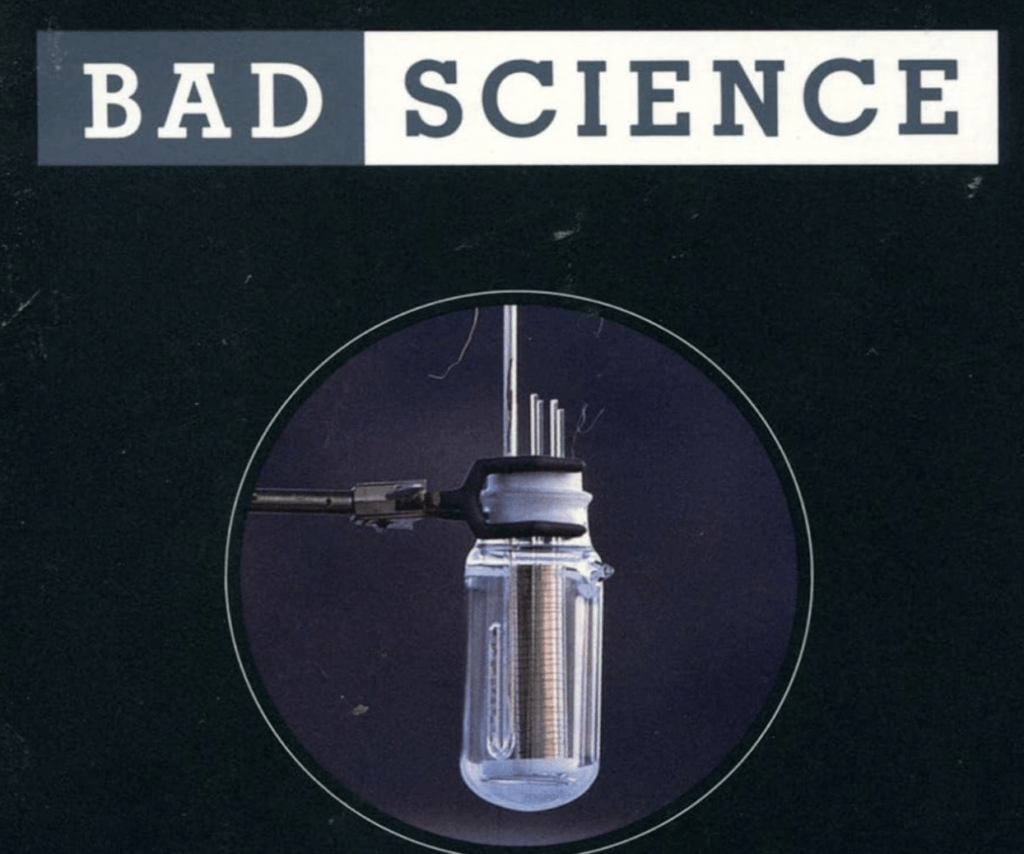
Here Pascal’s Wager and the precautionary principle come into play. As I wrote in Bad Science, Blaise Pascal—the renowned 17th-century mathematician, and philosopher—was the patron saint of every researcher, administrator and politician who took the leap of faith to assume that cold fusion was real and they had to act on it

“Pascal renounced a life of science for one of faith, which many of the proponents of cold fusion seem to have done, and he wrote down the terms of the wager that, for him, made this choice inevitable. Pascal argued that to bet on the existence of God and to be wrong is to lose little or nothing. To wager correctly that there is a God is to be rewarded with an “‘infinity of infinitely happy life.” “Let us assess the two cases,” he wrote: “if you win you win everything, if you lose you lose nothing. Do not hesitate then; wager that he does exist.”
Throughout the cold fusion episode, the proponents of cold fusion would subscribe to the logic of Pascal’s wager. To bet that cold fusion existed and to win was to be rewarded with a payoff that, while not literally infinite, certainly seemed like it at times. To bet wrongly cost relatively nothing: a few million dollars, a few months of work, or a reputation would always seem inconsequential in comparison to the potential reward.
One year later, for instance, Chase Peterson [then president of the University of Utah, where the “discovery” had been made] insisted that he had never believed that cold fusion necessarily was real, but that what was important was that it could have been real. Here was Pascal’s wager. Peterson said, “You get burned if cold fusion doesn’t work, but you sure get burned if you don’t do anything about it and it does work. So you’ve just got to be smart.””
The precautionary principle in public health is the flip side of this thinking. Now you’re confronted with ambiguous evidence suggesting some aspect of the environment or of medical practice might be harmful. If you don’t act, people will die. If you’re right about the harm and you do nothing, they will die unnecessarily. And so you evoke the precautionary principle and act as though you are right, because if you are, you’ve prevented enormous harm.
…
One problem with these public‑health scares is that the logic of the precautionary principle can always feels compelling. With industrial chemicals or pesticides, the alleged harms are obvious—the child or adult who gets ill after exposure. Not so the risks of regulating or restricting their use?
It’s far more complicated with vaccines because you have to balance benefits and harms. If you acknowledge the benefits, seemingly enormous, the logic of Pascal’s wager and the precautionary principle will be flipped. If you can convince yourself, though, that the COVID vaccine, for instance, provided no meaningful benefits, it is far easier to argue (and to believe) that the harms are unacceptable.
These controversies also raise another difficulty, which is the precedent set by lowering evidentiary standards. Acting on weak evidence can feel justified in the moment, but it risks degrading the norms of scientific rigor. If ambiguous data are treated as sufficient to declare harm—or safety—the entire scientific enterprise absorbs the cost.
Good scientists and philosophers of science emphasize humility for precisely this reason. Because the likelihood of being wrong is always high, ignoring ambiguity corrodes the method that is supposed to protect us from our own biases. A contribution to the edifice of scientific knowledge can no longer be trusted if it’s built on unreliable evidence, and neither can the research that follows from it (as I’ve discussed in previous posts).
This is a harm that can neither be seen nor quantified, but it may be enormous nonetheless. Perhaps not immediately, but eventually. It’s much like the legal profession’s concern over precedents: a rule or law meant to address one case shapes all future cases.
…
So what about toxic chemicals, vaccines and… cell phones?
Why did I side with Kabat on the BPA issue, despite acknowledging my ignorance of the field? Because, as I’ve said, I’ve seen this pattern before. I know how a non-existent phenomenon can generate exactly the mishmash of ambiguous evidence that Kabat’s critic described and that Birnbaum finds convincing. It’s now what I expect from hyped health scares. The real ones manifest a very different pattern—or so I think.
In 2000, I wrote an essay [The Cell Phone Scare] for Technology Review on this issue …. Back then it was about the idea that electromagnetic fields from cell phones cause cancer—an anxiety that’s still with us (as I predicted it would be in the essay). Robert F. Kennedy, Jr, unsurprisingly, thinks we should take it seriously.
The essay is a case study in how these elements of faith and human nature come together to turn a non-existent phenomenon into the appearance of a strong signal—a reason to invoke the precautionary principle. I could have written the essay about the notion that vaccines cause autism, but it was too new at the time. I wasn’t paying attention.
When readers ask today what I think about the vaccine–autism issue, though, I send them this Tech Review essay and suggest they replace the words “cell phones” with “vaccines” and “cancer” with “autism.” That sums up my opinion. It doesn’t mean vaccines are not a cause of autism; it explains why I find the evidence that they are so uncompelling.
Jon Entine is the founding executive director of the Genetic Literacy Project, and winner of 19 major journalism awards. He has written extensively in the popular and academic press on agricultural and population genetics. You can follow him on X @JonEntine
Michael Schulson is a contributing editor for Undark. His work has also been published by Aeon, NPR, Pacific Standard, Scientific American, Slate, and Wired, among other publications.
Geoffrey Kabat is an epidemiologist and the author of Hyping Health Risks: Environmental Hazards in Daily Life and the Science of Epidemiology and Getting Risk Right: Understanding the Science of Elusive Health Risks. He writes frequently about controversies pertaining to environmental and personal health risks. Find Geoffrey on X @GeoKabat or his website geoffreykabat.com
Gary Taubes is an investigative science and health journalist and author of numerous books, including Rethinking Diabetes, Why We Get Fat, and Bad Science. Find Gary on X @garytaubes or his website garytaubes.com