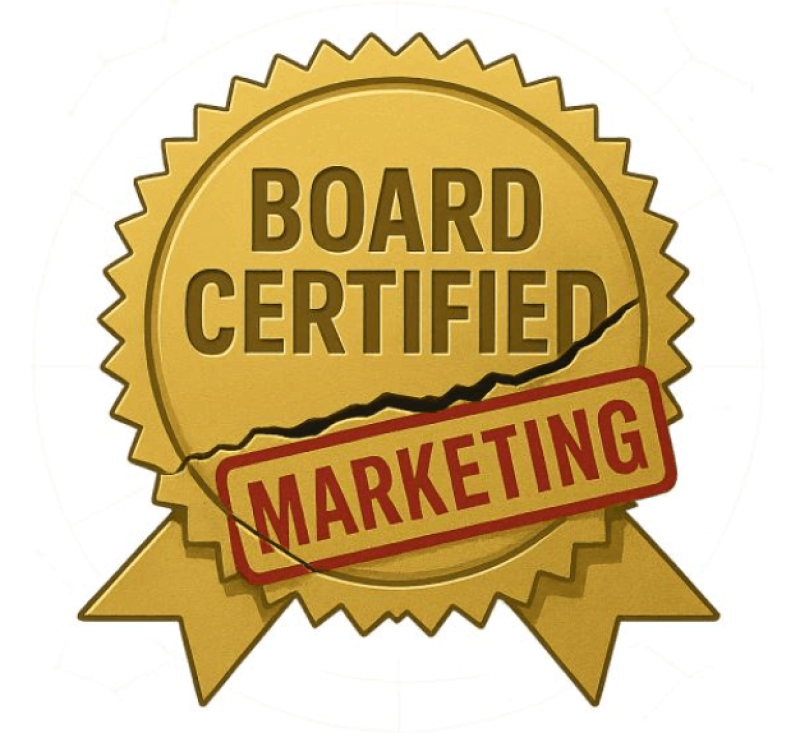
“Board certified” is a common and persuasive credential, particularly in medicine, often implying a recognized level of expertise. However, this term doesn’t automatically equate to scientific backing. For example, the Institute for Functional Medicine has a new board certification for its practitioners. While the title may sound official, the details suggest it’s more of a marketing tactic than a genuine scientific or medical endorsement.
“Board certified” is actually a relatively simple concept.
“The process by which a physician, veterinarian, or other professional demonstrates a mastery of advanced knowledge and skills through written, oral, practical, or simulator-based testing.”
Most people associate the phrase “board certified” with doctors, though medicine isn’t the only area with board certifications. Board certification carries gravitas, indicating that a body has established standardized expectations for knowledge in a particular area, and those who are certified have met or exceeded those expectations.
Understanding what board certification is not is arguably just as important as understanding what it is. While board certification can assure a certain standard of quality and knowledge, it does not legitimize an area. For example, an astrology group could decide to offer a board certification for individuals who create star charts. They could create a board for people hoping to become board-certified in star charts, agreeing on what knowledge and skills are required. However, that doesn’t mean that astrology is real or backed by science. Herein lies the issue.
The creation of a seemingly official ‘board’ legitimizes the practice to the public, even if the underlying principles lack scientific validation. This is the precise strategy now being leveraged by the Institute for Functional Medicine.
Functional Medicine
Functional Medicine is not a recognized specialty within the field of medicine; physicians cannot train exclusively in this area. Despite this, Functional Medicine insists that its core tenets are identifying root causes of illnesses and conditions and providing a personalized patient experience. You could be forgiven for not understanding how this is different from typical medical care. However, the differences really lie in the practice. Functional Medicine often involves running numerous tests, more than are clinically indicated or recommended, and recommending a multitude of supplements.
Functional medicine has been trying to make inroads in medicine by attempting to provide continuing medical education credits in Functional Medicine training. In 2017, the American Academy of Family Physicians (AAFP) prohibited the award of credits for continuing medical education in Functional Medicine. In 2018, they allowed credit for courses that discussed what Functional Medicine is, because patients may be curious, but not because research has demonstrated that Functional Medicine is an effective and science-based approach to patient care.
“While sufficient evidence does not exist, patients still may be utilizing or asking about functional medicine; therefore, it’s important for members to be informed on the concept of functional medicine and what patients might be asking about regarding their health care and treatment options… given the current lack of evidence, the COCPD does not deem it appropriate to learn how to practice functional medicine or implement related techniques within an AAFP-certified CME activity.”
– Jordahl-Iafrato Chair of the AAFP’s Commission on Continuing Professional Development
It should come as no surprise that Functional Medicine has been adopted by a growing number of wellness influencers. Mark Hyman is one of its biggest proponents. Will Cole identifies as a Functional Medicine provider. Josh Axe. Courtney Swan. The list goes on. Functional Medicine has become a haven for Big Wellness.





Institute for Functional Medicine Board Certification
On September 16, 2025, the Institute for Functional Medicine announced its first certifying board for Functional Medicine: the International Board for Functional Medicine Certification. Starting in 2026, the IBFMC will offer two certifications: Functional Medicine Certified Professional (FMCP) and Functional Medicine Certified Professional–Medical (FMCP-M). The Medical certification is for licensed physicians, nurse practitioners, and physician associates. The other certificate is for other healthcare professionals, which, according to the site, includes acupuncturists and doctors of naprapathy, a medicalized form of massage therapy.
Given the scientific consensus that Functional Medicine is not an effective approach to patient care and does not yield good outcomes, and being a home for many wellness influencers and grifters, all this casts the board certification into a different light. The establishment of the International Board for Functional Medicine Certification is clearly a business move meant to imply medical legitimacy where none exists. It will provide another way for people to tack more initials after their name, lending the appearance of expertise and credibility where none really exists.
Functional Medicine is not unique in utilizing this tactic. Board certification is popping up all over the wellness world. While Functional Medicine was used as the example, this playbook has been and will continue to be used in other areas. The phrase “board certified” should prompt further investigation. When in doubt, scrutinize.
Katie Suleta is a regional director of research in graduate medical education. Her background is in public health, health informatics, and infectious diseases. Follow Katie on Instagram @dr.katiesuleta
A version of this article was originally posted at American Council on Science and Health and has been reposted here with permission. Any reposting should credit the original author and provide links to both the GLP and the original article. Find American Council on Science and Health on X @ACSHorg