The American Academy of Pediatrics (AAP) v Kennedy litigation is now running on two parallel tracks. Legal actions are under way both regarding the stay issued on March 16th and the trial itself. There are a lot of steps along the way, so you may not hear about either in the news for a while, but that doesn’t mean work isn’t happening behind the scenes. Richard Hughes IV, the attorney representing AAP, doesn’t expect any official rulings on either until late summer or early fall.
The first track concerns the March 16th stay, which is the order that paused the major vaccine policy changes, including the revised childhood immunization schedule, while the case proceeds. The AAP argues that the government had only 10 days to appeal. On May 7th (52 days later…), the government finally filed a notice of appeal and is now preparing its brief. The brief is due at the end of June, AAP has 30 days to respond, and then the government gets another round. Oral arguments before the appeals court are expected in early fall, and it’s not unreasonable to expect the case could ultimately reach the Supreme Court.
The second track is at the trial court level, where the focus has shifted to the administrative record (the paper trail documenting the government’s vaccine policy decisions, including conflicts of interest among members of the Advisory Committee on Immunization Practices). The AAP wants those documents handed over. Most recently, the government asked the court to issue a stay, pausing that process entirely—a federal judge denied the motion within an hour.
Behind the Scenes, Kennedy Hasn’t Pumped the Brakes
We’ve previously covered how vaccine skepticism has become a political liability heading into the midterms, and the notable quiet from the administration about vaccines. However, a new investigation by the New York Times suggests that the public silence is a strategy rather than a change of heart.
According to people close to the effort, Health and Human Services (HHS) Secretary Robert F. Kennedy Jr. is spearheading a large research initiative across HHS agencies to find evidence linking vaccines to chronic disease, autism, and other neurological conditions—all topics that have been extensively studied, with no causal link established. The effort is estimated to cost between $40 million and $50 million. Dr. Sara Brenner (whom we discuss below) is expected to help move the studies forward.
No Shortage of Personnel News
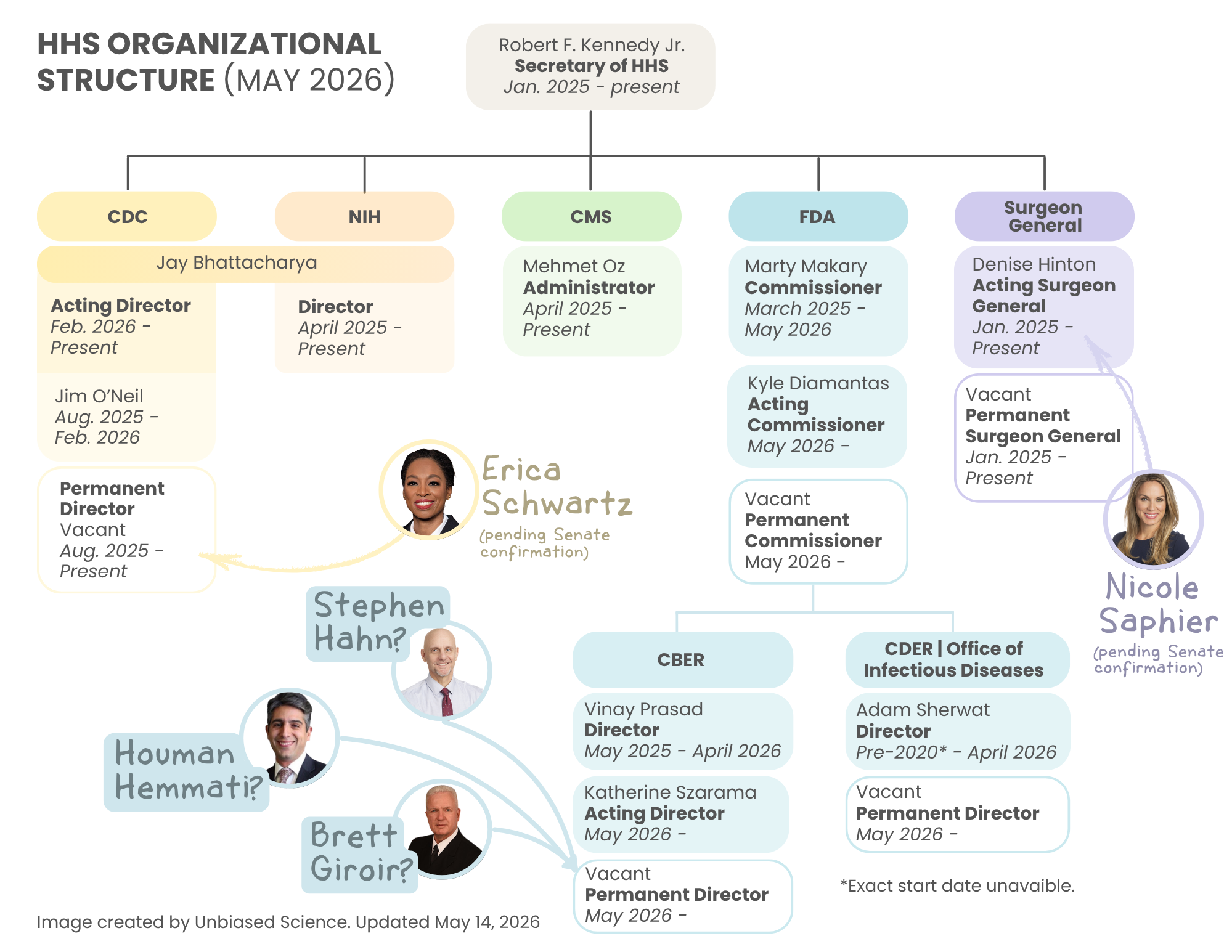
U.S. Surgeon General: After Janette Nesheiwat’s nomination was withdrawn and Casey Means was never formally nominated, President Donald Trump has nominated his third pick—Dr. Nicole Saphier, a radiologist and former Fox News medical contributor. She has overall positioned herself as pro-vaccine, but has also questioned parts of the childhood vaccine schedule and criticized school vaccine mandates. She still needs to be confirmed by the Senate.
FDA Commissioner: Marty Makary is out after 13 months. His tenure was marked by staff turnover and layoffs and fights over vaccines, abortion pills, and rare disease drugs. Kyle Diamantas, the U.S. Food and Drug Administration’s (FDA) top food regulator and a former corporate lawyer, is serving as acting commissioner. The White House is reportedly considering former FDA Commissioner Stephen Hahn and former Assistant Secretary for Health Brett Giroir for the permanent role. This also requires Senate confirmation.
FDA’s Center for Biologics Evaluation and Research (CBER): Katherine Szarama has been named acting director, replacing Vinay Prasad, who left at the end of April. She was previously Prasad’s deputy, and her background is primarily regulatory and administrative. As a reminder, CBER regulates vaccines, gene therapies, and blood supply. It’s not clear yet whether she will stay in the role permanently.
RFK Jr.’s new inside ally: President Trump appointed Dr. Sara Brenner—a preventive medicine physician, FDA deputy commissioner and self-described “MAHA mom”—as Kennedy’s senior counselor for public health. The role sits at the intersection of HHS, the Centers for Disease Control and Prevention (CDC), and the National Institutes of Health, but, notably, it does not require Senate confirmation. Brenner has expressed concerns about COVID-19 vaccination during pregnancy and questioned whether the COVID-19 vaccine benefits for children outweigh the risks.
State Round-Up
New Hampshire’s two biggest anti-vaccine bills stalled out this session. HB 1719, which would have removed hepatitis B from the state’s required childhood immunizations, was shelved until at least next year. HB 1811, which would have ended nearly all school vaccine requirements in the state, was killed by a bipartisan House vote in February.
In Illinois, SB 3487 advanced out of the House Public Health Committee. If passed, the bill would update hospital vaccination policies for flu and pneumococcal vaccines, and decouple the state from federal vaccine guidance.
West Virginia remains the site of one of the bigger vaccine policy battles to watch. Governor Patrick Morrisey has asked the state Supreme Court to uphold a lower court ruling that would allow religious exemptions to school vaccine requirements under the state’s Equal Protection for Religion Act. Schools will continue to reject religious exemptions while the case moves forward.
Jess Steier is a public health scientist dedicated to bridging the gap between complex scientific evidence and public understanding. Jess is the Founder of Unbiased Science, CEO of Vital Statistics Consulting, and Executive Director of The Science Literacy Lab (a 501c3 non-profit organization).
Izzy Brandstetter Figueroa is an epidemiologist, educator, and statistics consultant for Unbiased Science. Find Izzy on LinkedIn
Riley Mulholland is a public health consultant and content coordinator at Unbiased Science. Find Riley on LinkedIn
A version of this article was originally posted at Unbiased Science, in collaboration with CIDRAP (Center for Infectious Disease Research and Policy at the University of Minnesota), and has been reposted here with permission. Any reposting should credit the original author and provide links to both the GLP and the original article. Find Unbiased Science and CIDRAP on X @unbiasedscipod and @CIDRAP