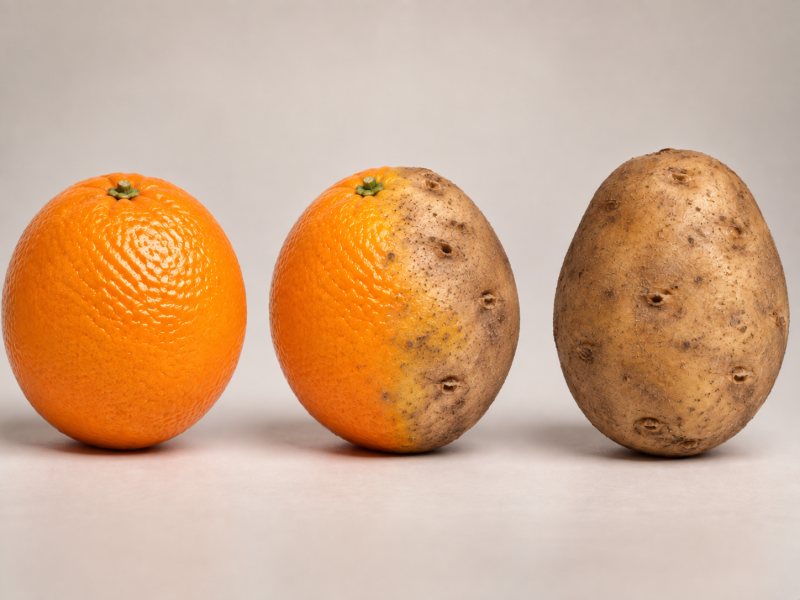

Potato is a central pillar of global food security, yet its highly heterozygous, tetraploid genome has long frustrated conventional breeding efforts. While humans cannot synthesize vitamin C and rely entirely on dietary intake, enhancing this essential antioxidant in staple crops has remained a formidable challenge. Traditional metabolic engineering approaches—often relying on strong, constitutive gene overexpression—frequently disrupt cellular homeostasis and incur yield penalties. Moreover, the relationship between vitamin C accumulation and plant growth has been poorly understood, with little guidance on how much enrichment is beneficial versus detrimental. Based on these challenges, a deeper investigation into the physiological limits of vitamin C enhancement in potato was urgently needed.
A team of researchers from the Chinese Academy of Agricultural Sciences, Yunnan Normal University, and Huazhong Agricultural University has published (DOI: 10.1093/hr/uhag191) their findings in Horticulture Research on May 13, 2026. Using CRISPR/Cas9 genome editing, they targeted the upstream open reading frames (uORFs) of two key vitamin C biosynthesis genes—StGGP1 and StGGP2—to fine-tune vitamin C accumulation in potato tubers. The work reveals a precise, dose-dependent relationship between gene editing and vitamin C levels, and identifies a critical enrichment threshold beyond which plant growth becomes compromised.
The team generated a spectrum of edited potato lines with vitamin C increases ranging from 3.79-fold to an unprecedented 24.12-fold—the highest ever reported in a crop. Through dual-luciferase reporter assays, they demonstrated that larger uORF deletions progressively enhance translational efficiency, establishing a clear molecular dose-response. Remarkably, lines with moderate enrichment (up to 9.47-fold) showed no trade-offs: tuber yield, starch content, starch granule morphology, and α-amylase activity all remained indistinguishable from wild-type plants. Even after 30 minutes of steaming, these enriched tubers retained enough vitamin C—approximately 95 mg per 100 g serving—to meet the recommended daily intake.
However, the high-accumulator line with a 24.12-fold increase told a different story. These plants exhibited severe developmental penalties: stunted growth, reduced plant height, significant yield loss, and even male sterility. Transcriptome profiling and hormone quantification revealed the culprit: excessive vitamin C disrupts auxin homeostasis—suppressing the biosynthesis, transport, and signaling of this master growth hormone. The team confirmed the causal link by applying exogenous auxin, which partially rescued the growth defects. In essence, the researchers uncovered a bidirectional antagonism: while auxin normally suppresses vitamin C production to prioritize growth, excessive vitamin C accumulation triggers a feedback loop that cripples auxin action.
“We found that vitamin C enrichment in potatoes is not simply a matter of ‘more is better’—there is a clear physiological ceiling,” the authors said. “Moderate enhancement gives you all the nutritional benefits without any agronomic cost. But once you cross that threshold, the plant’s own hormonal network collapses, and you pay a heavy price in yield. This tells us that precision, not brute force, is the key to successful crop biofortification.”
The study has immediate practical implications for potato breeding and beyond. The moderate-edited lines offer a ready-made path to nutritionally enhanced potatoes that could help address vitamin C deficiency in populations where potatoes are a dietary staple. The retention of vitamin C after cooking makes these potatoes a practical, everyday source of this essential nutrient. More broadly, the work provides a generalizable framework for metabolic engineering in other crops: by identifying the safe operating window for any given trait, breeders can avoid the yield penalties that have historically plagued biofortification efforts. The research also opens new questions about the molecular mechanisms linking vitamin C to auxin signaling—questions that could reshape our understanding of how plants balance growth and nutritional quality.
Read the original article here