The current European regulatory framework relating to new genomic techniques (NGTs) is undergoing a thorough review. The ruling of the Court of Justice of the European Union in “Confédération paysanne” (C-528/16), which made GMO legislation (and the stringent restrictions provided for by that legislation) applicable also to plants obtained through genome editing techniques, has clearly highlighted the inadequacy of the current regime. This finding was formalised in the Commission’s 2019 Study, which highlighted that the current GMO legislation is not structured to operate adequately on new genomic techniques, paving the way for the need for an ad hoc legislative proposal, a true lex specialis dedicated to NGTs.
This marked the start of an update process aimed at distinguishing between NGT1 organisms, obtained through specific genetic modifications and considered equivalent to those obtained using conventional techniques, and NGT2 organisms, which undergo more complex editing procedures and will continue to be classified as GMOs and to be subject to the relevant rules. From the developments in 2019 (Council Decision 2019/1904 and related ‘Study on new genomic techniques’) to the proposed regulation of 2023, up to the most recent political developments, the picture remains unclear: the trilogue between Parliament, Council and Commission on 3 December ended positively with a provisional agreement on a regulation establishing a criterion of equivalence between NGTs and ‘conventional’ plants, reducing the labelling requirements originally envisaged and, above all, allowing patent protection on NGTs, in return for the introduction of mechanisms aiming to balance exclusive rights with the need for access to patented technologies and products. However, the legislative process continues.
Heterogeneous regulatory framework
One of the key issues to be defined is the management of intellectual property, a topic on which the European debate is progressing in a global context that, although extremely heterogeneous, precedes it. Several non-EU countries have already introduced operational approaches to regulate plants obtained through genome editing: since 2019, Australia has not considered plants obtained using genome editing techniques without exogenous DNA to be GMOs; the US applies a ‘product-based’ model with streamlined procedures for ‘SiteDirected Nuclease 1’ (Sdn-1) modifications, such as point mutations obtained without the introduction of external DNA. Since 2015, Argentina has adopted a rapid and pragmatic case-by-case assessment model which, similarly to the United States and Australia, considers plants without exogenous DNA to be non-GMOs. China has defined guidelines on genome editing since 2022, authorising the first edited varieties the following year. The United Kingdom has also completed the implementation of the Precision Breeding Act, which came into full force in November 2025, introducing the category of ‘Precision Bred Organisms’. Other jurisdictions, such as Mexico, New Zealand and Russia, maintain more restrictive or uncertain approaches. The international framework thus shows that the issue of access to innovation and IP protection is already addressed by established regulatory systems, confirming that the issue is not exclusive to Europe but part of a changing global context.
Industrial patents and plant variety rights
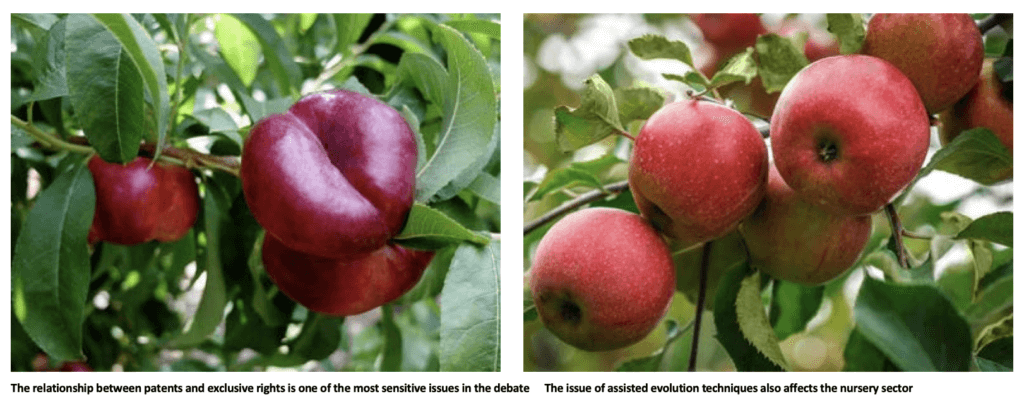
The relationship between patents and plant variety rights for new plant varieties is one of the most sensitive issues in the debate on the regulation of NGTs. The two protection systems have very marked structural differences, but they are not mutually exclusive; on the contrary, they can coexist: patents protect technical inventions such as a gene, a trait or biological material (cells, seeds, plants) with an inventive function; plant variety rights protect a specific variety defined at the phenotypic level and subject to DUS requirements. In the patent system, protection extends to all plants that contain or express the claimed gene or function, including, in fact, the progeny which maintains that function.
Furthermore, another crucial issue related to protection concerns process patents, which inevitably affect products obtained using processes related to new genome editing technologies, necessary for creating NGT plants. In this case, the patent landscape is very broad and complex, so particular attention must be paid to what is permissible in terms of research and development and what will require appropriate licences once a new NGT has been developed for market release, as further explained in the following.
In the UPOV system a partially similar task, aimed at preventing the proliferation of ‘copycat’ varieties obtained through minimal modifications, is performed by the concept of ‘Essentially Derived Variety’ (EDV), a variety that retains the expression of the essential characteristics of the initial variety, but differs from it in other, non-essential characteristics, as provided for in Article 14(5)(b) of the UPOV Convention. A key aspect of the concept of EDV is that defined in Article 14(5)(c): essential derivation may exist regardless of the technique used to obtain the variety, whether it be selection, mutagenesis, backcrossing or genome editing, with the focus on the substantial relationship with the initial variety. The explanatory notes published by UPOV in 2023 also add that single-parent interventions, point mutations or single-locus edits introduced through genome editing (e.g. CRISPR-Cas) are a strong indication of substantial derivation. However, given the role that NGTs play in variety development, the current scenario forces us to reflect more deeply and, above all, to consider the UPOV guidelines as not strictly binding, since, ultimately, the very need to interpret the guidelines reveals the existence of different perspectives (in claris non fit interpretatio).
Even the most well-known disputes, such as Nadorcott/Tang Gold or Sirio CL/Gladio, do not constitute precedents that can be identified as always valid and applicable references; they undoubtedly allow us to understand how EDV certification affects the commercialisation, use and profits of the varieties involved, but it should be noted that, in the specific example of the Sirio CL/Gladio ruling, the assessment of essential derivation did not take into account a fundamental element: the highly significant technical and agronomic contribution made by the characteristic introduced in the new variety (editor’s note: resistance to Clearfield © herbicides). This confirms, in essence, that the concept of essential derivation is so intrinsically complex that it cannot be reduced to simplified interpretations or applied through automatic interpretations or case law. Furthermore, limiting the assessment solely to genetic profiles, when the protection of plant variety rights concerns the phenotypic and, therefore, agronomic characteristics of the variety, could prove to be a convenient simplification, but one that is not fully consistent with the objectives of the rules on plant variety rights (i.e., as we have seen, to limit the phenomenon of photocopy varieties, while still encouraging genetic improvement – conventional and otherwise – that can lead to agronomically interesting results).
In the European patent system, the protection conferred on an invention can be particularly broad when it concerns living organisms. If the subject matter of the patent is a process, the protection covers not only the acts of using the process, but also the biological material directly obtained from that process (Art. 64(2) EPC). If, on the other hand, the patent concerns a product containing genetic information, the protection extends to any material in which that information is incorporated and performs its function (Art. 9 Directive 98/44/EC). This implies that the use of patented genome editing technology, or a sequence covered by a patent, may affect several stages of the plant development cycle, starting with the technology itself (e.g. the nuclease, guide RNA, vector construct), through to the act of application (the editing process), to the material directly obtained (the edited plant) and the progeny that inherits and expresses the introduced or activated function.
Unlike plant variety rights, the patent system does not provide for a generalised ‘breeder’s exemption’. However, both the PCP and national legislation (e.g. Article 68 of the Italian Industrial Property Code) and international legislation (in particular the Agreement on the Unified Patent Court – UPCA) include experimental exceptions that allow acts carried out for research purposes, including activities aimed at discovering or developing new varieties. The distinction is essential: research on patented technology falls within the exception, while the use of technology as a means of obtaining a final product remains subject to the exclusivity of the owner.
With the expansion of NGT techniques, often based on patented elements such as guide RNA, CRISPR cassettes or regulatory constructs, the application scenarios are broadening and the possible technological combinations are increasing, making the extension of patent rights more complex than the single discipline of plant variety rights. This does not transform intellectual property into an obstacle, but confirms its nature as a tool to be managed with care, distinguishing on a case-by-case basis between what falls within the scope of free research, what can be used legitimately, and what requires prior consent.





What access to technologies?
Alongside the issue of protection, consideration must also be given to access to technologies, an area that is becoming increasingly important today. As highlighted in doctrine and contractual practice, the relationship between exclusive rights and access rights is not binary: There is a wide range of legal, contractual and organisational tools that make it possible to reconcile the protection of innovation with the effective use of technologies by manufacturers and operators in the sector. These include voluntary licences, including for use as ‘research tools’; cross-licences; measures to manage the phenomena of ‘patent thickets’ and ‘royalty stacking’; as well as initiatives promoted by key market players such as ‘clearing houses’ (in fact, associations of patent holders such as Ilp® overseas and Aclp® in the EU) and ‘patent pools’ (consortia or companies that manage licences, whose activities are already well known in other sectors such as IT and telecommunications), which offer standardised conditions and a single point of access to the necessary technologies.
Added to this are coordinated licensing tools, such as FRAND clauses for essential technologies and licensing pledges, including the example of Syngenta’s ‘Traitability’ platform, which aims to create transparent e-licensing platforms for access to the patent and plant variety right portfolios entrusted to it.
At the regulatory level, compulsory licences are also provided for, including cross-licences between patents and plant variety rights, which can be activated in the presence of significant technical progress of economic relevance or for reasons of public interest. In all cases, these are solutions that are already known and used successfully. Taken as a whole, these instruments confirm that intellectual property, far from being an obstacle, can be managed in such a way as to promote access while protecting investment in innovation. The key lies in the quality of contractual frameworks and the transparency of information systems, which make it possible to transform a complex landscape into a functional and predictable ecosystem capable of supporting varietal development in the era of new genomic techniques.

Integration and knowledge are needed
In the context described so far, and in the context that could arise if the regulation were to be approved, the role of patent offices (UIBM in Italy, EPO at European level) and of the CPVO above all, is set to become increasingly strategic. The CPVO system, based on technological neutrality, does not distinguish varieties according to the technique used to obtain them: what matters are phenotypic characteristics and DUS criteria. NGTs do not change the definition of variety under Regulation 2100/94, but may require technical adjustments to examination procedures, particularly with regard to the assessment of distinctiveness and the management of characteristics obtained through genome editing. The tools of the CPVO technical protocols, including the possibility of conducting ‘special tests’ on additional characteristics, allow innovations to be gradually integrated without compromising the consistency and neutrality of the system. Through coordination, supervision of examination offices and updating of protocols, the CPVO is therefore a key player in ensuring that plant variety protection remains an effective, reliable tool that can adapt to ongoing technological changes.
The picture that emerges is that of a system in transformation, called upon to measure itself against technologies that are advancing more rapidly than the rules designed to govern them.
[Editor’s note: This article has been translated from Italian and has been edited for clarity.]
A version of this article was originally posted at Fruit Growing Magazine by Edagricole and is reposted here. Any reposting should credit both the GLP and original article. Find Edagricole on Instagram @edagricole_official