
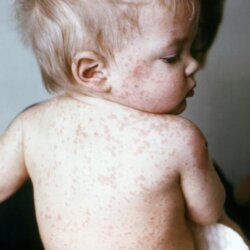
One of the biggest modern American medical stories has been the rise of vaccine hesitancy. From the decline in childhood vaccinations for measles to apprehension about the COVID-19 vaccines, this trend has real consequences—including lives lost. Consider measles, the highly contagious childhood disease health officials declared eradicated in 2000 thanks to widespread vaccination. But as vaccinations for measles fell below the 95 percent threshold needed to prevent transmission of the virus, cases exploded, according to Johns Hopkins University’s US measles tracker. In 2025, 2,206 reported measles cases resulted in three deaths. Individuals who were vaccinated against measles made up just 6 percent of those cases.

Kira Ganga Kieffer (GRS’23) studies alternative health views like vaccine hesitancy to understand how individuals develop such beliefs. At first glance, this may seem like an unlikely field of study for a religion and history scholar who holds a PhD from BU in religious studies. But Kieffer (GRS’23) contends that vaccine hesitancy is best understood as religious expression—and that may be the key to addressing it as a public health crisis.
Kieffer expands on this concept in her first book, Unvaccinated Under God: Religion and Vaccine Hesitancy in Modern America (Princeton University Press, 2026), which comes out in May. In it, she lays out the modern history of vaccine hesitancy in America, from safety concerns over the childhood Diphtheria-Tetanus-Pertussis (DPT) vaccine in the 1980s to the politicized vaccine refusal of the COVID-19 era. The religion she describes—whether it’s parents describing their journey to distrusting vaccines as “conversions” or mythmaking around vaccines, purity regimes, and ritual practices—is often enacted outside of institutional faith structures.
“I started reading articles [from the 1980s DPT safety crisis] and seeing quotes from parents who spoke like they were evangelical,” says Kieffer, a visiting faculty member in religion at Fairfield University. “I was struck to find that these were just regular folks who had a major experience of having their child become ill, and then they attributed the cause to the vaccine because they had to make meaning out of it. That is what religions do—they give you frameworks to make meaning out of things that don’t make sense.”
When a dissertation becomes “very, very relevant”

When Kieffer began a doctoral dissertation at BU in 2018 exploring alternative medicine as a form of American spirituality, she was hesitant about including vaccine hesitancy. “It felt like a hot-button topic that people had a knee-jerk reaction to, and I didn’t want that to be my dissertation,” she says. Two things changed Kieffer’s mind:
her adviser, Stephen Prothero, the C. Allyn and Elizabeth V. Russell Professor Emeritus of Religion and Culture in the United States, who found the vaccine content compelling and culturally timely; and a talk she gave at the American Academy of Religion Conference in 2019, amid a measles outbreak in the US.
“My goal is really to understand where people who are hesitant are coming from, and what are the contexts that drive hesitancy at different points in time,” she recalls. “When I gave the initial conference talk, I focused on young mothers in the early 2000s making decisions about their children, and I had a lot of women scholars at the conference come up to me in kind of hushed tones and say, ‘This was really interesting. I was kind of hesitant. I see myself in this. Keep going.’”
Her research was about to become even more timely. In early 2020, the COVID-19 pandemic exploded across the globe, and along with it came conspiracy theories, alternative medicine claims, and apprehension about masks, restrictions, and vaccines—all topics she was already studying. A piece Kieffer wrote in June 2020 for Religion & Politics Magazine (now ARC) predicting vaccine skeptics would oppose COVID-19 safety restrictions went viral and caught the attention of an editor at Princeton University Press, who invited her to write a book on the subject. Prothero encouraged her to write her dissertation as a book.
“It’s bittersweet to think about how I launched my writing career based on the pandemic,” Kieffer says. “But it’s what I was already interested in, and it just became very, very relevant.”
The 40-year arc of modern vaccine hesitancy
Unvaccinated Under God traces nearly four decades of vaccine hesitancy in America. The original “antivaxxers” were really nothing of the sort; they were parents who, following a 1982 NBC documentary, DPT: Vaccine Roulette, that depicted children who experienced brain damage after taking the DPT vaccine, began to call for a safer DPT vaccine. Kieffer found parents of brain injured children who spoke of their experiences almost like religious conversions.
“I could see the way that they spoke about warning other parents, and I was like, ‘This is witnessing,’” Kieffer says. “This was like an evangelical Christian telling their struggle story to try to get someone else to go on that same journey. That was what really bowled me over.”




Building on now-debunked research claiming that the measles, mumps, and rubella (MMR) vaccine may cause autism in children, several celebrity and alternative-health networks sprung up in the late 1990s and early 2000s warning of the dangers of the vaccine. “Mother warriors”—a movement and the title of actress Jenny McCarthy’s 2008 book on intensive mothering and alternative natural health—tended to sacralize children and maternal knowledge. Around the same time, Gardasil—which vaccinated adolescent boys and girls against the sexually transmitted human papillomavirus (HPV)—caused an uproar as conservative parents said the vaccine condoned premarital sex and undermined parental authority. Vaccines could now be read as moral technologies, not just biomedical tools.
During the 2010s, many enclave groups experienced measles outbreaks, including Somali Muslim immigrants in Minneapolis and ultra-orthodox Jews in New York City. Kieffer says these cases seemed to imply that vaccine hesitancy was doctrinally religious. But given how different these groups are, that did not make sense to her. Instead, she argues that vaccine hesitancy actually flowed in from the broader culture, not from their religious beliefs, leading to misplaced scrutiny from the public health community. This led many states to try to repeal laws that allowed religious exemptions from childhood vaccines. In doing so, they fueled an activist countermovement centered on medical freedom and religious liberty. As soon as California passed a law abolishing its religious exemption law, Kieffer says, the reaction was “‘Get your hands off my religious exemptions. Now you’re just violating religious freedom.’”
Meanwhile, Kieffer notes that some Black Americans are hesitant to take vaccines (and seek medical care more broadly) because of beliefs that draw on historical and personal experiences of medical racism. The most famous example is the Tuskegee Experiment, a 40-year study by the federal government of Black men with syphilis in which proper treatment was withheld from a control group of participants, leading to more than 100 deaths.
The vaccine hesitancy that reemerges during COVID-19 builds on the previous iterations, layering it into a politically driven conspiracy culture. “Vaccines are just one little player in that much broader universe in which the powers that be are not to be trusted and are there possibly to hurt you,” she says.
Vaccine skeptics are still in the minority in American society, and the American Academy of Pediatrics “strongly recommends immunizations as the safest and most cost-effective way of preventing disease, disability and death.” Surveys show the vast majority of Americans still trust vaccines and the public health agencies that tout them. In March 2026, a survey conducted by the University of Pennsylvania’s Annenberg Public Policy Center found that more Americans polled (77 percent) expressed confidence in the American Academy of Pediatrics than in Robert F. Kennedy, Jr., the US Secretary of Health and Human Services (38 percent).
Kieffer is working on a follow-up book, expected to publish in 2029, expanding on the conservative alternative health movement more broadly. She says reframing vaccine hesitancy as religious expression clarifies why facts alone often fail to change minds and may hold implications for the ways public health officials, doctors, and the media engage with individuals and communities who are apprehensive about the vaccine schedule. Improving outreach requires adopting the language of vaccine hesitancy, she writes in Unvaccinated Under God, including acknowledging the moral concerns at the heart of vaccine hesitancy instead of caricaturing the vaccine hesitant or treating all hesitancy as misinformation.
Kieffer hopes that her work will speak to people who are on all sides of the vaccine issue, including doctors and public health leaders.
“I wanted to present this history in a way that humanizes, contextualizes, and explains vaccine hesitancy without judging those who are hesitant,” she says. “I want to set an example for how to move the conversation forward.”
A version of this article was originally posted at Boston University and is reposted here. Any reposting should credit both the GLP and original article. Find Boston University on X @BU_Tweets