Another year, another scary “don’t eat this” list from the Environmental Working Group. If you believe this nonsense, you’ll be hurling your spinach, blueberries, and 10 other “produce demons” out of the window. But it’s a bunch of nonsense. Here’s why.
Philippus Aureolus Theophrastus Bombastus von Hohenheim a/k/a Paracelsus must be doing the Cha-cha in his grave.
Once again, the Environmental Worthless Working Group has come up with its (yawn) annual Dirty Dozen™ list, where they try to needlessly (or is it intentionally?) scare people about eating a bunch of fruits and vegetables. Why? Because they have tiny amounts of non-organic pesticide residues on them.
These chuckleheads don’t seem to know what Paracelsus—a Swiss physician and the father of toxicology—figured out over five centuries ago. The dose makes the poison.
You know the game. EWG plays it perfectly. The group equates the presence of a chemical with its risk—something Philippus Aureolus would have scoffed at centuries ago. What’s missing? Any information on the amount of the chemical present (the dose). Of course, it’s missing. Otherwise, EWG would be hard-pressed to make its claims. (Hard-pressed, maybe—but I’m guessing they’d figure something out. The bar is low.)
Numbers. Or the Lack Thereof.
That’s because toxicology doesn’t care how many substances are present; it cares about dose. And in the Dirty Dozen, any meaningful mention of dose is almost entirely absent. Spinach—the supposed poster child of pesticide danger—is the only one that even includes any information about dose—and that comes from a 2016 USDA report. You know what else is in that report? More than 99% of samples are below permitted limits—and those limits already have a 100-fold safety margin built in. Hardly cause for hysteria.
Singin’ the Blues About Blueberries
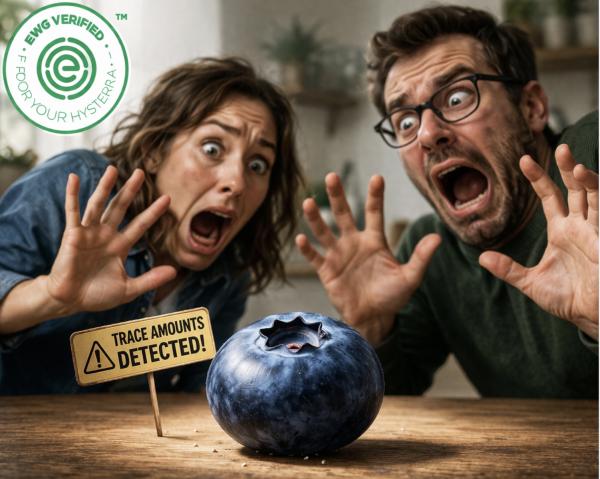
When EWG claims that blueberries have “more pesticides” than other fruits, it sounds like a meaningful measurement. It’s not.
What they’re really saying is that lab instruments have detected more different trace residues, not that blueberries pose a greater risk or even contain more pesticides, and not a peep about how much is there. This is a classic bait-and-switch: they substitute counts for consequences. Modern analytical methods can detect vanishingly small amounts—parts per billion or trillion–so foods can rack up multiple “detections” that are toxicologically meaningless.

This is like saying five different play toys are more dangerous than one rocket launcher.
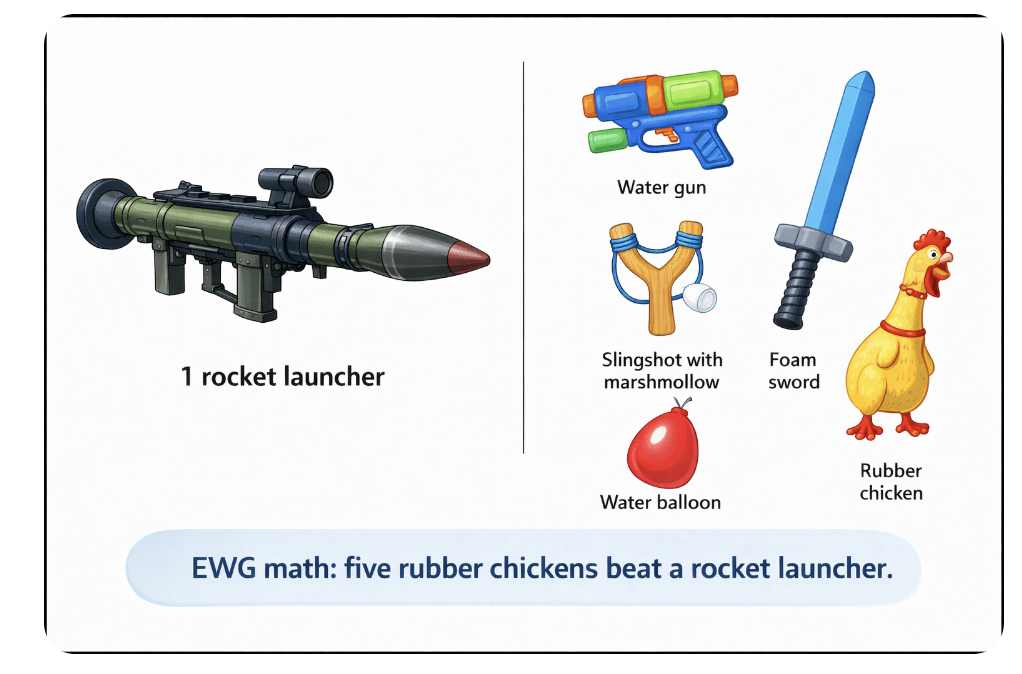
It’s the same deal with the other 10 “dirty” items. Full of rubber chickens.
Bottom line
Will people fall for these scare tactics? It would seem so. EWG’s 2024 Form 990 discloses annual revenue of $21.7 million, so someone is giving them a bunch of money. Does this explain the phony scares?
You tell me.

EWG – Money for nothin’ and your chickpeas for free.
Josh Bloom is ACSH’s Director of Chemical and Pharmaceutical Science. Josh earned his Ph.D. in organic chemistry at the University of Virginia, followed by postdoctoral training at the University of Pennsylvania. Find Josh on X @JoshBloomACSH
A version of this article was originally posted at American Council on Science and Health and has been reposted here with permission. Any reposting should credit the original author and provide links to both the GLP and the original article. Find American Council on Science and Health on X @ACSHorg