
The Centers for Disease Control’s weekly measles report is supposed to be a scientific record, not an opportunity to score political points. But this is the Trump administration, where everything, sadly, including science and health policy, appears to be driven by self-interest, personal grievances, and ideological litmus tests. Why should the current uproar over two measles-related deaths in Pennsylvania last month be any different?
The United States has seen a surge in measles cases this year and last under the Trump administration, numbers not seen since the virus was declared eliminated in 2000. Nationally, 2026 has produced more than 2,900 cases, already surpassing the full-year 2025 total of 2,289.
Last month, Pennsylvania’s health department reported that two people — both unvaccinated —had died from complications linked to measles. The Atlantic reported that the infant who died belonged to a Plain-community family in Lancaster County.
The Atlantic confirmed that both deaths were in Lancaster County. The number of cases in the state has soared from 16 in 2025 to roughly 460 as of August 28. Roughly one third of the cases are in children — an inversion of the national pattern, where about 69 percent of last year’s cases were in children and teenagers.
The case count is almost certainly an undercount, because the state’s large Amish and Mennonite communities eschew vaccination and often avoid conventional health care. The “Plain community,” as they call it, has emerged as one of the outbreak’s national epicenters — not for the number of cases but for their severity, with statewide hospitalization running at nearly triple the national rate.

The Pennsylvania deaths were the first linked to the disease in the US in 2026 — unless you believe the count at Robert F. Kennedy Jr.’s Centers for Disease Control, which has maintained that available information does not establish whether measles caused or contributed to them. That touched off a circus-like debate with the state’s governor, Josh Shapiro, whose office first announced the deaths. He blamed Kennedy for sowing distrust in vaccines that led to the decline in measles, mumps and rubella (MMR) vaccination rates.
The Lancaster County coroner has said publicly that the infant who died had a ruptured spleen, and that the forensic pathologist who examined the child did not believe measles contributed to the death. Pennsylvania’s own health department has been careful to describe both deaths as “measles-associated” — a term it uses when laboratory or epidemiologic evidence of measles is present but a medical certifier has not named the disease as the immediate cause. Those determinations will be worked out case by case, as they should be. They are also beside the point. The argument here is not about how these two deaths get classified. It is about the deaths no one will classify at all.
Kennedy claimed in a social media post that the governor showed “giddy delight” in reporting the deaths, which he claimed “may have even been altogether fabricated” by Shapiro’s staff.
Meanwhile, turmoil ensued at his CDC. It accused Shapiro of rejecting its help and declined to provide more information on the deaths. It also thanked Kennedy for raising questions about whether the two people had died from measles.
The CDC then delayed its measles update and edited the dashboard several times, saying it could not determine whether measles caused or contributed to the two deaths. When the count finally appeared, it at first marked the death total as two, but with an asterisk, and then switched it to zero on its weekly measles report.
Asked to explain the changes, recently confirmed CDC director Dr. Erica Schwartz went AWOL. At her confirmation hearing, she had promised, ‘I will never compromise on the science.’ In a bizarre social media post, CDC’s media office accused Shapiro of rejecting their help. Schwartz’s office directed reporters back to Kennedy.
The politics of science
Commenting on the bizarre developments, Dr. Nirav Shah, a former deputy director of CDC, said that second-guessing the determination of the state epidemiologist is remarkable: “For the CDC, let alone the CDC director, to overrule that sort of determination and just put that vague language up on the website, it’s more than atypical. It is the definition of the politicization of public health.”
The current administration’s role in Lancaster County is not incidental. Last month, President Trump made an unsubstantiated claim that vaccinating against measles, mumps, and rubella simultaneously (with the MMR vaccine) could be dangerous.
Kennedy’s role has been even more consequential. He has a long history of downplaying measles severity and spreading vaccine misinformation. In 2021, while leading Children’s Health Defense, he visited Amish country, praised its low childhood vaccination rates, and repeated false claims that vaccines cause autism and autoimmune disease. Health authorities, he claimed, “cannot stand the fact that you are healthy.” Governor Shapiro pointed directly at this rhetoric as a contributing factor to the confusion driving down vaccination rates in his state.
During the 2025 Texas outbreak, Kennedy promoted chicken soup and vitamin A while facing an escalating measles crisis. His record also reaches Samoa, where his anti-vaccine activism preceded a devastating 2019 outbreak. He is now using contested details of deaths in a community whose vaccine hesitancy he helped cultivate to make measles appear less dangerous.
The politics are a sideshow; Kennedy’s effort to make a lethal outbreak sound less alarming is not. One of the world’s leading experts in infectious disease — Amesh Adalja of the Johns Hopkins Center for Health Security — said that the five American measles deaths since 2025 — a tally that includes the two the CDC now declines to certify — are “extremely, extremely rare in the modern era” and “a harbinger of what is happening as this virus takes hold again in the United States.” The official death toll from measles is almost certainly an undercount — not because of missed diagnoses or lagging paperwork, but because of basic immunology.
The reason has a name: “immune amnesia.” And understanding it should change how we think about every measles case, not just the ones that end in a death certificate with “measles” listed as the cause.
What is “immune amnesia”?
Most people think of measles as a disease with a beginning and an end. You get the rash, fever, and cough; you ride it out, or you don’t; and then, weeks later, you’ve either recovered or not. That framing is wrong, and the science explaining why has accumulated for over a decade.
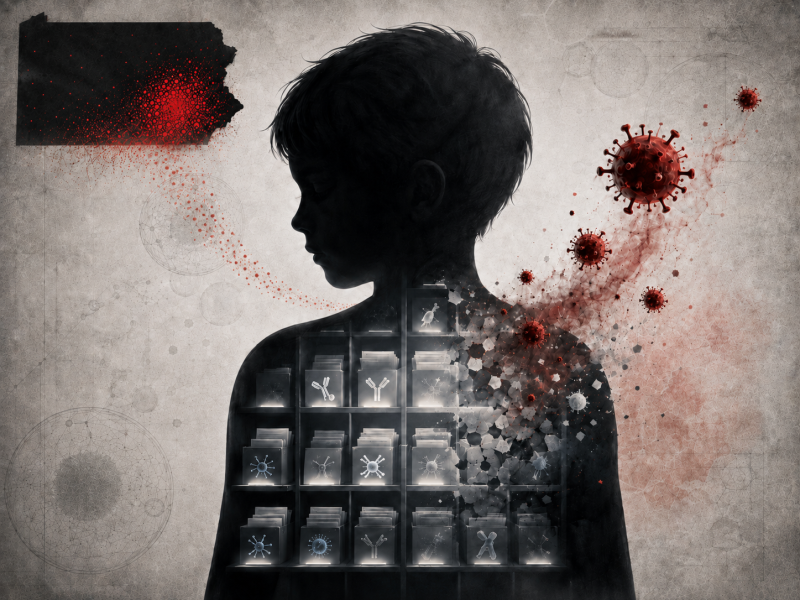
Measles virus doesn’t just infect the cells of the respiratory tract. It has a particular affinity for immune cells — specifically, cells that display a receptor called CD150 (also known as SLAM), which is expressed on activated lymphocytes, including the long-lived memory B cells and memory T cells that form the backbone of the adaptive immune system.
Memory cells are, in a very real sense, the body’s archive of every pathogen it has successfully fought off — every childhood cold, every flu strain, every vaccine ever received. When you encounter a pathogen a second time, it’s these memory cells that allow your immune system to recognize the threat instantly and respond within hours instead of the week or more it takes to mount a response from scratch.
Measles infects and kills a substantial fraction of these cells. A study published in the journal Science of 77 unvaccinated children before and 2 months after natural measles virus infection found that, depending on the severity of the case, “measles caused elimination of 11 to 73% of the antibody repertoire across individuals,” and that “[r]ecovery of antibodies was detected after natural reexposure to pathogens.”



In effect, the virus doesn’t just make you sick — it reaches into your immune system’s memory bank and erases chunk of the archive. The article included this important observation: “Notably, these immune system effects were not observed in infants vaccinated against MMR (measles, mumps, and rubella) ….”
The consequences of this are not theoretical. Children and adults who recover from measles become measurably more susceptible to other infections — influenza, bacterial pneumonia, and various childhood illnesses — for a period that can stretch from several months to two or three years after the measles rash has faded. Population-level epidemiological studies, conducted in the era before widespread vaccination, found that childhood mortality from non-measles infectious diseases rose in the two to three years following a measles outbreak, tracking almost exactly with what the immunology would predict.
The counting problem
This is where the death toll problem arises, and it’s worth being precise about it.
The CDC’s decision does not settle what the death toll leaves out. When a child dies during an acute measles infection — from pneumonia or encephalitis that can accompany the illness — the death is recorded as measles-related. States investigate those deaths; the CDC normally pools their reports. But immune amnesia does not operate on that timetable.
A child who survives measles in March and then dies of bacterial pneumonia in July will have that death recorded simply as pneumonia, not measles. But it was measles that left the child unable to fight the pneumonia off, having erased the immune system’s memory of similar pathogens. The connection, even though it is real and increasingly well-documented in the immunological literature, is invisible in the vital statistics. No death certificate checkbox exists for “immune system compromised by measles infection five months ago.”
This isn’t a fringe concern or a speculative extrapolation. A second team of researchers, working independently, found the same pattern of immune damage in the same outbreak. The children recovered from measles and then walked back out into the world with the immune defenses of infants.
What follows is a rise in deaths from unrelated infections over the next two to three years. That pattern shows up in the data. What doesn’t show up is which child belongs to which outbreak. No death certificate reads “pneumonia, following measles in 2026.” Our surveillance was never built to make that connection, and it doesn’t.
No one is hiding these deaths. But they can’t simply be added to the official count either. They’re recorded as pneumonia or sepsis, a year later, in children whose measles nobody thinks to mention.
A death toll counted during an outbreak cannot capture everything that outbreak does. Immune amnesia leaves people open to infections that kill them later, but it doesn’t generate a second toll to be added to the first. The official U.S. measles death count for 2026 currently stands at zero, with Pennsylvania’s two August deaths still under federal review. Whatever the (currently politicized) CDC ultimately determines, it will not be a full accounting.
Why this outbreak matters more than headline numbers suggest
The scale of the outbreak makes this concern more than academic. Each of those thousands of cases represents a person whose immune memory has potentially been partially erased, whether he or she was ever hospitalized for the acute infection. Most measles cases are mild in the sense that the patient recovers from the rash and fever without incident. But “mild” acute illness does not mean that immune amnesia didn’t occur; the antibody repertoire studies found meaningful losses even in cases that weren’t severe enough to require hospitalization.
This is part of why public health experts have grown increasingly alarmed now that the school year is underway: A return to classrooms gives the virus — one of the most infectious among common pathogens — more opportunities to spread among unvaccinated children. It’s also why vaccination rates matter far beyond simply preventing the acute illness.
Nationwide, routine childhood vaccination rates have fallen below the 95% threshold that epidemiologists consider necessary to maintain herd immunity, and within some pockets of the current outbreak, vaccination rates are dramatically lower still — only about one quarter of the county’s Amish community is vaccinated against measles. Kindergarten MMR coverage in the county has fallen from 95.5 percent in 2017 to 87.6 percent in 2025, versus 92.4 percent nationally.
The vaccine doesn’t cause immune amnesia
One of the more important — and more reassuring — findings from the immune amnesia research is that vaccination does not cause immune amnesia. The MMR vaccine does not appear to produce the same effect as natural measles infection, and it prevents the downstream immune vulnerability that a wild infection can create. Some researchers have described this as a form of indirect “bystander protection” — the vaccine protects against diseases it has nothing to do with, simply by preventing the immune system compromise caused by natural infection.
The medical case should not be lost in the politics. Whatever one’s views of the political dispute, the underlying biology is not in dispute: Unvaccinated populations experience the acute risks first. Pennsylvania’s health department puts hospitalization at nearly one in five cases and death at one to three per thousand, with pneumonia in about one in twenty affected children, and rare but devastating complications like encephalitis that can cause permanent hearing loss or intellectual disability. Then come the delayed, harder-to-trace risks that immune amnesia imposes.
|
Related on the SLP
‘The cure for measles is chicken soup and vitamin A’: Kennedy’s dangerous history of mocking vaccines
|
When the count becomes the story
Shapiro has cast this as a fight with the Trump administration, not merely with Kennedy. He has warned that federal health information is, in some cases, not ‘driven by facts and by science,’ making parents’ decisions harder. His vaccine-access executive order, signed at Children’s Hospital of Philadelphia last October, predated this outbreak. The federal backdrop is clear: Trump later signed a vaccine executive order with Kennedy at his side. Whatever the political calculation, the medical stakes are not in doubt.
A political fight can burn itself out. A federal surveillance decision is harder to unwind. State epidemiologists do the investigating; the CDC compiles the national picture while local reviews continue. It could have reported Pennsylvania’s determination and noted the open questions. Instead, after Kennedy attacked the credibility of those deaths, the agency omitted them. The off-ramp has closed because the administration has made the count itself part of the dispute.
None of this is a criticism of the CDC’s reporting methodology, which follows standard epidemiological practice: A death is attributed to the cause listed on the death certificate, which is generally the proximate medical cause. But it means that every time a measles death toll is reported — whether it’s the three U.S. deaths last year or the two August deaths in Pennsylvania — the public should understand that number as a floor, not a genuine tally. The full toll of an outbreak, like the one currently unfolding in Lancaster County and elsewhere in the country, won’t be visible in any single year’s mortality statistics.
The deaths reported in Pennsylvania are real, tragic, and rightly headline news. But immunology tells us that treating them as the complete accounting of the outbreak’s cost significantly understates the true price of letting measles spread.
Henry I. Miller, a physician and molecular biologist, is the Glenn Swogger Distinguished Fellow at the Science Literacy Project. He was the co-discoverer of the enzyme in the influenza virus that replicates its RNA and the founding director of the FDA’s Office of Biotechnology. Find Henry on X @henryimiller