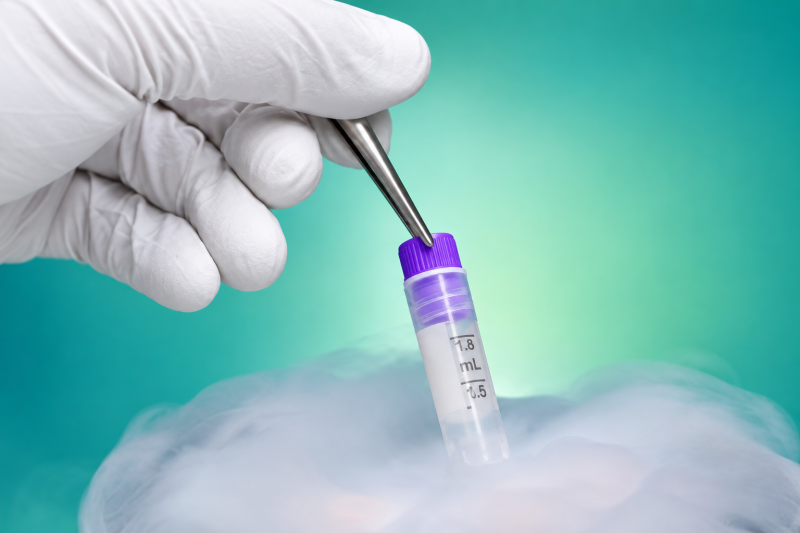
22-year frozen embryo: In one of the longest delayed births ever, middle-aged Greek couple gives birth to a daughter

A 54-year-old Greek woman has given birth to a healthy baby girl conceived from an embryo that spent 22 years in a freezer, one of the longest gaps on record between fertilization and birth, as the Associated Press’s Derek Gatopoulos reports.

Cristina Rapti-Tzelepi and her husband, Constantinos Raptis, 60, welcomed daughter Georgia, born weighing 3.49 kilograms (7 pounds, 11 ounces), using an embryo frozen through in vitro fertilization more than two decades earlier. The couple turned to the long-stored embryo after tragedy struck their family: their 21-year-old son, Giorgos, who was himself conceived via IVF, died in a road accident last October.

“We decided to give life a second chance, to make a new start, bring new life into our home and keep our family’s story going,” Rapti-Tzelepi said. The couple named their daughter Georgia in honor of their late son.

Constantinos Raptis said the pregnancy helped carry the family through grief: “He took us by the hand and pulled us out of our deepest darkness.”

Mis- and disinformation are distorting science and public policy. Subscribe to our Daily and Weekly Digests for incisive coverage of ‘disruptive’ innovations in AI, agricultural biotechnology, food, chemicals, nuclear energy, vaccines, and other disruptive innovations.

The birth came right up against Greece’s legal window for fertility treatment. Greek law bars IVF procedures for women over 54, and Rapti-Tzelepi reportedly had only about two and a half months to complete the process before aging out of eligibility.
Dr. Kostas Pantos, a gynecologist and head of the Hellenic Society of Reproductive Medicine, called the cutoff rigid: “The law is very strict: 54 plus one day is not allowed. Maybe it’s time for it to change.”

Long-frozen embryos have repeatedly produced headline-grabbing “world’s oldest embryo” births in recent years, as cryopreservation techniques have proven capable of keeping embryos viable far longer than clinicians once assumed, raising questions about how fertility laws should adapt as the technology outpaces them.


Read the original article here

Related Articles

Infographic: Global regulatory and health research agencies on whether glyphosate causes cancer

Infographic: Global regulatory and health research agencies on whether glyphosate causes cancer

Does glyphosate—the world's most heavily-used herbicide—pose serious harm to humans? Is it carcinogenic? Those issues are of both legal and ...

Most Popular

ChatGPT-Image-Sep-2-2026-02_03_32-PM
AI data centers and water usage: It’s a genuine and growing problem
Screenshot-2026-09-16-at-3.14.20-PM
19%: Plunging support for Trump-RFK, Jr. measles vaccine safety oversight
ChatGPT-Image-Mar-10-2026-01_39_01-PM
Viewpoint—“Miracle molecule” debunked: Why acemannan supplements don’t work
ChatGPT-Image-Sep-10-2026-01_44_53-PM
Viewpoint: Why medical and health nonsense spreads so casually on pop culture media
ChatGPT-Image-Sep-17-2026-12_28_43-PM
Vitamin D, omega-3 fish oil and glucosamine supplements could cause brain damage 
Screenshot-2026-09-16-at-2.26.42-PM
Viewpoint: How to ecologically damage America’s forests: Ban glyphosate
ChatGPT-Image-Sep-16-2026-11_28_54-AM
Viewpoint: Study links childhood vaccination to autism!!! Here’s how anti-vaxxers twist evidence to corrupt science
ChatGPT-Image-Sep-21-2026-10_55_04-AM
Viewpoint: America’s food-safety system is being methodically dismantled by the Trump administration.
ChatGPT-Image-Sep-21-2026-10_18_59-AM-2
Viewpoint: Is corporate embrace of regenerative agriculture greenwashing?
ChatGPT-Image-Sep-17-2026-11_03_54-AM-2
AI sparks a bioweapons race
ChatGPT-Image-Sep-21-2026-02_35_25-PM
22-year frozen embryo: In one of the longest delayed births ever, middle-aged Greek couple gives birth to a daughter
glp menu logo outlined

Get news on human & agricultural genetics and biotechnology delivered to your inbox.