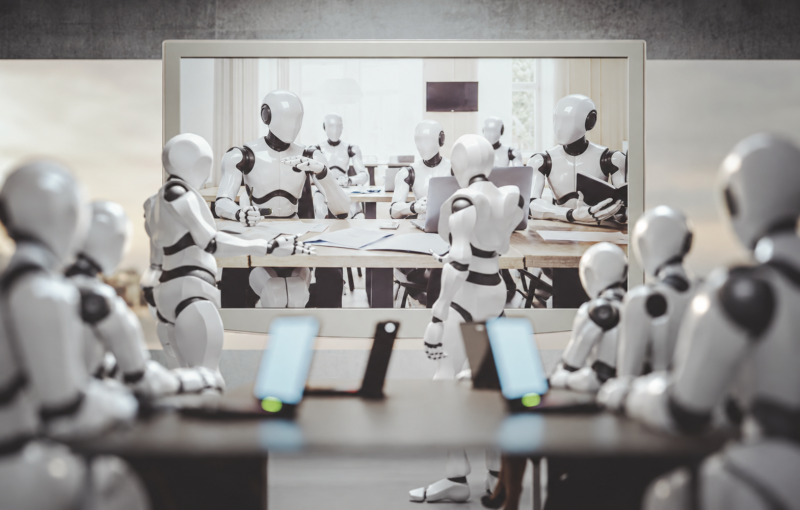

Forget killer robots. The AI catastrophe some researchers worry about most won’t arrive with a bang. It could slip in quietly, one delegated task at a time, until humans no longer have much say in how society runs, as CBS News’ Shaun Raviv reports.
The concept, dubbed “gradual disempowerment,” comes from a paper published in early 2025. Its authors argue the shift “does not need to emerge from a deliberate scheme or powergrab by AI systems.” Ordinary economic logic does the work: companies under competitive pressure swap human workers for AI, AI takes over key decisions, and people’s skills and leverage erode along the way.
“It’s a civilization-scale problem,” said Jay Chooi, founder and CEO of Robocurve, a company that tracks AI-driven robotics capabilities. “All the organizations have the incentives to adopt it and phase out humans.”
The stakes extend to politics. Paper co-author Jan Kulveit, co-founder of ACS Research Group, notes that governments rely on citizens for taxes and military service. “If, or when, existing states don’t need their citizens, they’re less likely to be democratic,” he said, likening the dynamic to oil states.
Skill loss is another worry. Margaret Mitchell, an AI research scientist at Hugging Face, warns that people who stop practicing the tasks they hand to AI agents may be unable to step in when things break. “What happens when something goes wrong? There’s no human you can point to who can fix it,” she said.
Proposed fixes include tracking how much work gets delegated to AI, deliberately building in friction that keeps humans in the loop, and training AI to complement people rather than replace them. “We can’t be in the situation where we are competing with the machines,” Kulveit said. “Because if we are just competing with the machines, we will probably lose.”




Part of the challenge is that the threat lacks drama. As Chooi put it: “No one has made a movie about gradual disempowerment.”