Understanding how CRISPR works: The basics

CRISPR
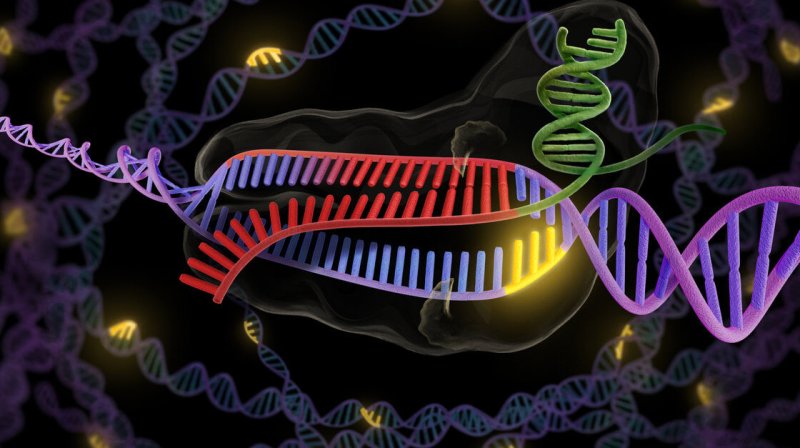
Credit: Jennifer Doudna, UC Berkeley

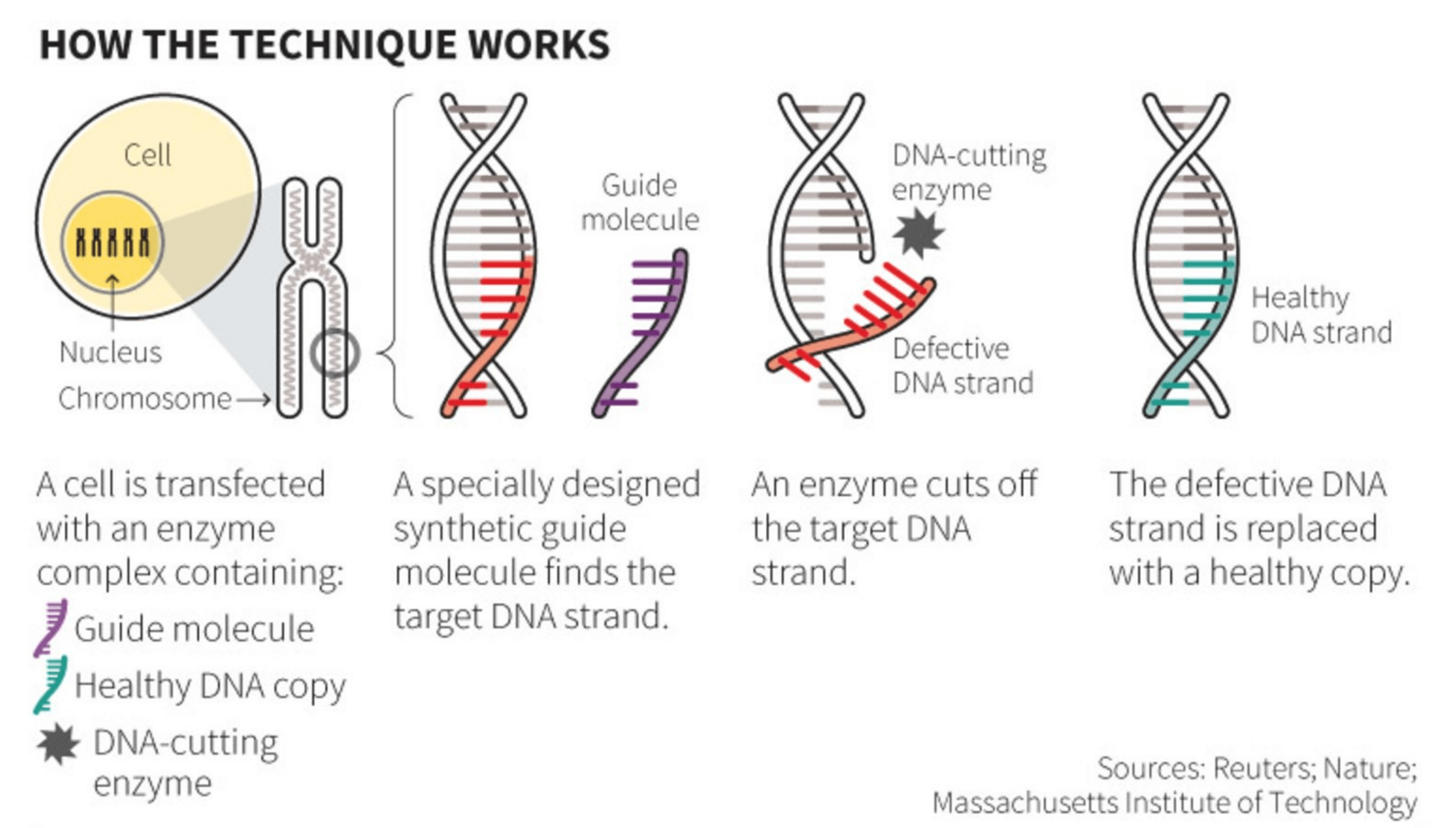
CRISPR stands for “clustered regularly interspaced short palindromic repeats.” Those repeats are elements of the genetic code in DNA. Cas9 is an enzyme that can cut apart DNA. Bacteria fight off viruses by wielding the Cas9 enzyme to reorder those repeated genetic segments. Scientists recently figured out how bacteria do this. Now, in the lab, they use a similar approach to turn the microbe’s virus-fighting system into the hottest new lab tool.

This low-cost gene editor is easy to use. That has made it possible for researchers to delve into the basic mysteries of life. And they can do it in ways that used to be difficult if not impossible.

CRISPR/Cas9 in its original form is a homing device (the CRISPR part) that guides molecular scissors (the Cas9 enzyme) to a target section of DNA. Together, they work as a genetic-engineering cruise missile that disables or repairs a gene, or inserts something new where the Cas9 scissors has made some cuts.

“The original Cas9 is like a Swiss army knife with only one application: It’s a knife,” says Gene Yeo, […] an RNA biologist at the University of California, San Diego. But Yeo and others have bolted other proteins and chemicals to the dulled blades, [transforming] that knife into a multifunctional tool.
Screen Shot at PM

The GLP aggregated and excerpted this blog/article to reflect the diversity of news, opinion, and analysis. Read full, original post: Explainer: How CRISPR works

{{ reviewsTotal }}{{ options.labels.singularReviewCountLabel }}
{{ reviewsTotal }}{{ options.labels.pluralReviewCountLabel }}
{{ options.labels.newReviewButton }}
{{ userData.canReview.message }}

Related Articles

Infographic: Global regulatory and health research agencies on whether glyphosate causes cancer

Infographic: Global regulatory and health research agencies on whether glyphosate causes cancer

Does glyphosate—the world's most heavily-used herbicide—pose serious harm to humans? Is it carcinogenic? Those issues are of both legal and ...

Most Popular

Screenshot-2026-05-01-at-1.29.41-PM
Viewpoint: What happens when whole grains meet modern food manufacturing? Labels don’t tell the whole story.
S
As vaccine rejectionism spreads, measles may be taking a more dangerous turn
Screenshot 2026-05-06 at 2.56
Singularity crisis ahead? Can super babies save us from rogue AI geniuses?
Screenshot-2026-03-13-at-12.14.04-PM
The FDA wants to make many popular prescription drugs OTC—a great idea. Here’s why it’s unlikely to happen
Screenshot-2026-05-06-at-2.07.43-PM
Manufacturing a conspiracy: The timeline of how  the White House embraced the fringe claim that scientists are being mysteriously murdered
Screenshot-2026-04-30-at-2.19.37-PM
5 myths about summer dehydration that could damage your health — or even kill you
Screenshot-2026-04-20-at-2.26.27-PM
Viewpoint — Food-fear world: The latest activist scientists campaign: Cancer-causing additives
Screenshot-2026-05-01-at-11.56.24-AM
‘Science moves forward when people are willing to think differently’: Memories of DNA maverick Craig Venter
Screenshot-2026-04-03-at-11.15.51-AM
Paraben panic: How a flawed study, media hype, and chemophobia convinced the public of the danger of one of the safest classes of preservatives
images
The never-ending GMO debate: Pros and cons
ChatGPT-Image-May-6-2026-03_41_05-PM
‘Protecting the integrity of science’: Kennedy’s FDA blocks release of taxpayer-funded studies finding COVID and shingles vaccines safe
glp menu logo outlined

Get news on human & agricultural genetics and biotechnology delivered to your inbox.