Ancient corn genome could unlock secrets of crop diversity and adaptation

evocorn

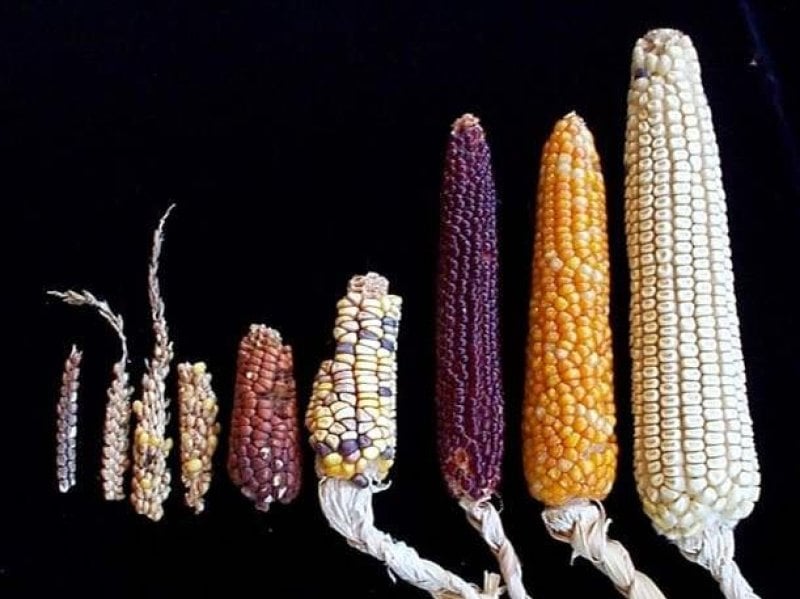
[Kelly Swarts, a quantitative geneticist, and her] team sequenced the genomes of fifteen 1,900-year-old maize cobs found in [a Utah cave] and compared their sequences to those in a database of genomes and physical traits from some 2,600 modern maize lines. The researchers then used that information to extrapolate the physical characteristics of the Turkey Pen maize plants, including complex traits such as flowering time. The analysis revealed a crop that was shorter and more branched than modern varieties…The crop also flowered more quickly than lowland varieties — an important adaptation to life in the highlands, which have a shorter growing season than lower elevations.

A key finding from the study, says [Matthew Hufford, who studies evolutionary genomics in maize at Iowa State University in Ames], was the realization that the genetic variants needed to adapt to highland life were already circulating in maize populations thousands of years ago “The diversity needed for high altitudes was there, but getting it in the right combination took 2,000 years,” he says.

And that diversity could be crucial for breeders as they try to adapt modern maize to a rapidly changing climate, says Swarts.

The GLP aggregated and excerpted this article to reflect the diversity of news, opinion and analysis. Read full, original post: Ancient genomes show how maize adapted to life at high altitudes


{{ reviewsTotal }}{{ options.labels.singularReviewCountLabel }}
{{ reviewsTotal }}{{ options.labels.pluralReviewCountLabel }}
{{ options.labels.noReviewsLabel }}
{{ options.labels.newReviewButton }}
{{ userData.canReview.message }}

Related Articles

Infographic: Global regulatory and health research agencies on whether glyphosate causes cancer

Infographic: Global regulatory and health research agencies on whether glyphosate causes cancer

Does glyphosate—the world's most heavily-used herbicide—pose serious harm to humans? Is it carcinogenic? Those issues are of both legal and ...

Most Popular

Screenshot-2026-07-01-at-2.49.48-PM
Dr. TikTok and male fertility: Viral claims tout GLP-1 drugs as fertility boosters. What does the science say?
ChatGPT-Image-Mar-10-2026-01_39_01-PM
Viewpoint—“Miracle molecule” debunked: Why acemannan supplements don’t work
a-mature-farmer-working-in-the-field-at-sunrise-harvesting-crops-generated-by-ai-photo
What’s the prospect of developing gene-altered crops that are more nutritious and resist climate disruption
ChatGPT-Image-Jun-25-2026-02_53_56-PM
Embryo gene editing is on the horizon, stirring mixed emotions
reverse-aging
Rapamycin: Here’s the skinny on the anti-aging pill that increases the lifespan—of mice by 10%
png-upside-food-syn-bio-cultured-meat
Regulating cultured meat around the world
Screenshot-2026-07-21-at-6.22.06-PM
The Indian physician’s one-woman battle against health disinformation on Wikipedia
ChatGPT-Image-Jul-6-2026-02_25_26-PM
40 million Americans take glucosamine. If you have memory loss, it could accelerate cognitive decline.
ChatGPT-Image-Jul-17-2026-12_42_10-PM
Viewpoint: RFK, Jr. is setting up a panel to compensate people who claim they were injured by a COVID vaccine–no proof needed 
YearReview Grift
Viewpoint: A practical guide to evaluating social media wellness hype
ChatGPT-Image-Jun-17-2026-03_29_08-PM
Viewpoint: What’s the impact of the U.S. abandoning support for global health?
file-f-d-d-
Facts & Fallacies Podcast: Europe's AC debacle underscores fatal flaw in green activism
glp menu logo outlined

Get news on human & agricultural genetics and biotechnology delivered to your inbox.