Is public fear of GMO food increasing?

common sense must rule gmo controversy

The National Science Foundation surveys a representative sample of Americans every two years. Theย General Social Surveyย asks about general attitudes about science in general and about specific science topics.ย For a quick overview of the highlights, seeย Everything Americans Know About Science in Seven Graphsย byย Sara Chodosh.

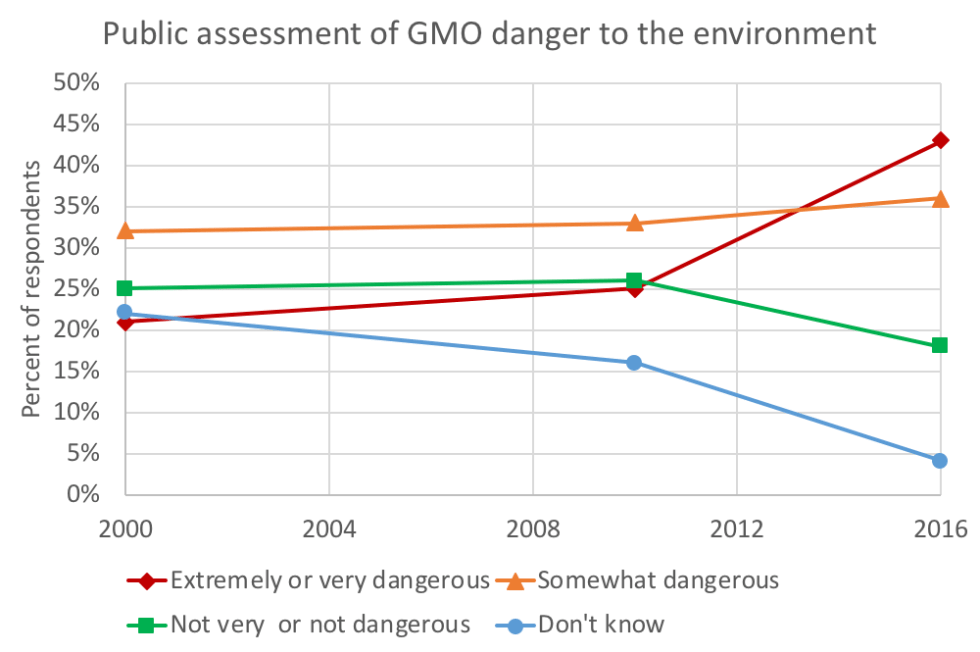
According to the NSF, โ€œdata suggest that concern aboutย GEย food is increasingโ€.

Screen Shot at PM

The results from 2016 are strikingly different from results in 2000 and 2010. The number of respondents who find GMOs dangerous shot up to 79% in 2016, while just 18% thought GMOs are not dangerous, and 4% said they did not know. People are becoming more certain in their fear, not a good sign.

Women were more fearful than men. Those with more science knowledge or higher levels of education are less fearful than those who have less knowledge or are less educated. Age was not a factor.

These results may not accurately describe how Americans feel about GMOs. If you ask people what are the top things they are concerned about when it comes to food, GMOs hardly make the list.

Selling fear is lucrative. Itโ€™s really hard to fundraise when your message is โ€œfood is pretty safeโ€. Multiple organizations and individuals have made names for themselves by scaring people about GMOs.

Editor’s note: Anastasia Bodnar has a PhD in genetics from Iowa State University

Read full, original post:ย The scary truth behind fear of GMOs

{{ reviewsTotal }}{{ options.labels.singularReviewCountLabel }}
{{ reviewsTotal }}{{ options.labels.pluralReviewCountLabel }}
{{ options.labels.newReviewButton }}
{{ userData.canReview.message }}

Related Articles

Infographic: Global regulatory and health research agencies on whether glyphosate causes cancer

Infographic: Global regulatory and health research agencies on whether glyphosate causes cancer

Does glyphosateโ€”the world's most heavily-used herbicideโ€”pose serious harm to humans? Is it carcinogenic? Those issues are of both legal and ...

Most Popular

wuhan institute of virology main entrance
โ€‹โ€‹COVID lab leak? Making a case that the Wuhan market origins theory is wrong
Screenshot-2026-06-17-at-9.44.03-AM
Viewpoint: Embryos are becoming the newest battleground of love, loss, and legal uncertainty
Screenshot-2026-06-18-at-11.41.51-AM
Viewpointโ€”Protecting baloney science: Far right senators move to protect the phony homeopathy industry
Screenshot-2026-06-17-at-11.57.12-AM
Viewpoint: Raw milk and the myth of safetyโ€”ProPublica exposes the growing anti-homogenization movement
ChatGPT-Image-Jun-9-2026-01_11_37-PM
Turmeric supplements: More risks than benefits
ChatGPT-Image-Mar-10-2026-01_39_01-PM
Viewpointโ€”โ€œMiracle moleculeโ€ debunked: Why acemannan supplements donโ€™t work
Screenshot-2026-06-18-at-2.52.05-PM
Activist organization accuses Trump of protecting methane-generating stripper wells to benefit billionaire and donor Jeffrey Hildebrandย 
Screenshot-2026-06-16-at-10.02.22-PM
Viewpoint: โ€˜Industrial foodโ€™ primerโ€”Challenging the dangerous delusions of the alternative food movement
ChatGPT-Image-Jun-18-2026-02_32_04-PM
Can illegal social media content be stopped before it goes viral? UK is going to try.
ChatGPT-Image-Jun-16-2026-10_01_45-AM-2
Viewpointโ€”Recursive self-improvement: AI leader Anthropic calls for AI slowdown
ChatGPT-Image-Jun-4-2026-03_07_27-PM
AAP v. Kennedy: While a court challenge grinds on, RFK Jr. quietly advances his anti-vaccine conspiracy agenda

Sorry. No data so far.

glp menu logo outlined

Get news on human & agricultural genetics and biotechnology delivered to your inbox.