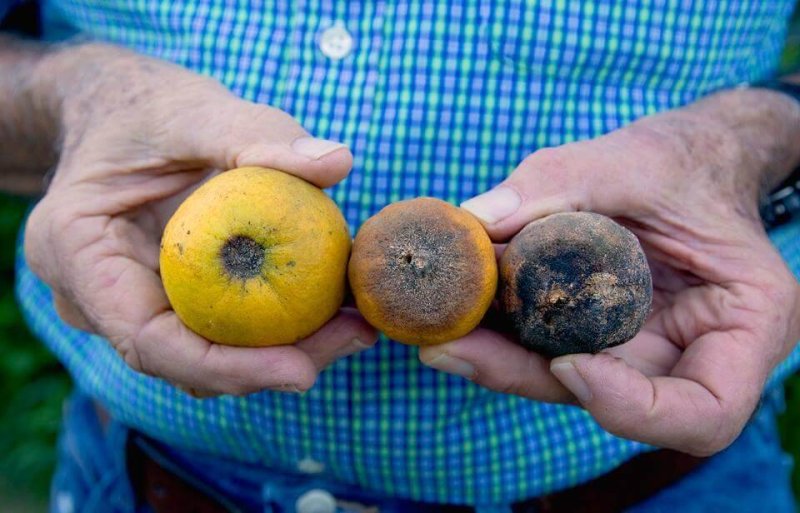
How CRISPR gene editing could unlock resistance to destructive citrus greening disease

citrus greening boston organics
Image credit: Boston Organics

Researchers at the University of California, Riverside have made an important step in understanding the molecular mechanism of huanglongbing (HLB), a destructive disease that is a serious threat to the citrus industry worldwide.

In a paper published [April 30] in Nature Communications, a team led by [Wenbo Ma, a professor of plant pathology in UCR’s College of Natural & Agricultural Sciences] reported a significant breakthrough in understanding the disease mechanism of HLB. They discovered that the bacterium secretes a protein—called Sec-delivered effector 1 (SDE1)—that helps infect plants. SDE1 works by attacking specific proteases—called papain-like cysteine proteases (PLCPs)—that could otherwise help the citrus trees resist infection.

Ma said since scientists cannot grow CLas in the laboratory, the team used a surrogate system comprising the model plant Arabidopsis thaliana and the bacterial pathogen Pseudomonas syringae that was genetically engineered to produce SDE1. Using this system, they show that SDE1 promotes bacterial infection. This study is among the first to describe the molecular tactics employed by CLas to colonize citrus plants.

The team is now investigating the molecular details of how SDE1 suppresses citrus PLCPs with the aim to use the CRISPR gene editing system to modify the proteases to become resistant to the inhibitory effects of SDE1.

Read full, original post: Researchers Move Toward Understanding Deadly Citrus Disease

{{ reviewsTotal }}{{ options.labels.singularReviewCountLabel }}
{{ reviewsTotal }}{{ options.labels.pluralReviewCountLabel }}
{{ options.labels.newReviewButton }}
{{ userData.canReview.message }}

Related Articles

Infographic: Global regulatory and health research agencies on whether glyphosate causes cancer

Infographic: Global regulatory and health research agencies on whether glyphosate causes cancer

Does glyphosate—the world's most heavily-used herbicide—pose serious harm to humans? Is it carcinogenic? Those issues are of both legal and ...

Most Popular

ChatGPT-Image-Jun-16-2026-10_29_11-AM
What’s behind Anthropic’s warning about the accelerating development of AI
Screenshot-2026-06-16-at-10.02.22-PM
Viewpoint: ‘Industrial food’ primer—Challenging the dangerous delusions of the alternative food movement
Screenshot-2026-06-17-at-11.57.12-AM
Viewpoint: Raw milk and the myth of safety—ProPublica exposes the growing anti-homogenization movement
Screenshot-2026-06-17-at-9.44.03-AM
Viewpoint: Embryos are becoming the newest battleground of love, loss, and legal uncertainty
ChatGPT-Image-Jun-9-2026-01_11_37-PM
Turmeric supplements: More risks than benefits
ChatGPT-Image-Jun-16-2026-10_01_45-AM-2
Viewpoint—Recursive self-improvement: AI leader Anthropic calls for AI slowdown
ChatGPT-Image-Mar-10-2026-01_39_01-PM
Viewpoint—“Miracle molecule” debunked: Why acemannan supplements don’t work
ChatGPT-Image-Jun-15-2026-02_31_28-PM-2
Trump-appointed cancer panel head backed by supplement and anti-vaccine companies promotes discredited support for ivermectin as a potential cure
ChatGPT-Image-Jun-4-2026-03_07_27-PM
AAP v. Kennedy: While a court challenge grinds on, RFK Jr. quietly advances his anti-vaccine conspiracy agenda
newborn infant baby mother
Facts & Fallacies Podcast: The truth about vitamin K shots
ChatGPT Image Jun 16, 2026, 12_03_37 PM
Kennedy accused of trying to ‘bully’ science journal that retracted study linking vaccines to infant deaths
Screenshot-2026-06-16-at-11.23.32-AM
In a rebuke to RFK, Jr.’s anti-vax crusade, journal retracts study claiming hepatitis B vaccine–autism link
Screenshot 2025-07-30 at 10.48
Can gene editing eliminate Down syndrome? Scientists have done it in lab-grown cells
glp menu logo outlined

Get news on human & agricultural genetics and biotechnology delivered to your inbox.