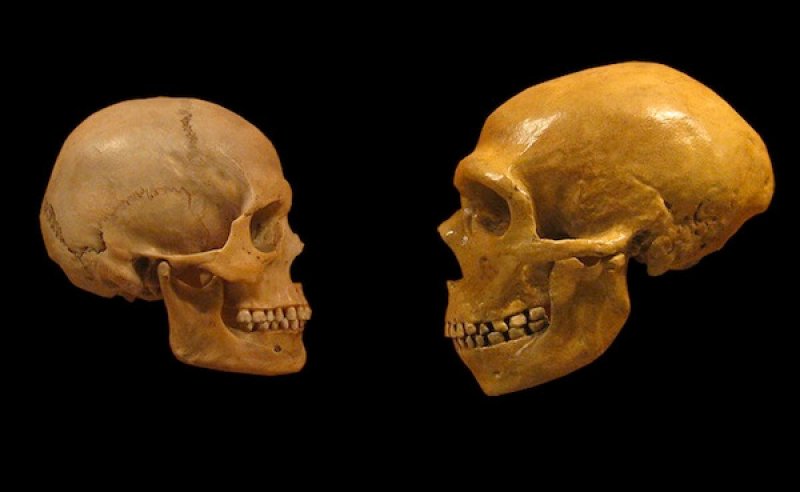
Using computers and MRI scans, researchers have created the most detailed reconstruction of a Neanderthal brain to date, offering new insights into the social and cognitive abilities of these extinct humans. But as to whether these characteristics were responsible for their ultimate demise remains an open question.
New research published [April 26] in Scientific Reports suggests important differences in cognitive and neural function between Homo sapiens and Neanderthals led to differences in behavior that may have resulted in the conditions under which anatomically modern humans succeeded and Neanderthals failed some 45,000 years ago.
…
[T]he researchers uncovered “significant” differences in brain morphology. Even though Neanderthals had larger skulls, and thus larger brain volume overall, H. sapiens had a proportionately larger cerebellum, the part of brain involved in movement, balance, vision, learning, language, and mood.…

Looking at these differences, the researchers inferred such abilities as cognitive flexibility (i.e. learning, adaptability, and out-of-the-box thinking), attention, language processing, and short-term and long-term memory. Homo sapiens, the researchers concluded, had better cognitive and social abilities than Neanderthals, and a greater capacity for long-term memory and language processing.
…
[A]bility to adapt to changing environment by creating innovation may have been limited in [Neanderthals] and this difference possibly affected their chance of survival and drove the replacement process.Read full, original post: Did Neanderthals Go Extinct Because of the Size of Their Brains?