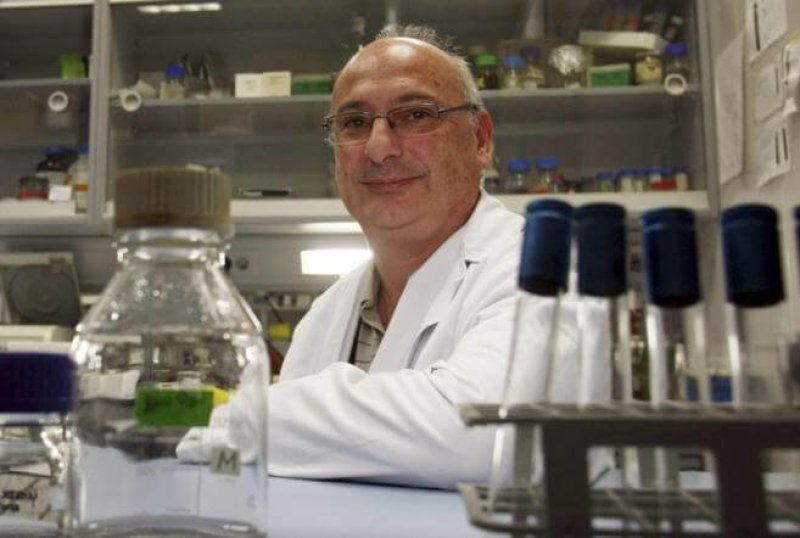
Meet Francisco Mojica, the scientist who first discovered CRISPR in a Spanish salt marsh

francis mojica
Francisco Mojica. Image credit:: Universidad de Alicante

Professor [Francisco] Mojica grew up near the Mediterranean port of Santa Pola in Spain, a region famous for its salt lakes and the flamingos that live in them, and one day he noticed something odd. He was looking at the bacteria that thrived in those marshes, and realised bits of DNA that were repeated many times, with regular spaces in between.

“And that was very unexpected and very amazing — and very peculiar,” Professor Mojica.

…

Professor Mojica devoted the next decade of his life figuring out exactly what these repeating structures were. Today, they are known as CRISPR, which stands for “clustered regularly interspaced short palindromic repeats”. And they are the basis of a technology that lets scientists edit genomes of everything from bacteria to humans.

…

Suddenly, scientists effectively had a cut-and-paste tool for the DNA.
“Now it is like a Google search,” Professor Crossley said. “You can search through vast genomes, actually in a test tube. And home in on the region you want, you can cut it, and you can put a new gene there, or you can change the sequence.”

…

Most scientists in the field agree someone will get a Nobel Prize for CRISPR. As Professor Mojica emphasised, there were a lot of people that came after him, and did arguably just as important work, turning his discovery into a tool.

Read full, original post: Francisco Mojica, the scientist who discovered CRISPR and DNA editing

Related Articles

Infographic: Global regulatory and health research agencies on whether glyphosate causes cancer

Infographic: Global regulatory and health research agencies on whether glyphosate causes cancer

Does glyphosate—the world's most heavily-used herbicide—pose serious harm to humans? Is it carcinogenic? Those issues are of both legal and ...

Most Popular

ChatGPT-Image-Mar-10-2026-01_39_01-PM
Viewpoint—“Miracle molecule” debunked: Why acemannan supplements don’t work
ChatGPT-Image-Sep-29-2026-12_16_42-PM
Social media influencers are driving food misinformation across Europe
ChatGPT-Image-Sep-30-2026-01_11_07-PM
How U.S. teamed with Russia to block global human AI weapons oversight
ChatGPT-Image-Sep-21-2026-03_15_09-PM
Viewpoint: Chipotle-inspired lesson: 10,000 sick customers suggest that processed foods can be safer than fresh ones
Screenshot-2026-09-29-at-11.06.43-AM
Astrology, homeopathy, vaccine rejectionism, creationism: Why pseudoscience thrives as science advances
ChatGPT-Image-Sep-23-2026-02_36_39-PM
Viewpoint: After firing the entire National Science Board, Trump reshapes funding initiatives. Here’s the good and the bad.
generated-1790707585414
Facts & Fallacies podcast: America's health care system is broken. A doctor explains how to fix it
Screenshot-2026-09-28-at-1.16.38-PM
Defying public perceptions, U.S. cancer deaths plunged 35% since 1991
Screenshot-2026-09-17-at-1.07.08-PM
'We are dangerously addicted to antidepressants': Should we heed RFK Jr.’s sobering warning?
ChatGPT-Image-Jun-18-2026-04_15_29-PM
Viewpoint: Kennedy’s ‘bad science’: MAGA embrace bolsters HHS secretary’s influence and popularity
ChatGPT-Image-Sep-2-2026-02_03_32-PM
How much of a problem is AI’s water use?
glp menu logo outlined

Get news on human & agricultural genetics and biotechnology delivered to your inbox.