Therapy dogs spread joy—and possibly superbugs—to kids in hospitals

dog

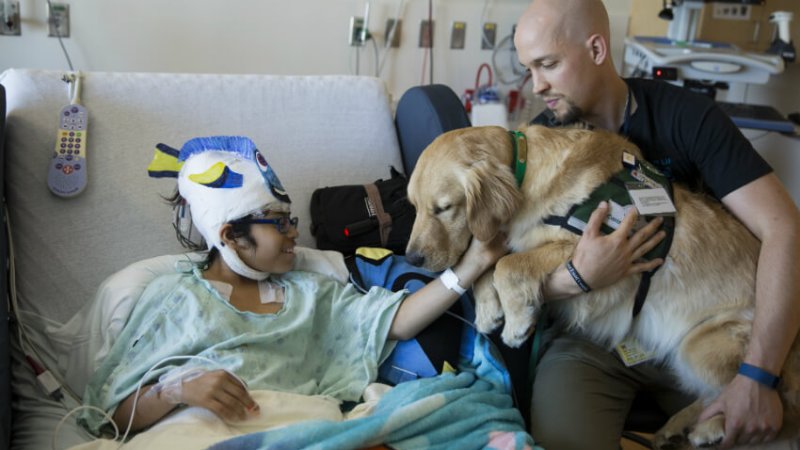
Therapy dogs can bring more than joy and comfort to hospitalized kids. They can also bring stubborn germs.

Doctors at Johns Hopkins Hospital in Baltimore were suspicious that the dogs might pose an infection risk to patients with weakened immune systems. So they conducted some tests when Pippi, Poppy, Badger, and Winnie visited 45 children getting cancer treatment.

They discovered that kids who spent more time with the dogs had a six times greater chance of coming away with superbug bacteria than kids who spent less time with the animals. But the study also found that washing the dogs before visits and using special wipes while they’re in the hospital took away the risk of spreading that bacteria.

The Baltimore study looked at 45 children who interacted with the four dogs — petting, hugging, feeding, or playing with them — over 13 visits in 2016 and 2017.

Among kids who had no MRSA, the researchers found the superbug on about 10 percent of the samples taken from those kids after the dog visits. They also found MRSA on nearly 40 percent of the samples from the dogs.

The researchers think the dogs were generally clean of MRSA when they first came to the hospital, but picked it up from patients or others while they were there.

Read full, original post: Therapy dogs can spread superbugs to kids, hospital finds

{{ reviewsTotal }}{{ options.labels.singularReviewCountLabel }}
{{ reviewsTotal }}{{ options.labels.pluralReviewCountLabel }}
{{ options.labels.newReviewButton }}
{{ userData.canReview.message }}

Related Articles

Infographic: Global regulatory and health research agencies on whether glyphosate causes cancer

Infographic: Global regulatory and health research agencies on whether glyphosate causes cancer

Does glyphosate—the world's most heavily-used herbicide—pose serious harm to humans? Is it carcinogenic? Those issues are of both legal and ...

Most Popular

ChatGPT-Image-Mar-27-2026-11_47_30-AM-2
FDA’s expedited drug reviews are hailed in some quarters but other approval practices are problematic
Screenshot-2026-05-01-at-1.29.41-PM
Viewpoint: What happens when whole grains meet modern food manufacturing? Labels don’t tell the whole story.
Farmers can talk to plants
Farmers are a major source of misinformation—about farming
ChatGPT-Image-Apr-13-2026-02_20_22-PM
Viewpoint: Misinformation infodemic? Why assessing evidence is so challenging 
S
As vaccine rejectionism spreads, measles may be taking a more dangerous turn
Screenshot 2026-05-06 at 2.19
Vaccine shootout at the CDC 
What explains Homo sapiens’ huge brains? Ancient climate change played a role
Viewpoint: Internal White House documents detail administration’s strategy to undermine climate science
Screenshot-2026-04-20-at-2.26.27-PM
Viewpoint — Food-fear world: The latest activist scientists campaign: Cancer-causing additives
ChatGPT-Image-May-7-2026-11_28_04-AM-2
‘Conflict entrepreneurs’ are driving disinformation and shaping public opinion
ChatGPT-Image-May-6-2026-03_41_05-PM
‘Protecting the integrity of science’: Kennedy’s FDA blocks release of taxpayer-funded studies finding COVID and shingles vaccines safe
bigstock opioids on chalkboard with rol

GLP podcast: 'Safe injection sites': enabling drug addiction or saving lives?
Screenshot-2026-05-06-at-2.07.43-PM
Manufacturing a conspiracy: The timeline of how  the White House embraced the fringe claim that scientists are being mysteriously murdered
Screenshot 2026-05-06 at 2.56
Singularity crisis ahead? Can super babies save us from rogue AI geniuses?
glp menu logo outlined

Get news on human & agricultural genetics and biotechnology delivered to your inbox.