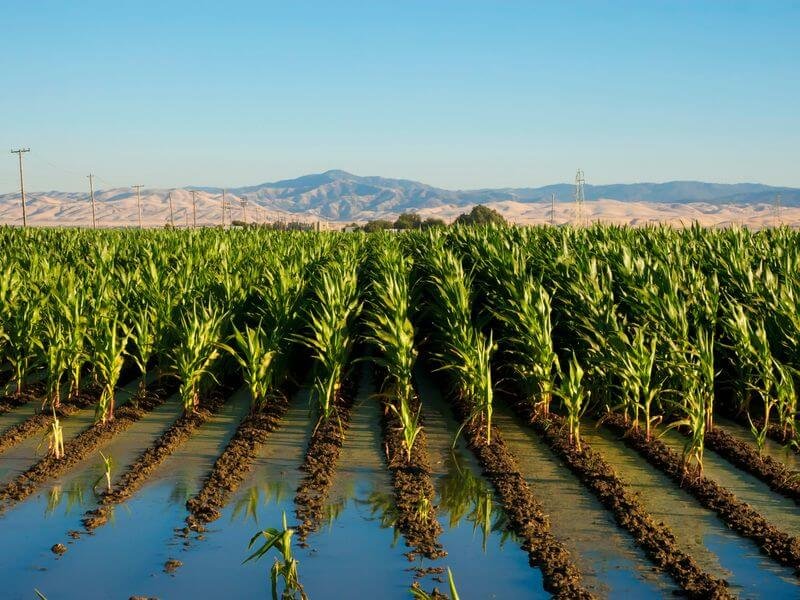
Bacteria inoculate crops against salty soil, potentially bringing unworkable farmland back to life

Overly salty soil can severely limit crop yields. Credit: Smithsonian Magazine
[S]cientists have used bacteria found in the roots of salt-tolerant plants to successfully inoculate alfalfa plants against overly salty soil.

“We take the roots of these salt-tolerant plants (called halophytes), grind them up and grow the bacteria in a petri dish in the lab,” Nielsen said. “Doing this, we isolated over 40 different bacteria isolates, some of which can tolerate ocean-level salt content.”

The team then applied the bacteria isolates to alfalfa seeds through a solution and tested the alfalfa’s ability to grow in high-saline conditions. They saw significant growth of the alfalfa both in their lab and in greenhouse experiments carried out by collaborators at the Institute for Advanced Learning and Research in Virginia.

The study identifies two specific bacteria isolates — Halomonas and Bacillus — that worked to stimulate plant growth in the presence of 1 percent sodium chloride (salt), a level that significantly inhibits growth of uninoculated plants. This discovery is significant since soils throughout areas of China, Australia and the Middle East have grown increasingly salty, as well as major farmland in the southwest United States.

“As an area of land is repeatedly used for farming, the salinity rises; the irrigation water has salt in it and when it evaporates or is taken up by the plants, the salt is left behind,” said student Caitlyn McNary, one of six [Bringham Young University] undergraduate co-authors on the paper. “With what we’ve found, lands that are now unable to sustain plant life due to high salinity could once again be used for crops.”

In addition to the work on alfalfa, America’s No. 4 crop, the research team has already started to conduct lab and greenhouse experiments on rice, green beans and lettuce. The next step is to carry out field trials on the inoculated crops.

Read full, original article: Scientists successfully innoculate, grow crops in salt-damaged soil

{{ reviewsTotal }}{{ options.labels.singularReviewCountLabel }}
{{ reviewsTotal }}{{ options.labels.pluralReviewCountLabel }}
{{ options.labels.newReviewButton }}
{{ userData.canReview.message }}

Related Articles

Infographic: Global regulatory and health research agencies on whether glyphosate causes cancer

Infographic: Global regulatory and health research agencies on whether glyphosate causes cancer

Does glyphosateโ€”the world's most heavily-used herbicideโ€”pose serious harm to humans? Is it carcinogenic? Those issues are of both legal and ...

Most Popular

Screenshot-2026-04-20-at-2.26.27-PM
Viewpoint โ€” Food-fear world: The latest activist scientists campaign: Cancer-causing additives
Screenshot-2026-03-13-at-12.14.04-PM
The FDA wants to make many popular prescription drugs OTCโ€”a great idea. Hereโ€™s why itโ€™s unlikely to happen
ChatGPT-Image-May-1-2026-02_20_13-PM
How RFK, Jr.โ€™s false vaccine claims are holding up $600 million to fight diseases in poor countries
Screenshot-2026-05-01-at-11.56.24-AM
โ€˜Science moves forward when people are willing to think differentlyโ€™: Memories of DNA maverick Craig Venter
Screenshot-2026-04-03-at-11.15.51-AM
Paraben panic: How a flawed study, media hype, and chemophobia convinced the public of the danger of one of the safest classes of preservatives
viva-la-vida-watermelons
Misinformation and climate change are endangering summer watermelons
Screenshot-2026-04-30-at-2.19.37-PM
5 myths about summer dehydration that could damage your health โ€” or even kill you
ChatGPT-Image-Mar-27-2026-11_27_05-AM
The myths of โ€œprocessโ€: What science says about the โ€œdangersโ€™ of synthetic products and ultra-processed foods
Screenshot-2026-05-04-at-12.54.32-PM
How Utah became the countryโ€™s supplement capitalย  โ€” and a haven for unregulated, ineffective and fake products
Drinking lots of water can help reduce the effects of aging
Nanoplastics in drinking water: MAHA activists forge science-based bipartisan coalitionย 
ChatGPT-Image-Mar-10-2026-01_39_01-PM
Viewpointโ€”โ€œMiracle moleculeโ€ debunked: Why acemannan supplements donโ€™t work
79d03212-2508-45d0-b427-8e9743ff6432
Viewpoint: The Casey Means hustleโ€”Wellness woo opportunism dressed up as medical wisdom
circular-bioeconomy-should-focus-on-sustainable-wellbeing
GLP podcast: What's wrong with 'doomsday' environmentalism? It's false.
glp menu logo outlined

Get news on human & agricultural genetics and biotechnology delivered to your inbox.