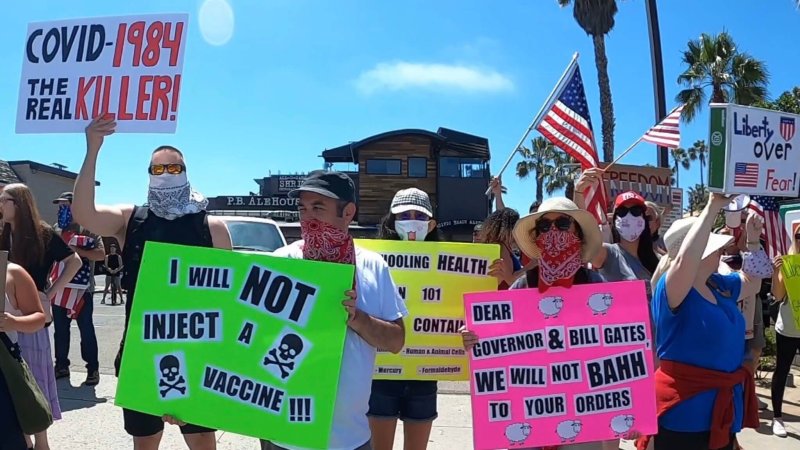
Republicans, young people and minorities: How to persuade the vaccine hesitant to get a COVID shot

Credit: Matt Hoffman

As the United States screams past 500,000 fatalities, the choice between a deadly disease and a shot in the arm might seem like the easiest decision in the world.

Or not. One-third of American adults said this month that they don’t want the vaccine or are undecided about whether they’ll get one. That figure has declined in some polls. But it remains disconcertingly high among Republicans, young people, and certain minority populations. In pockets of vaccine hesitancy, the coronavirus could continue to spread, kill, mutate, and escape. That puts all of us at risk.

Follow the latest news and policy debates on sustainable agriculture, biomedicine, and other ‘disruptive’ innovations. Subscribe to our newsletter.

When we disentangle the constituent parts of vaccine hesitancy—conspiracy theorizing, wait-and-see deliberation, frustration, and distrust—it becomes clear that vaccine reluctance will never be solved by one big thing.

Better national messaging on how vaccines could change our lives might encourage young people to get the shot, but would do little to change inequities at the community level. Clearer eligibility rules and more equitable distribution could accelerate vaccination in low-income neighborhoods, but might not solve vaccine indifference among young white Republicans. Motivational interviewing might bring along the skeptical, but more information is unlikely to convert the full-blown conspiracists. 

The multiple-choice question of combatting vaccine resistance has an obvious answer: We need all of the above.


Read the original post

{{ reviewsTotal }}{{ options.labels.singularReviewCountLabel }}
{{ reviewsTotal }}{{ options.labels.pluralReviewCountLabel }}
{{ options.labels.newReviewButton }}
{{ userData.canReview.message }}

Related Articles

Infographic: Global regulatory and health research agencies on whether glyphosate causes cancer

Infographic: Global regulatory and health research agencies on whether glyphosate causes cancer

Does glyphosate—the world's most heavily-used herbicide—pose serious harm to humans? Is it carcinogenic? Those issues are of both legal and ...

Most Popular

wuhan institute of virology main entrance
​​COVID lab leak? Making a case that the Wuhan market origins theory is wrong
ChatGPT-Image-Mar-10-2026-01_39_01-PM
Viewpoint—“Miracle molecule” debunked: Why acemannan supplements don’t work
Screenshot-2026-06-18-at-11.41.51-AM
Viewpoint—Protecting baloney science: Far right senators move to protect the phony homeopathy industry
artificial intelligence brain think illustration md
Viewpoint — Digital gods and human extinction: Will we be the first species ever to design our own descendants?
ChatGPT-Image-May-18-2026-12_06_18-PM-2
Defying death: The immortality movement goes mainstream

Sorry. No data so far.

glp menu logo outlined

Get news on human & agricultural genetics and biotechnology delivered to your inbox.