‘Humans developed complex belief systems around death’: 78,000-year old gravesite marks oldest human burial in Africa

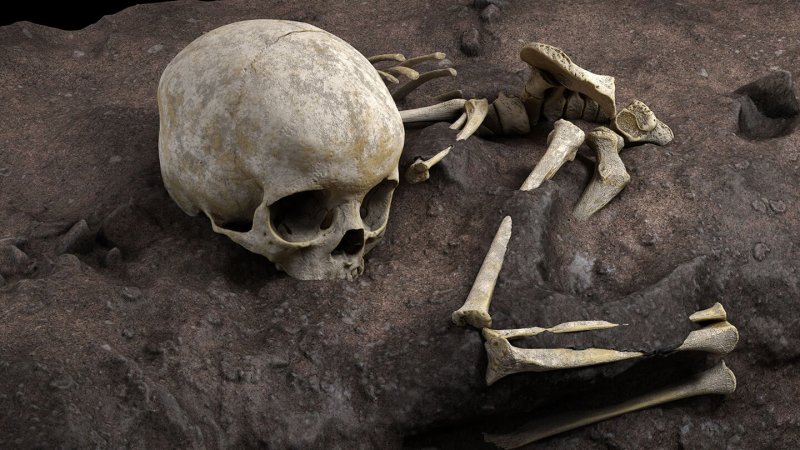
This virtual reconstruction shows the original position of Mtoto's bones in a Kenyan grave dug around 78,300 years ago. Credit: Jorge Gonzáles/Elena Santos

Archaeologists have identified the oldest known human burial in Africa during field work that uncovered the remains of a child laid carefully to rest in a grave nearly 80,000 years ago.

The arrangement of the bones shows the three-year-old – named Mtoto after the Swahili word for child – was placed with legs tucked to chest, and perhaps wrapped in a shroud with their head on a pillow, before being gently covered in soil.

Researchers discovered the delicate and degraded bones while excavating the floor beneath a sheltered overhang at the mouth of the Panga ya Saidi cave in the tropical uplands of Kenya’s coastal plain about 10 miles from the shore.

“Humans, unlike chimps, began to develop complex belief systems around death,” said Prof Nicole Boivin, the principal investigator on the project in Jena.

Follow the latest news and policy debates on sustainable agriculture, biomedicine, and other ‘disruptive’ innovations. Subscribe to our newsletter.

“But what seems clear is that there is not just an emotional connection to the dead, but almost certainly also a framework for understanding and navigating death, and for making it meaningful. Unlike other species, we have cosmological belief systems that give meaning to experience and to events like the death of a loved one.”


Read the original post

{{ reviewsTotal }}{{ options.labels.singularReviewCountLabel }}
{{ reviewsTotal }}{{ options.labels.pluralReviewCountLabel }}
{{ options.labels.newReviewButton }}
{{ userData.canReview.message }}

Related Articles

Infographic: Global regulatory and health research agencies on whether glyphosate causes cancer

Infographic: Global regulatory and health research agencies on whether glyphosate causes cancer

Does glyphosate—the world's most heavily-used herbicide—pose serious harm to humans? Is it carcinogenic? Those issues are of both legal and ...

Most Popular

wuhan institute of virology main entrance
​​COVID lab leak? Making a case that the Wuhan market origins theory is wrong
ChatGPT-Image-Mar-10-2026-01_39_01-PM
Viewpoint—“Miracle molecule” debunked: Why acemannan supplements don’t work
Screenshot-2026-06-17-at-9.44.03-AM
Viewpoint: Embryos are becoming the newest battleground of love, loss, and legal uncertainty
Screenshot-2026-06-18-at-11.41.51-AM
Viewpoint—Protecting baloney science: Far right senators move to protect the phony homeopathy industry
ChatGPT-Image-Jun-9-2026-01_11_37-PM
Turmeric supplements: More risks than benefits
artificial intelligence brain think illustration md
Viewpoint — Digital gods and human extinction: Will we be the first species ever to design our own descendants?

Sorry. No data so far.

glp menu logo outlined

Get news on human & agricultural genetics and biotechnology delivered to your inbox.