African scientists have created a CRISPR-edited banana that’s resistant to a disease ravaging farms across the continent

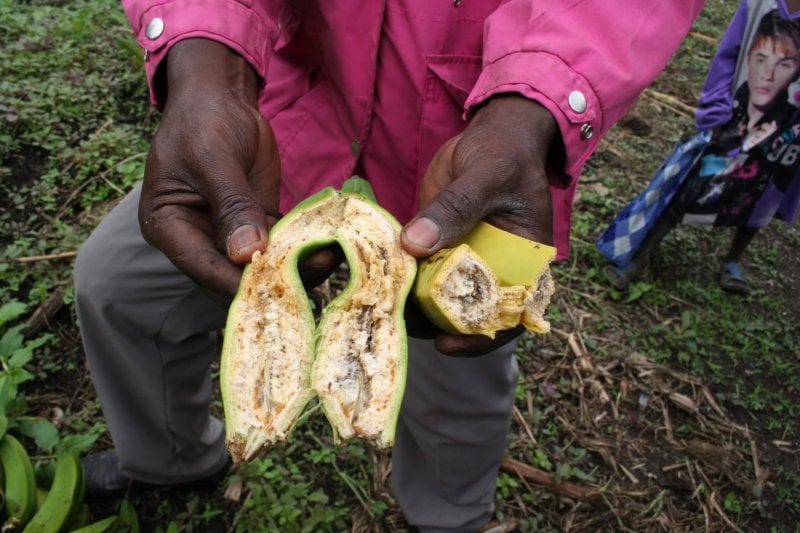
A farmer showing a banana affected by the Banana Xanthomonas Wilt disease (BXW), whose signs include premature ripening of the bunch and rotting of the fruit. Credit: Busani Bafana/IPS

Banana xanthomonas wilt (BXW) is a bacterial disease that spreads easily and kills any banana plant it infects — farmers’ only recourse once an infection takes hold is to cut down and burn the entire plant.

Every species of cultivated banana is susceptible to BXW, and in places where the fruit is a primary source of both income and food, such as Africa, an infection can threaten not only farmers’ livelihoods but the entire local economy.

In an attempt to stop the devastation caused by BXW, International Institute of Tropical Agriculture (IITA) scientists in Kenya set out to develop a disease-resistant banana.

For their study, they focused on a gene called downy mildew resistance 6 (DMR6) — during a pathogen infection, the expression of this gene increases, and that suppresses the plant’s immune function.


Follow the latest news and policy debates on sustainable agriculture, biomedicine, and other ‘disruptive’ innovations. Subscribe to our newsletter.

Bananas are notoriously susceptible to disease because they are all clones. In the past, varieties of banana have been driven virtually extinct by infections like Panama Disease, and today, viruses, bacteria, and fungi again threaten the world’s banana supply.

But if CRISPR can help bananas survive BXW, it may offer a solution to the plant’s other enemies, too.


Read the original post

{{ reviewsTotal }}{{ options.labels.singularReviewCountLabel }}
{{ reviewsTotal }}{{ options.labels.pluralReviewCountLabel }}
{{ options.labels.newReviewButton }}
{{ userData.canReview.message }}

Related Articles

Infographic: Global regulatory and health research agencies on whether glyphosate causes cancer

Infographic: Global regulatory and health research agencies on whether glyphosate causes cancer

Does glyphosate—the world's most heavily-used herbicide—pose serious harm to humans? Is it carcinogenic? Those issues are of both legal and ...

Most Popular

ChatGPT-Image-Jun-16-2026-10_29_11-AM
What’s behind Anthropic’s warning about the accelerating development of AI
ChatGPT-Image-Jun-16-2026-10_01_45-AM-2
Viewpoint—Recursive self-improvement: AI leader Anthropic calls for AI slowdown
Screenshot-2026-06-16-at-10.02.22-PM
Viewpoint: ‘Industrial food’ primer—Challenging the dangerous delusions of the alternative food movement
Screenshot-2026-06-17-at-11.57.12-AM
Viewpoint: Raw milk and the myth of safety—ProPublica exposes the growing anti-homogenization movement
ChatGPT-Image-Jun-9-2026-01_11_37-PM
Turmeric supplements: More risks than benefits
ChatGPT-Image-Jun-15-2026-02_31_28-PM-2
Trump-appointed cancer panel head backed by supplement and anti-vaccine companies promotes discredited support for ivermectin as a potential cure
ChatGPT-Image-Jun-4-2026-03_07_27-PM
AAP v. Kennedy: While a court challenge grinds on, RFK Jr. quietly advances his anti-vaccine conspiracy agenda
ChatGPT-Image-Mar-10-2026-01_39_01-PM
Viewpoint—“Miracle molecule” debunked: Why acemannan supplements don’t work
Screenshot-2026-06-16-at-11.23.32-AM
In a rebuke to RFK, Jr.’s anti-vax crusade, journal retracts study claiming hepatitis B vaccine–autism link
ChatGPT Image Jun 16, 2026, 12_03_37 PM
Kennedy accused of trying to ‘bully’ science journal that retracted study linking vaccines to infant deaths
newborn infant baby mother
Facts & Fallacies Podcast: The truth about vitamin K shots
Screenshot 2025-07-30 at 10.48
Can gene editing eliminate Down syndrome? Scientists have done it in lab-grown cells
glp menu logo outlined

Get news on human & agricultural genetics and biotechnology delivered to your inbox.