Should race be considered when diagnosing kidney disease?

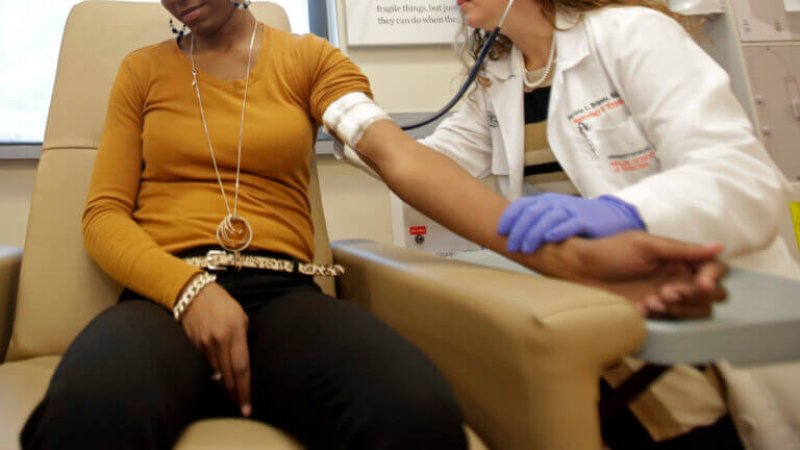
Patricia Briones, a nurse practitioner at the University of Miami, performs an auscultation of lungs on patient Treaunna Hardaway as part of daily rounds among patients in kidney failure. Credit: Alan Diaz/AP

A scientific task force on [September 23] called for jettisoning a common measure of kidney function that adjusts results by race, providing different assessments for Black patients than for others.

The adjustment may make Black patients seem less ill than they really are, according to many experts. Instead, doctors should rely on a race-neutral method for diagnosing and managing kidney disease, concluded a report from the National Kidney Foundation and the American Society of Nephrology.

The specific equation recommended was described in a study published [September 23] in the New England Journal of Medicine.

If adopted, the new approach would affect hundreds of millions of kidney function tests performed yearly in hospitals and outpatient settings, both for acutely ill patients and as part of routine screening blood tests. By one estimate, one million Black Americans might be treated earlier for kidney disease if the diagnostic equation were not adjusted for race.

Follow the latest news and policy debates on sustainable agriculture, biomedicine, and other ‘disruptive’ innovations. Subscribe to our newsletter.

“The issue is a moral issue,” said Dr. Neil R. Powe, co-chair of the task force and chief of medicine at Zuckerberg San Francisco General Hospital and Trauma Center. “It is time to remove race from the equation.”


This is an excerpt. Read the original post here.

Related Articles

Infographic: Global regulatory and health research agencies on whether glyphosate causes cancer

Infographic: Global regulatory and health research agencies on whether glyphosate causes cancer

Does glyphosate—the world's most heavily-used herbicide—pose serious harm to humans? Is it carcinogenic? Those issues are of both legal and ...

Most Popular

Picture1
Hiroshima at 81: America’s new nuclear bomb, a buried Iranian target, and a question no one wants to ask
ChatGPT-Image-Jul-31-2026-07_35_35-AM
Wikipedia has assembled an informative list of fake news websites from across the ideological spectrum
png livestock cow cattle a
Consumer skepticism about gene-edited milk is neither fixed nor particularly high—and falls even more if it’s priced lower
Screenshot-2026-08-03-at-2.15.16-PM
Viewpoint: Trump’s relaxed controls on supplying China with microchips could undermine U.S. AI dominance
ChatGPT-Image-Mar-10-2026-01_39_01-PM
Viewpoint—“Miracle molecule” debunked: Why acemannan supplements don’t work
Screenshot-2026-08-03-at-2.25.49-PM
As measles vaccination rates collapse, scientists push for treatments long considered unnecessary
Screenshot-2026-07-31-at-10.52.03-AM
Love sweets and fatty foods? You can blame your genes, but there are ways to quell the obsessions
ChatGPT Image Jul 29, 2026, 09_08_15 AM 2
The retreat of environmental extremism: Why activist NGOs are losing favor
Screenshot-2026-07-17-at-1.34.59-PM
Poll: Vaccine hesitancy soars when patients distrust health providers and turn to social media
ChatGPT Image Jul 29, 2026, 10_17_59 AM
Viewpoint: What does it mean when critics of conventional agriculture say many fruits and vegetables are “linked” to pesticide poisoning?
Screenshot-2026-08-03-at-2.06.39-PM
Viewpoint: Green energy supporters ‘fight back’ against conservative foundations backing  fossil fuel industry
ChatGPT Image Jul 31, 2026, 08_05_37 AM
With trust in RFK, Jr.'s CDC vaccine advice collapsing, physicians scramble to fill the information gap
glp menu logo outlined

Get news on human & agricultural genetics and biotechnology delivered to your inbox.