Viewpoint: Here’s the backstory behind Sri Lanka’s synthetic pesticide ban and organic only decree

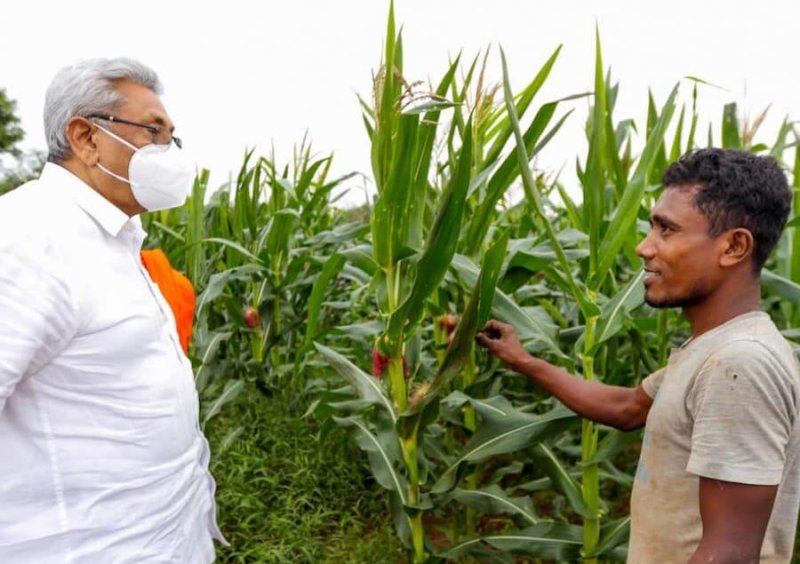
Sri Lankan President Gotabaya Rajapaksa speaks with a farmer. Credit: Colombo Telegraph

For most folks, “Sri Lanka” is likely to evoke a number of thoughts: tropical paradise with swaying palms and cerulean waters; excellent “Ceylon” tea; incendiary cuisine.

Political turmoil will also likely come to mind for news nerds, but the terms “economic collapse” and “organic farming” would not. But recent headlines introduce a new storyline.

First: “How Sri Lanka’s overnight flip to total organic farming has led to an economic disaster.”

Then: “Sri Lanka declares economic emergency to contain food prices as forex crisis worsens.”

Follow the latest news and policy debates on sustainable agriculture, biomedicine, and other ‘disruptive’ innovations. Subscribe to our newsletter.

Digging deeper quickly clarifies: Sri Lankan President Gotabaya Rajapaksa, a military man apparently unburdened by understanding of biology or agriculture, succumbed to the siren call of conspiracy theories from a well-known and persistent myth-monger from neighboring India, Vandana Shiva.

Following her advice, Rajapaksa has banned imports of fertilizers and pesticides. His stated aim is to transform the agricultural economy of Sri Lanka into a purely organic enterprise.

The realities of substantially reduced yields and limited markets seem not to have entered into his calculations, and actual stakeholders in the agricultural economy are warning of cataclysmic consequences, starting with halving the $1.5 billion export market for Sri Lankan tea.

[Editor’s note: Read the GLP profile on Vandana Shiva here.]

This is an excerpt. Read the original post here.

{{ reviewsTotal }}{{ options.labels.singularReviewCountLabel }}
{{ reviewsTotal }}{{ options.labels.pluralReviewCountLabel }}
{{ options.labels.noReviewsLabel }}
{{ options.labels.newReviewButton }}
{{ userData.canReview.message }}

Related Articles

Infographic: Global regulatory and health research agencies on whether glyphosate causes cancer

Infographic: Global regulatory and health research agencies on whether glyphosate causes cancer

Does glyphosate—the world's most heavily-used herbicide—pose serious harm to humans? Is it carcinogenic? Those issues are of both legal and ...

Most Popular

ChatGPT-Image-Mar-10-2026-01_39_01-PM
Viewpoint—“Miracle molecule” debunked: Why acemannan supplements don’t work
reverse-aging
Rapamycin: Here’s the skinny on the anti-aging pill that increases the lifespan—of mice by 10%
Screenshot-2026-07-01-at-2.49.48-PM
Dr. TikTok and male fertility: Viral claims tout GLP-1 drugs as fertility boosters. What does the science say?
ChatGPT-Image-Jul-17-2026-12_42_10-PM
Viewpoint: RFK, Jr. is setting up a panel to compensate people who claim they were injured by a COVID vaccine–no proof needed 
ChatGPT-Image-Jun-25-2026-02_53_56-PM
Embryo gene editing is on the horizon, stirring mixed emotions
UK scientists support loosening restrictions limiting embryo research
Are we edging closer to precisely, and safely, editing human embryos?
a-mature-farmer-working-in-the-field-at-sunrise-harvesting-crops-generated-by-ai-photo
What’s the prospect of developing gene-altered crops that are more nutritious and resist climate disruption
Screenshot-2026-07-21-at-6.22.06-PM
The Indian physician’s one-woman battle against health disinformation on Wikipedia
png-upside-food-syn-bio-cultured-meat
Regulating cultured meat around the world
ChatGPT-Image-Jun-25-2026-12_23_17-PM
No, Bill Gates did not secretly engineer ticks to promote veganism
YearReview Grift
Viewpoint: A practical guide to evaluating social media wellness hype
ChatGPT-Image-Jun-17-2026-03_29_08-PM
Viewpoint: What’s the impact of the U.S. abandoning support for global health?
vitamin k refuse genai
More and more babies are developing uncontrollable bleeding—linked directly to vaccine deniers' rejection of vitamin K shots
glp menu logo outlined

Get news on human & agricultural genetics and biotechnology delivered to your inbox.