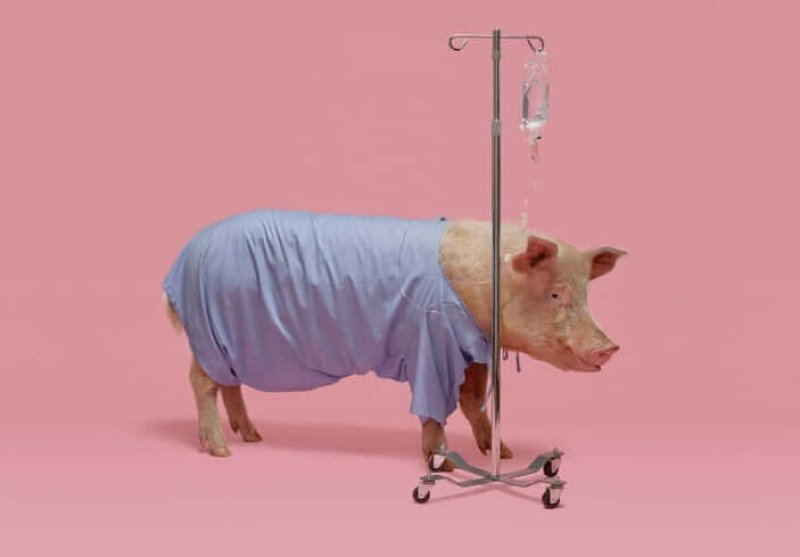
‘It is hype and bullshit’: Scientist challenges claims that pig-to-human xenotransplantation is close to realization

Credit: Jamie Chung/New York Times

Steve Holtzman was awoken by a 1 a.m. call from a doctor at Duke University asking if he could put some pigs on a plane and fly them from Ohio to North Carolina that day. A motorcyclist had gotten into a horrific crash, the doctor explained. He believed the pigs’ livers, sutured onto the patient’s skin like an external filter, might be able to tide the young man over until a donor liver became available.

Follow the latest news and policy debates on sustainable agriculture, biomedicine, and other ‘disruptive’ innovations. Subscribe to our newsletter.

The results were published in the New England Journal of Medicine in 1994.

Which is why Holtzman was shocked and a little bit confused when he read reports [recently] that doctors at NYU had conducted a “groundbreaking” procedure by, with the family’s consent, taking a pig kidney and suturing it to the leg of a brain-dead patient for 54 hours.

It was something scientists could’ve done for years, he said. And it didn’t get them closer to actually making animal-to-human transplants possible, or addressing the field’s main goal: solving a national organ shortage that kills 20 Americans per day.

“It is hype and bullshit,” said Holtzman, who is now the chairman of a Chinese company working on xenotransplantation. “It belongs in the National Enquirer.”


This is an excerpt. Read the original post here.

{{ reviewsTotal }}{{ options.labels.singularReviewCountLabel }}
{{ reviewsTotal }}{{ options.labels.pluralReviewCountLabel }}
{{ options.labels.newReviewButton }}
{{ userData.canReview.message }}

Related Articles

Infographic: Global regulatory and health research agencies on whether glyphosate causes cancer

Infographic: Global regulatory and health research agencies on whether glyphosate causes cancer

Does glyphosate—the world's most heavily-used herbicide—pose serious harm to humans? Is it carcinogenic? Those issues are of both legal and ...

Most Popular

ChatGPT-Image-Mar-10-2026-01_39_01-PM
Viewpoint—“Miracle molecule” debunked: Why acemannan supplements don’t work
ChatGPT-Image-Jun-25-2026-01_14_50-PM
Viewpoint: Disinformation grift: The wellness industry is a lucrative and mostly worthless marketplace of ‘balms, brews, and baloney’
ChatGPT-Image-Jun-25-2026-12_23_17-PM
No, Bill Gates did not secretly engineer ticks to promote veganism
ChatGPT-Image-Jun-30-2026-01_09_47-PM
Viewpoint: As MAHA blows up over Supreme Court ruling limiting glyphosate litigation, Trump offers toothless plan to reduce pesticides in food
Screenshot-2026-06-05-at-2.12.30-PM
Some plants can poison you. So how did humans figure out what is safe to eat?
ChatGPT-Image-Mar-4-2026-09_39_03-AM
Transgender female athletes and Title IX: Separating ‘policy’ from ‘legality’
ChatGPT-Image-Jun-23-2026-12_19_35-PM
Ideological red flag: Led by anti-vax doctor, Tennessee is now the U.S. epicenter selling potent ivermectin shown worthless to prevent or treat Covid
ChatGPT-Image-May-18-2026-12_06_18-PM-2
Defying death: The immortality movement goes mainstream
marijuana-pot-in-hand-nveri-st-xpm-t-abq-fkifeos-s-rws-cmpx-
Facts & Fallacies podcast: Legalized weed drives drug addiction, psychosis?

Sorry. No data so far.

glp menu logo outlined

Get news on human & agricultural genetics and biotechnology delivered to your inbox.