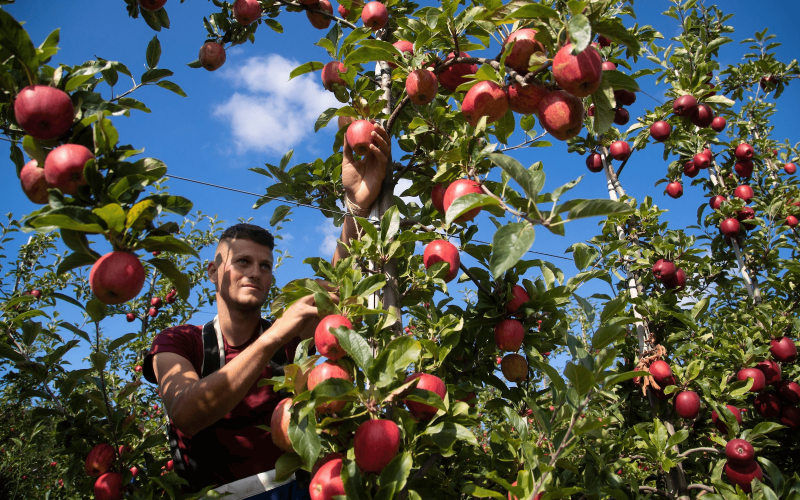
CRISPR is revolutionizing agriculture but modifying fruit remains challenging. Here’s how scientists are working to overcome that barrier

Credit: Telegraph
Credit: Telegraph

One of the major advantages of CRISPR-CAS-edited crops over the classic genetically modified (GM) crops is that the former does not contain any foreign DNA, making them indistinguishable from those developed by conventional plant breeding.

In annual crops, such as rice and tomato, the CRISPR-CAS gene-editing components (considered foreign DNA) that were introduced into their genome can be quickly removed though genetic segregation in two life cycles, taking only one or two years.

However, this strategy could not be adapted in perennial woody fruit crops, causing a major technical hurdle due to the following two reasons:

The first is their long juvenile phase before flowering. In apple, for example, the juvenile phase usually requires five or more years.

The second is their highly heterozygous genomes. This makes it impossible to reproduce the mother trees from their own seeds.  Similarly, any foreign DNA-free segregants with desired gene edits will be different from their mother trees, inevitably causing uncertainties in their performance.

Follow the latest news and policy debates on sustainable agriculture, biomedicine, and other ‘disruptive’ innovations. Subscribe to our newsletter.

What looks promising is an approach that uses a DNA base editor (a modified version of CRISPR-CAS) capable of editing single DNA bases, the Agrobacterium-based DNA delivery system, and one or more herbicide-resistance genes in plants.

Agrobacterium is a plant tumor-causing bacterium due to its ability to transfer DNA into plant cells, which has been used widely for developing conventional GM crops.


This is an excerpt. Read the original post here

{{ reviewsTotal }}{{ options.labels.singularReviewCountLabel }}
{{ reviewsTotal }}{{ options.labels.pluralReviewCountLabel }}
{{ options.labels.newReviewButton }}
{{ userData.canReview.message }}

Related Articles

Infographic: Global regulatory and health research agencies on whether glyphosate causes cancer

Infographic: Global regulatory and health research agencies on whether glyphosate causes cancer

Does glyphosate—the world's most heavily-used herbicide—pose serious harm to humans? Is it carcinogenic? Those issues are of both legal and ...

Most Popular

Credit: ACSH
Viewpoint: Who and what’s to blame for the surge in vaccine-preventable diseases?
ChatGPT-Image-May-28-2026-12_56_54-PM
Viewpoint: Vaccines' non-specific effects? The ‘shoddy’ Danish couple whose 'research’ inspires RFK, Jr.’s health delusion
ChatGPT Image Jun 3, 2026, 03_14_43 PM
Viewpoint: How Earthjustice became the poster child for the abuse of special interest activist funding
Organic-Produce
Viewpoint: Why you should ignore organic food advocates’ advice to avoid ‘pesticide soaked’ conventional fruits and vegetables
Screenshot-2026-06-08-at-11.05.51-AM
Can vaping lead to cancer? New ‘association study’ raises questions of “links"
Screenshot-2026-06-05-at-2.12.30-PM
Some plants can poison you. So how did humans figure out what is safe to eat?
Screenshot-2026-06-08-at-10.19.30-AM
‘Natural’ wellness supplements linked to liver injury
Screenshot-2026-06-05-at-3.30.20-PM
Republican lawmakers spread misinformation claiming solar farms permanently destroy potato farms
ChatGPT-Image-Jun-5-2026-01_17_48-PM
GLP-1 weight-loss drugs may reshape our desires and emotions
edb7f6d7-2370-418f-9578-74e29678e35c
Facts & Fallacies Podcast: Nicotine vaping—public health miracle, or risk to children? Professor Cliff Douglas
Screenshot 2025-07-30 at 10.48
Can gene editing eliminate Down syndrome? Scientists have done it in lab-grown cells
downsyndrome_compilation_MID_1
CRISPR breakthrough that can remove the chromosome responsible for Down syndrome raises ethical questions
glp menu logo outlined

Get news on human & agricultural genetics and biotechnology delivered to your inbox.