On foot: ‘Evolution of walking has everything to do with what makes us human’

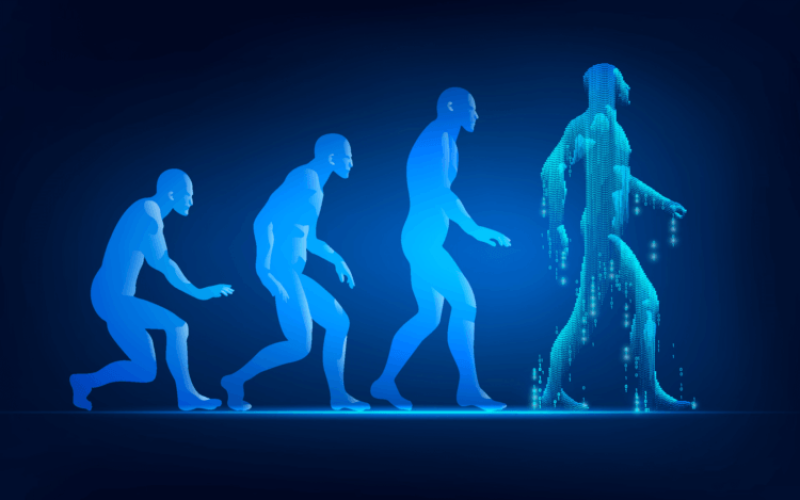
evolution of walking
Credit: Vecteezy

Going places on foot isn’t a particularly glamorous way to get around. Sure, there are proven health, social and environmental benefits. But walking is… well, pedestrian, and for many running is a chore — or something you do when you’re late to catch a bus.

According to human evolutionary biologist Daniel Lieberman, though, those activities are central to understanding what makes us human. When our ancestors adapted to getting around on two limbs instead of four, that adjustment made its mark on nearly every part of the human body from head to toe (and even our butts).

Follow the latest news and policy debates on sustainable agriculture, biomedicine, and other ‘disruptive’ innovations. Subscribe to our newsletter.

“So imagine, 7 million years ago, you’ve got some little group of our chimpanzee-like ancestors, and all of a sudden the forest is gone. And now they’re in a woodland habitat and have to travel about twice as far every day to get food. If you can save energy by standing upright, then obviously, natural selection is going to favor that. If you can spend less energy on walking around, you can spend more on having babies. It’s very hard to know exactly what the first bipeds were like, but by 4 million years ago, they were pretty good bipeds,” [said Lieberman.]


This is an excerpt. Read the full article here

{{ reviewsTotal }}{{ options.labels.singularReviewCountLabel }}
{{ reviewsTotal }}{{ options.labels.pluralReviewCountLabel }}
{{ options.labels.newReviewButton }}
{{ userData.canReview.message }}

Related Articles

Infographic: Global regulatory and health research agencies on whether glyphosate causes cancer

Infographic: Global regulatory and health research agencies on whether glyphosate causes cancer

Does glyphosate—the world's most heavily-used herbicide—pose serious harm to humans? Is it carcinogenic? Those issues are of both legal and ...

Most Popular

Screenshot 2025-07-30 at 10.48
Can gene editing eliminate Down syndrome? Scientists have done it in lab-grown cells
ChatGPT-Image-Mar-10-2026-01_39_01-PM
Viewpoint—“Miracle molecule” debunked: Why acemannan supplements don’t work
Screenshot 2026-05-26 at 10.15
Viewpoint: Double standard—Why does the wellness industry get a free pass while Big Healthcare is treated as morally suspect?
ChatGPT-Image-May-26-2026-07_51_21-AM-2
Viewpoint: There are more than 1,000 chemicals in a cup of coffee—including many substances that can cause cancer. Why isn’t it banned?
Screenshot-2026-06-04-at-12.05.08-PM
Cases of brain inflammation surge as U.S. measles pandemic approaches 2000
Screenshot-2026-05-28-at-1.36.28-PM
Viewpoint: Can mRNA research survive the Trump administration?
ChatGPT Image May 26, 2026, 08_42_17 AM (1)
Viewpoint: Greenpeace and poison: How environmental advocacy groups rely on compliant (and often ignorant) journalists to spread disinformation and spark litigation

Sorry. No data so far.

glp menu logo outlined

Get news on human & agricultural genetics and biotechnology delivered to your inbox.