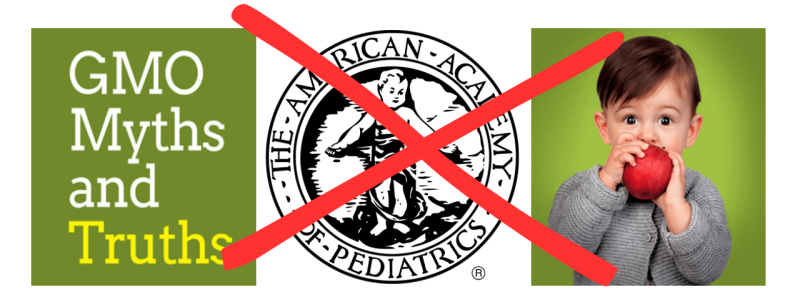

A report published in Pediatrics, the flagship journal of the American Academy of Pediatrics (AAP), warn[s] parents about genetically modified organism (GMO) based foods and conventional pesticides. The paper suggested unknown long-term impacts on children’s health and urged more research and transparency in food labeling.
The Pediatrics report also suggested a solution: “Families who desire to completely avoid GMO products can do so by purchasing organic products or those labeled as non-GMO based on third-party testing.”

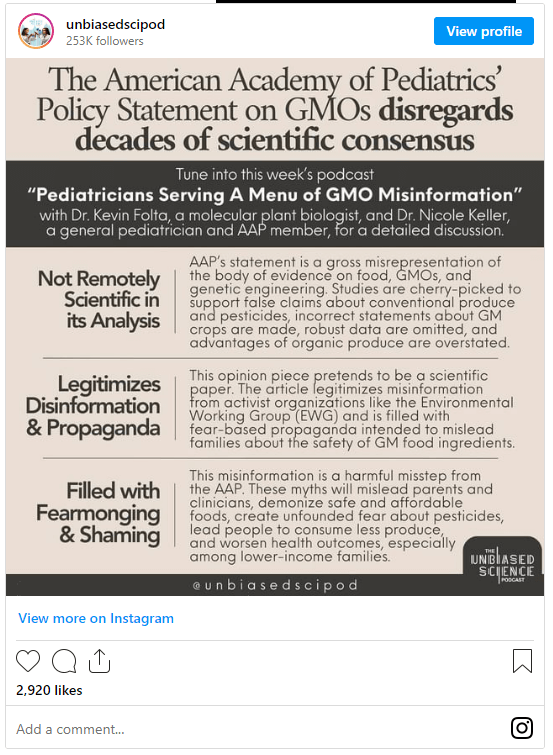
[Immunologist and microbiologist Andrea] Love was shocked. “It’s essentially legitimizing fallacies about what these crops and food products are,” the scientist tells The Messenger. “There’s so much misinformation about GMOs and what that actually means … a lot of it is exploiting low science literacy.”
…
While there have been lingering public concerns, GMO-based foods are entirely safe according to numerous agencies, including the Food and Drug Administration (FDA).
The FDA says that “studies show that GMOs do not affect you differently than non-GMO foods.” The National Academies of Sciences, Engineering, and Medicine also released a report in 2016 about the scientific consensus surrounding genetically modified food safety.




…
Jon Entine, executive director of the Genetic Literacy Project, a non-profit focused on challenging mis- and disinformation on agricultural biotechnology, adds “there’s not one major credible federal, national or global organization that has raised any questions about the health implications of genetic modification. Just none.” … “This paper should be retracted,” adds Entine.
The AAP did not respond to The Messenger’s request for comment.
Rina Raphael is the wellness editor at The Messenger. Find Rina on X @rrrins
The complete version of this excerpted article was originally posted at The Messenger a @TheMessenger