Italy’s first gene-edited crop trial, fungus-resistant rice, destroyed by vandals

Credit: Vittoria Brambilla via Università Statale di Milano

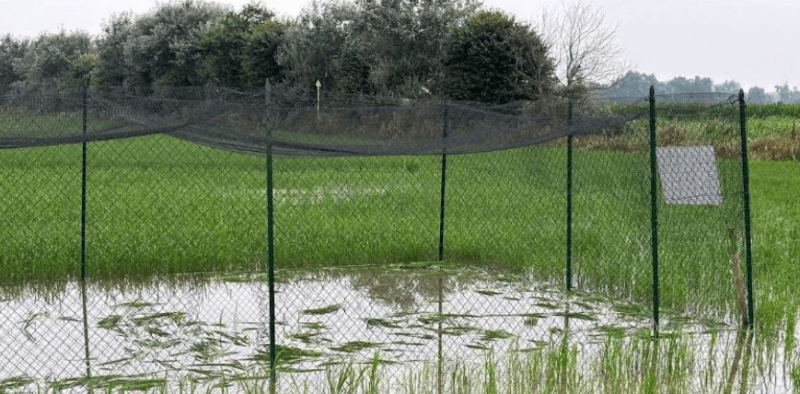
Italy’s first field trial of a gene-edited crop is in tatters, after vandals completely destroyed a test plot of experimental rice near the northern city of Pavia. No one has claimed responsibility for the destruction.

The small field trial of Arborio rice altered to make it more resistant to a common fungus was the country’s first outdoor experiment allowed under a recent loosening of the laws governing such studies. The rule change opened the way to field testing crops with precise modifications to their DNA made with the gene-editing tools such as CRISPR-Cas9. Trials using older forms of genetic modification are still virtually impossible to conduct in Italy.

“What happened is very tragic, especially for the colleagues who lost an important experiment,” says Silvio Salvi, plant geneticist at the University of Bologna and president of the Italian Society of Agricultural Genetics. But he is convinced the attack won’t derail similar projects in the pipeline. “None of us will feel scared by what happened,” he says. “There will definitely be no step back.”

Follow the latest news and policy debates on sustainable agriculture, biomedicine, and other ‘disruptive’ innovations. Subscribe to our newsletter.

After being replanted in the field, some of the plants have begun to recover, but “the experiment has lost its scientific value,” Brambilla says. She worries there are now too few plants to perform proper tests of the rice’s resistance to P. oryzae in the field.

Several other experimental field trials of gene-edited crops are now being planned in Italy, including trials of wine grapes edited to be more resistant to disease while maintaining their appearance and flavor.


This is an excerpt. Read the original post here

{{ reviewsTotal }}{{ options.labels.singularReviewCountLabel }}
{{ reviewsTotal }}{{ options.labels.pluralReviewCountLabel }}
{{ options.labels.newReviewButton }}
{{ userData.canReview.message }}

Related Articles

Infographic: Global regulatory and health research agencies on whether glyphosate causes cancer

Infographic: Global regulatory and health research agencies on whether glyphosate causes cancer

Does glyphosate—the world's most heavily-used herbicide—pose serious harm to humans? Is it carcinogenic? Those issues are of both legal and ...

Most Popular

Screenshot 2025-08-25 203032
Mazzenga’s 20-year old muscles: How a still-going-strong 92-year old sprinter wins every race she enters
Screenshot-2026-06-08-at-10.19.30-AM
‘Natural’ wellness supplements linked to liver injury
ChatGPT-Image-May-28-2026-12_56_54-PM
Viewpoint: Vaccines' non-specific effects? The ‘shoddy’ Danish couple whose 'research’ inspires RFK, Jr.’s health delusion
Screenshot-2026-06-05-at-2.12.30-PM
Some plants can poison you. So how did humans figure out what is safe to eat?
Credit: ACSH
Viewpoint: Who and what’s to blame for the surge in vaccine-preventable diseases?
Screen Shot at AM
Facts & Fallacies Podcast: Right-wing politics bad for your health? Separating speculation from science
ChatGPT-Image-Jun-9-2026-03_24_05-PM
Misinformed parents overdosing children with Vitamin A to fight measles
Screenshot 2025-07-30 at 10.48
Can gene editing eliminate Down syndrome? Scientists have done it in lab-grown cells
Screenshot-2026-06-05-at-1.44.09-PM
Viewpoint: Scientists have scrapped the worst-case climate scenario. Is that proof that climate change is a hoax, as Trump claims?
ChatGPT-Image-Mar-10-2026-01_39_01-PM
Viewpoint—“Miracle molecule” debunked: Why acemannan supplements don’t work
ChatGPT-Image-Jun-9-2026-11_54_59-AM
Why weight-loss drugs might be reducing cancer rates and making treatment more effective
Screenshot-2026-06-08-at-11.05.51-AM
Can vaping lead to cancer? New ‘association study’ raises questions of “links"
glp menu logo outlined

Get news on human & agricultural genetics and biotechnology delivered to your inbox.