80 per cent of the world’s population uses some folk medicine. Here’s why magical thinking will never go away

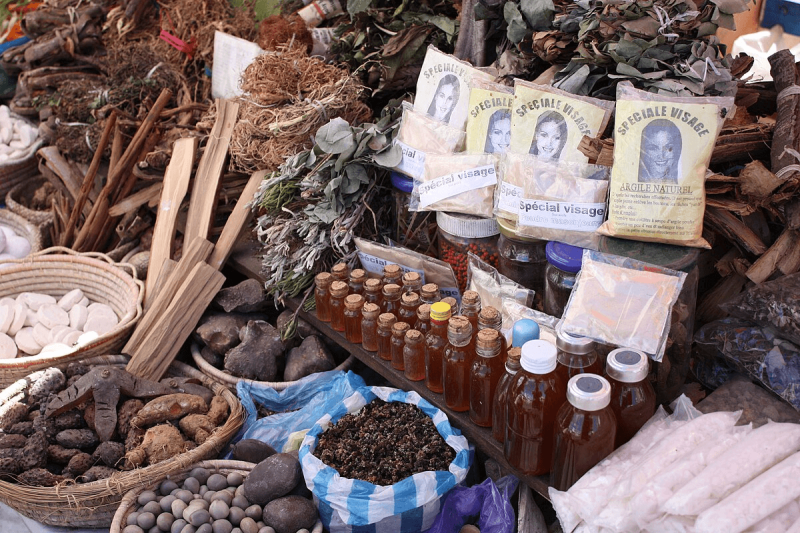
Traditional medicine in a market in Antananarivo, Madagascar. Credit: Wikimedia

At one point or another, we all knew something about how to heal ourselves using the plants and animals that surround us, at least somewhat. We treated pain with willow bark and terminated pregnancies with abortifacient herbs. We treated insomnia with lettuce and halitosis with parsley – according to a 10th-century cookbook from Baghdad, which devotes an entire chapter to the humoral properties of different vegetables. Many of us still know something about these treatments: studies estimate that as much as 80 per cent of the world’s population, roughly 6 billion people, still use traditional plant- and animal-based medicines. Such bonds that once existed between all humans and the rest of the natural world were born of scarcity, which dictates need.

Follow the latest news and policy debates on sustainable agriculture, biomedicine, and other ‘disruptive’ innovations. Subscribe to our newsletter.

Lately, we often relegate this kind of intelligence to laboratories: who needs myrrh when there is aspirin? My childhood herbalist memory, for instance, is fading. I remember picking fireweed and goatweed, but I have forgotten what they are for. It seems portentous that we should lose the memories of how to maintain our bodies: it is as if we are unremembering how to stay alive, and our forgetting what sustains us allows us to neglect and abuse the resources we no longer know how to use.

Sometimes hope itself feels like magical thinking. And maybe it is. And maybe magical thinking is precisely what has sustained us through hundreds of thousands of years of drought, epidemics, climate shifts, migration, floods, enslavement, war.

This is an excerpt. Read the original post here

{{ reviewsTotal }}{{ options.labels.singularReviewCountLabel }}
{{ reviewsTotal }}{{ options.labels.pluralReviewCountLabel }}
{{ options.labels.newReviewButton }}
{{ userData.canReview.message }}

Related Articles

Infographic: Global regulatory and health research agencies on whether glyphosate causes cancer

Infographic: Global regulatory and health research agencies on whether glyphosate causes cancer

Does glyphosate—the world's most heavily-used herbicide—pose serious harm to humans? Is it carcinogenic? Those issues are of both legal and ...

Most Popular

wuhan institute of virology main entrance
​​COVID lab leak? Making a case that the Wuhan market origins theory is wrong
Screenshot-2026-06-17-at-9.44.03-AM
Viewpoint: Embryos are becoming the newest battleground of love, loss, and legal uncertainty
Screenshot-2026-06-16-at-10.02.22-PM
Viewpoint: ‘Industrial food’ primer—Challenging the dangerous delusions of the alternative food movement
Screenshot-2026-06-17-at-11.57.12-AM
Viewpoint: Raw milk and the myth of safety—ProPublica exposes the growing anti-homogenization movement
ChatGPT-Image-Jun-9-2026-01_11_37-PM
Turmeric supplements: More risks than benefits
Screenshot-2026-06-18-at-11.41.51-AM
Viewpoint—Protecting baloney science: Far right senators move to protect the phony homeopathy industry
ChatGPT-Image-Jun-16-2026-10_01_45-AM-2
Viewpoint—Recursive self-improvement: AI leader Anthropic calls for AI slowdown
ChatGPT-Image-Jun-16-2026-10_29_11-AM
What’s behind Anthropic’s warning about the accelerating development of AI
ChatGPT-Image-Mar-10-2026-01_39_01-PM
Viewpoint—“Miracle molecule” debunked: Why acemannan supplements don’t work
ChatGPT-Image-Jun-4-2026-03_07_27-PM
AAP v. Kennedy: While a court challenge grinds on, RFK Jr. quietly advances his anti-vaccine conspiracy agenda
Screenshot-2026-06-18-at-2.52.05-PM
Activist organization accuses Trump of protecting methane-generating stripper wells to benefit billionaire and donor Jeffrey Hildebrand 
newborn infant baby mother
Facts & Fallacies Podcast: The truth about vitamin K shots
ChatGPT-Image-Jun-15-2026-02_31_28-PM-2
Trump-appointed cancer panel head backed by supplement and anti-vaccine companies promotes discredited support for ivermectin as a potential cure
glp menu logo outlined

Get news on human & agricultural genetics and biotechnology delivered to your inbox.