As artificial intelligence (AI) becomes more common and sophisticated, its effects on human lives and societies raises new questions. A new paper published in The Quarterly Review of Biology posits how these new technologies might affect human evolution. In “How Might Artificial Intelligence Influence Human Evolution?” author Rob Brooks considers the inevitable but incremental evolutionary consequences of AI’s everyday use and human-AI interactions—without “dramatic but perhaps unlikely events, including possibilities of human annihilation, assimilation, or enslavement.”
In the paper, Brooks considers (“often with considerable speculation”) some possible forms of human-AI interaction and the evolutionary implications of such interactions via natural selection, including forms of selection that resemble the inadvertent and deliberate selection that occurred when humans domesticated crops, livestock, and companion animals. He argues that technologies that deploy AI interact with humans and affect their lives in ways that can be understood by considering the kinds of biotic relationships between individuals of different species such as predators and prey, hosts and parasites, and biological competitors. “The ways such interspecies interactions have shaped animal evolution, including human evolution, can provide some basis for predicting how AI might influence human evolution in the future,” he notes.
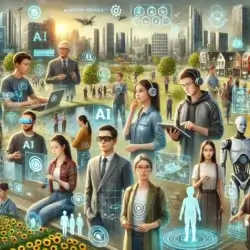
Human-AI interactions can resemble human-human social interactions, with computers, and especially AI-driven technologies, becoming increasingly important social actors. It is in these interactions that much of the potential for AI to influence human evolution lies. Through that lens, Brooks’ review examines AI’s possible effects on matchmaking (such as dating apps), intimacy, virtual friendships, and the criminal justice system.
He extracts several predictions, including the acceleration of recent evolutionary trends toward smaller brains, selection on attention spans, personality types, and mood-disorder susceptibilities. He also hypothesizes changes in intimacy-building and mating competition due to AI applications may influence the evolution of social behavior.
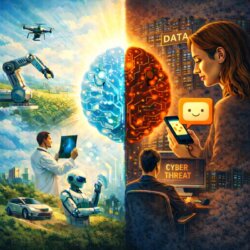


Brooks concludes that the cumulative effects of human-AI interactions on human differential reproduction and, thereby, gene frequencies and patterns of inheritance, are likely to be small relative to the immediate effects of those interactions on individual lives, well-being and happiness, and the effects on cultural evolution, keeping in mind that predicting how AI might change humanity is difficult and prone to error. “The direction and rate of evolution can be hard to predict even for organisms kept under controlled conditions,” he writes. “Far more so the complexities of predicting selection and resulting evolution of humans in a fast-moving AI-rich world.”