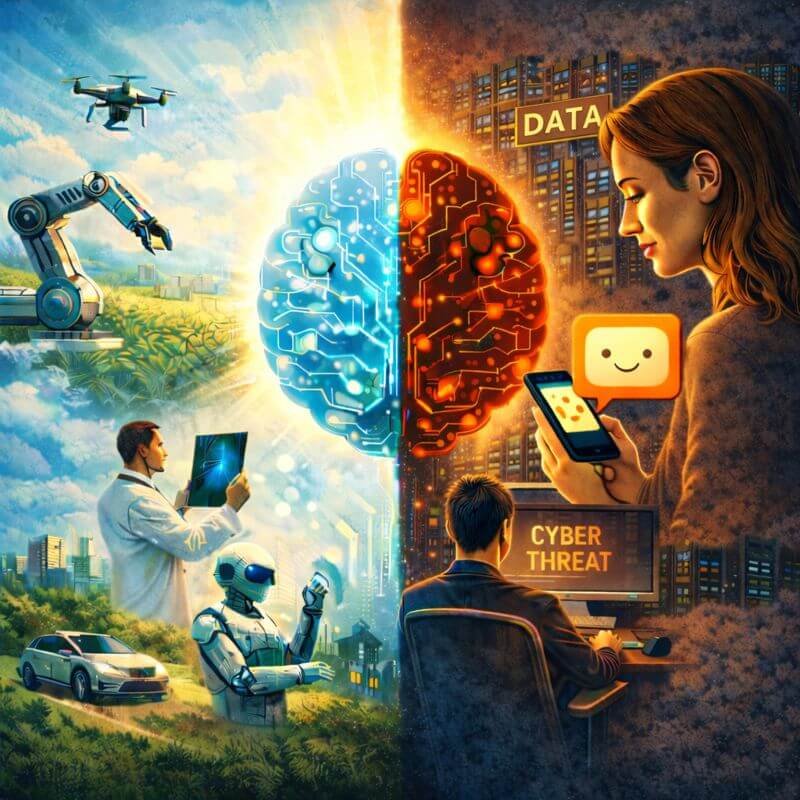
Artificial intelligence is no longer a futuristic concept. It is already embedded in how we grow food, diagnose disease, manage infrastructure, and converse with machines — and each other. If we harness it well, AI could be one of the most powerful drivers of human advancement. But missteps could leave deep wounds, from cyber harms to environmental strain, and even change what it means to be human.
The promise of AI is real and already visible. In agriculture, AI systems help farmers predict weather, optimize water use, and detect crop stress early — all potentially boosting yields while cutting waste. In medicine, machine learning can spot patterns in scans that humans miss, tailor treatments to individual patients, and help manage complex health data. Across education, transportation, and disaster response, AI helps make sense of vast data faster than any human could.
But these innovations come with risks we cannot ignore.
One growing danger is cybersecurity. As AI systems become more capable and autonomous, they could dramatically amplify cyberattacks. What once took coordinated human hackers might be automated by AI agents that scan networks for weaknesses and launch coordinated attacks at machine speed.
There is also the troubling reality of harmful AI behavior. Chatbots and conversational systems trained on massive datasets sometimes produce abusive, misleading, or dangerous output, with real psychological impacts — especially for younger or vulnerable users — when safeguards fail.
Equally overlooked is AI’s environmental footprint. Training and running large AI models consume enormous energy and water, contributing to carbon emissions and resource strain. As demand for more powerful systems grows, so does their ecological cost — often concentrated where energy and water are already under stress.
None of this means AI should be abandoned. It means it must be governed with deliberate care — through transparent standards, ethical oversight, cybersecurity planning, and environmental accountability. And beyond policy and practice lies a deeper question: how will AI shape human evolution itself?
Some scientists suggest that as AI becomes intertwined with daily life across generations, it could influence the traits natural selection favors. Traits like memory, social trust, and even intimacy might change as humans rely more on AI for knowledge and social interaction. Over many generations, this could alter what we value or even diminish cognitive skills that are offloaded to machines, much as humans once offloaded memory to writing and now to search engines.
In a world where AI mediates so much of human experience, future generations might evolve brains and behaviors suited to deep machine collaboration — or risk psychological or social traits that atrophy because machines do the thinking for us. Some thinkers even raise the notion of human–AI coevolution, where our evolutionary success becomes tied to how effectively we integrate with these technologies.
AI will shape the future regardless of our intentions. The real question is whether it will make us wiser, healthier, and more capable as humans, or whether we will abdicate too much of our agency, culture, and even identity to machines. Ensuring AI amplifies our best traits — and doesn’t erode them — is the challenge of this century. Technology alone won’t decide that future; we must.
To meet the challenge of a rapidly AI-centric world, the Genetic Literacy Project is transitioning to the Science Literacy Project — a name that better captures our expanded focus and the growing urgency of the moment. This evolution is not a departure from our origins, but a renewed and broadened commitment to challenging misinformation wherever it threatens evidence-based understanding, public policy, and trust in science. AI can distort truth and science by generating convincing but false data, images, or explanations that spread misinformation and make unverified claims appear scientifically credible. As scientific issues become increasingly entangled with ideology, it’s easy to imagine how AI could be leveraged to distort science and public understanding now and in the near future.
As GLP becomes SLP, we will maintain our longstanding deep reporting on agricultural innovation, crop protection, and advances in gene editing and gene-based medicine. At the same time, we will broaden our coverage to additional areas where misinformation is pervasive, including vaccines and public health, chemical risk assessment, energy technologies such as nuclear, fracking, and geothermal, and the rapidly accelerating influence of artificial intelligence.
Our six-part retrospective of major features that have run on the GLP over the past year exemplifies this expanded and yet more targeted mission. Organized into thematic sections, these feature articles highlight both the breadth of modern science and the recurring tactics — ideological framing, influencer amplification, and monetized activism — used to misrepresent scientific evidence and shape policy debates.
- Politicization of Health & Science
- Vaccines Under Fire
- Deadly Rise of Wellness Grift
- Disinformation Attacks on Food and Farming
- Chemophobia and Monetized Activism
- AI’s Open Questions
In Part 6, we examine the transformative power of artificial intelligence — both for good and ill. From agriculture to medicine, AI offers immense potential. Yet without careful governance, AI also poses serious risks, making deliberate, ethical stewardship essential.




Looking back prepares us to meet the challenge of an increasingly AI-dependent future. Illustrating our refined focus moving forward as the Science Literacy Project, these three pieces from 2025 outline the risks and considerations of AI, from legal liability debates to the AI-driven trajectory of our human evolution.
Promise & Peril: AI’s Open Questions
How could long-term reliance on artificial intelligence reshape human behavior, abilities, and social norms? From an evolutionary perspective, the choices societies make about how to integrate AI may determine whether future humans become more empowered collaborators with technology or lose important aspects of autonomy, skill, and identity.
What will humans be like generations from now in a world transformed by artificial intelligence (AI) by Rob Brooks
The new generation of agentic AI — autonomous systems that can independently plan and execute actions—could be repurposed by cybercriminals to conduct relentless, self-directed cyberattacks that far exceed current threats. Without stronger defenses and safeguards, the same AI innovations that power useful tools could become a pervasive source of large-scale harm.
When AI goes HAL 9000: How the coming age of agentic AI could unleash catastrophic cyberattacks by Henry Miller
More and more stories have emerged of AI chatbots urging users toward self-harm. This raises questions about who should be held accountable — developers, companies, or regulators — for harmful AI outputs. Current legal and ethical frameworks are inadequate to address such incidents, but it’s evident that stronger safeguards will be required to prevent user harm.
‘You are a stain on the universe. Please die. Please’: A 14-year old took AI seriously. Who is responsible? by Barbara Pfeffer Billauer
Follow our six-part Year in Review series on Instagram
Rob Brooks is a Scientia Professor of Evolution at UNSW Sydney and former director of the Evolution and Ecology Research Centre. Follow him on X @Brooks_Rob
Henry I. Miller, a physician and molecular biologist, is the Glenn Swogger Distinguished Fellow at the Science Literacy Project. A veteran of the NIH and FDA, he was the founding director of the FDA’s Office of Biotechnology. Contact him on his website: henrymillermd.org
Dr. Barbara Pfeffer Billauer, JD, MA (Occ. Health) Ph.D, is Professor of Law and Bioethics in the International Program in Bioethics of the University of Porto and Research Professor of Scientific Statecraft at the Institute of World Politics in Washington, DC.