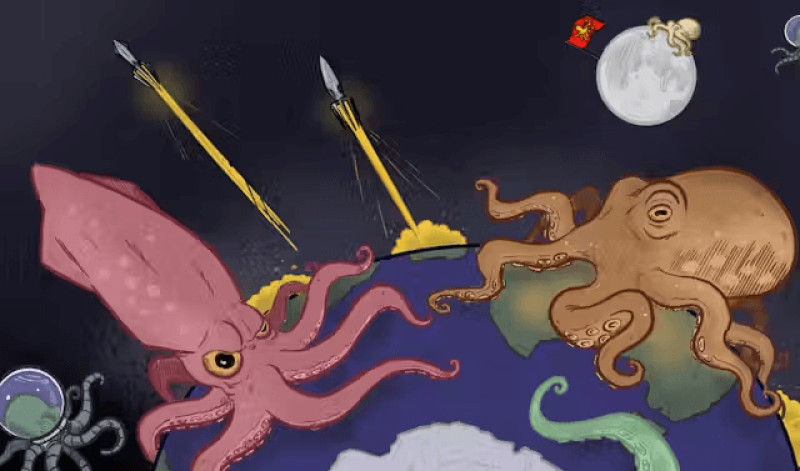
Who will inherit our planet if—when—humans breathe their last

Credit: Wes Mountain/The Conversation

Our species’ relationship with the planet has been profoundly destructive. Habitat destruction, climate change, and relentless resource extraction have pushed numerous species to the brink of extinction. Recent scientific studies paint a stark picture: we could lose up to 50% of all species by 2080 if current environmental trends continue.

This potential ecological collapse is not just a threat to wildlife—it represents an existential risk to human civilization itself. The intricate web of life that sustains our planet is unraveling at an alarming rate, forcing scientists and philosophers to contemplate a critical question: Who might inherit the Earth after humans?

Mis- and disinformation are distorting science and public policy. Subscribe to our Daily and Weekly Digests for incisive coverage of ‘disruptive’ innovations in AI, agricultural biotechnology, food, chemicals, nuclear energy, vaccines, and other disruptive innovations.

Among the most intriguing potential successors are octopuses, a species that challenges our conventional understanding of intelligence and adaptability. Biologists like Tim Coulson from the University of Oxford suggest that these extraordinary marine creatures possess unique characteristics that could position them as prime candidates for planetary inheritance.

This is an excerpt. Read the original post here

Related Articles

Infographic: Global regulatory and health research agencies on whether glyphosate causes cancer

Infographic: Global regulatory and health research agencies on whether glyphosate causes cancer

Does glyphosate—the world's most heavily-used herbicide—pose serious harm to humans? Is it carcinogenic? Those issues are of both legal and ...

Most Popular

ChatGPT-Image-Mar-10-2026-01_39_01-PM
Viewpoint—“Miracle molecule” debunked: Why acemannan supplements don’t work
ChatGPT-Image-Sep-23-2026-02_36_39-PM
Viewpoint: After firing the entire National Science Board, Trump reshapes funding initiatives. Here’s the good and the bad.
generated-1790707585414
Facts & Fallacies podcast: America's health care system is broken. A doctor explains how to fix it
Screenshot-2026-09-29-at-11.06.43-AM
Astrology, homeopathy, vaccine rejectionism, creationism: Why pseudoscience thrives as science advances
ChatGPT-Image-Sep-2-2026-02_03_32-PM
How much of a problem is AI’s water use?
Screenshot-2026-09-17-at-1.07.08-PM
'We are dangerously addicted to antidepressants': Should we heed RFK Jr.’s sobering warning?
Screenshot-2026-09-25-at-9.24.04-AM
What constitutes a measles death? RFK, Jr. maneuvers to restrict definition to make pandemic seem less dire
ChatGPT-Image-Sep-28-2026-11_51_41-AM
Energy-sucking data centers are unpopular across the political spectrum. Could moving them into space change the equation?
ChatGPT-Image-Sep-22-2026-11_17_31-AM
The exploding controversy over AI’s built-in survival drive
Screenshot-2026-09-28-at-2.41.21-PM
Viewpoint: 7-OH controversy: An opioid is available over-the-counter–even at gas stations. Should we be concerned?
glp menu logo outlined

Get news on human & agricultural genetics and biotechnology delivered to your inbox.