Resurrecting dead species—Despite the hype over the dire wolf and the wooly mammoth, chorongenetics poses immense challenges

82975227007-2411-dw-1-month-non-exclusive-1.jpg

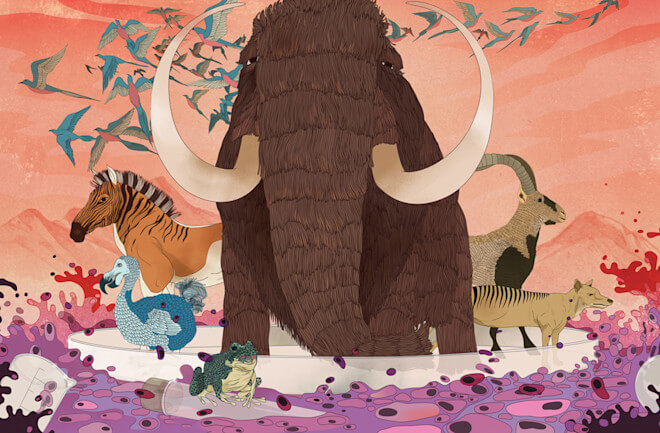
Colossal Biosciences, the biotech company behind [these] woolly mice [says the] eventual goal is to modify elephants with enough mammoth DNA to result in something resembling the extinct pachyderm. … The starting point for chronogenics appears to be in 2004. That year, US scientists reported they’d partly re-created the deadly 1918 influenza virus and used it to infect mice.
Follow the latest news and policy debates on sustainable agriculture, biomedicine, and other ‘disruptive’ innovations. Subscribe to our newsletter.
[G]ingko Bioworks, a synthetic-biology company, started hunting in herbariums for specimens of recently extinct flowers, like one that grew on Maui’s lava fields until the early 20th century. Then the company isolated some of the genes responsible for their scent molecules.

That’s a little bit similar to the woolly mouse project. Some scientists [have] complained … that when, or if, Colossal [Biosciences] starts to chrono-engineer elephants, it won’t really be able to make all the thousands of DNA changes needed to truly re-create the appearance and behavior of a mammoth. Instead, the result will be just “a crude approximation of an extinct creature,” one scientist said.

[Editor’s note: On April 7, Colossal Biosciences announced it had resurrected the dire wolf, which went extinct 12,500 years ago. Colossal CEO Ben Lamm said the team used DNA from a 13,000-year-old tooth and a 72,000-year-old skull to analyze the full genome of the species and create three healthy dire wolf puppies. However, critics say the physical and genetic resemblance to an extinct species falls short of a full revival. “All you can do now is make something look superficially like something else,” said Vincent Lynch, a biologist at the University at Buffalo who was not involved in the research.]


{{ reviewsTotal }}{{ options.labels.singularReviewCountLabel }}
{{ reviewsTotal }}{{ options.labels.pluralReviewCountLabel }}
{{ options.labels.newReviewButton }}
{{ userData.canReview.message }}

Related Articles

Infographic: Global regulatory and health research agencies on whether glyphosate causes cancer

Infographic: Global regulatory and health research agencies on whether glyphosate causes cancer

Does glyphosate—the world's most heavily-used herbicide—pose serious harm to humans? Is it carcinogenic? Those issues are of both legal and ...

Most Popular

ChatGPT Image Jun 3, 2026, 03_54_37 PM
Viewpoint: “Turn on, tune in, drop out”—Kennedy embraces the Timothy Leary psychedelic revolution
ChatGPT-Image-Jun-11-2026-01_15_03-PM
Selective Pressure, Selective Silence
Screenshot-2026-06-05-at-2.12.30-PM
Some plants can poison you. So how did humans figure out what is safe to eat?
Screenshot-2026-06-11-at-3.40.06-PM
'Toxin' detox: A gastroenterologist weighs in on $71 billion health trend
Screenshot-2026-06-05-at-1.44.09-PM
Viewpoint: Scientists have scrapped the worst-case climate scenario. Is that proof that climate change is a hoax, as Trump claims?
Screenshot-2026-06-11-at-4.00.17-PM
Gen Z burned by sunscreen misinformation and tanning myths
ChatGPT-Image-Jun-11-2026-10_34_44-AM-2
Will hi-tech genetic fortune-telling really help parents make healthier children?
Screenshot-2026-06-03-at-3.33.44-PM
Viewpoint: Vaccine deniers are attacking a life-saving Vitamin K shot for newborns that isn’t even a vaccine
Screenshot-2026-06-08-at-1.35.30-PM
Viewpoint: Social media and fake natural health propaganda fuel surge in use of mostly useless supplements
Screenshot 2026-05-26 at 10.15
Viewpoint: Double standard—Why does the wellness industry get a free pass while Big Healthcare is treated as morally suspect?

Sorry. No data so far.

glp menu logo outlined

Get news on human & agricultural genetics and biotechnology delivered to your inbox.