More evidence that intelligence is mostly genetic

Human intelligence and common cense is influenced by genetics
Credit: Rank Red

Brain dynamics and cognition share genetic roots. Criticality may guide future brain health research.

A recent study published on June 24 in PNAS presents strong evidence that brain criticality—the delicate balance between neural excitation and inhibition—is heavily influenced by genetic factors and closely linked to cognitive abilities.

The research, led by Prof. Ning Liu of the Institute of Biophysics at the Chinese Academy of Sciences (CAS) and Prof. Shan Yu of the Institute of Automation at CAS, utilized resting-state functional MRI (rs-fMRI) data from the Human Connectome Project S1200 release. This dataset included scans from 250 identical twins, 142 fraternal twins, and 437 individuals with no familial relation, allowing researchers to effectively assess the genetic contributions to brain criticality.

Follow the latest news and policy debates on sustainable agriculture, biomedicine, and other ‘disruptive’ innovations. Subscribe to our newsletter.

Sensory regions show strong heritability

The findings revealed that genetic factors play a significant role in shaping brain criticality, with more pronounced genetic influence detected in the primary sensory cortices than in higher-order association areas. This indicates that the brain’s ability to sustain near-critical dynamics—previously linked to efficient information processing and cognitive adaptability—is largely inherited.
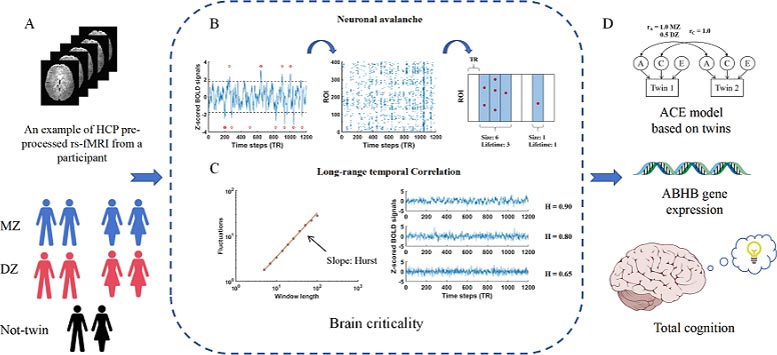
Heritability Analysis Pipeline for Brain Criticality and Cognition
Schematic diagram of the heritability estimation pipeline for critical dynamics. Credit: Ning Liu’s group

To further explore the underlying biology, the researchers combined the rs-fMRI data with gene expression maps from the Allen Human Brain Atlas. This analysis identified specific genetic expression patterns that correlate with regional brain criticality and are involved in biological processes associated with neurological disorders.

Importantly, the study also revealed that brain criticality and cognitive performance share a common genetic foundation, providing valuable insight into how inherited traits may support higher cognitive function.

Toward new understanding of brain health

“Maintaining criticality is essential for brain function,” said Prof. Liu. “Uncovering its genetic basis opens new directions for understanding cognition and neurological disease.”

This work lays the foundation for future research into the molecular mechanisms behind critical brain dynamics and their implications for brain health.

A version of this article was originally posted at SciTechDaily and is reposted here with permission. Any reposting should credit both the GLP and original article. Find SciTechDaily on X @SciTechDaily1


{{ reviewsTotal }}{{ options.labels.singularReviewCountLabel }}
{{ reviewsTotal }}{{ options.labels.pluralReviewCountLabel }}
{{ options.labels.noReviewsLabel }}
{{ options.labels.newReviewButton }}
{{ userData.canReview.message }}

Related Articles

Infographic: Global regulatory and health research agencies on whether glyphosate causes cancer

Infographic: Global regulatory and health research agencies on whether glyphosate causes cancer

Does glyphosate—the world's most heavily-used herbicide—pose serious harm to humans? Is it carcinogenic? Those issues are of both legal and ...

Most Popular

Screenshot 2026-07-16 at 8.49
Pete Hegseth’s bizarre Viagra commercial as Trump administration endorses ‘hormone replacement therapy’
ChatGPT-Image-Jul-1-2026-03_33_49-PM
‘Alternative’ cancer treatments that could kill you
ChatGPT-Image-Mar-10-2026-01_39_01-PM
Viewpoint—“Miracle molecule” debunked: Why acemannan supplements don’t work
ChatGPT-Image-Jul-8-2026-12_32_48-PM
Viewpoint: SCOTUS strikes a blow against junk science in Bayer glyphosate case. Will it deter mass tort litigators?
ChatGPT-Image-Jul-9-2026-02_39_22-PM
Viewpoint: Polyphenols or NAD+ supplements to combat aging: No, Gwenyth Paltrow and followers, don’t waste your money.
Screenshot-2026-07-16-at-8.33.45-AM
US court revives 550 lawsuits claiming Tylenol causes autism and ADHD. What does this ruling mean for science and the law?
png-social-media-Fb-wa-insta-CC
Farmers and agri-food companies are abandoning social media even as disinformation grows
afb-a-b
As the EU loosens restrictions on agricultural gene editing, it remains years behind the rest of the world on equally-safe GMO foods
aca45222-ae49-44a7-aee5-ef4b3dfcc505
Science under siege: As federal funding dries up, top research universities are turning out fewer PhDs
Viewpoint: Consensus as truth? How ‘misinformation police’ control policy narratives
Which among war, weather and cyber attacks is the biggest world threat? None of the above. It’s misinformation, and here’s why.
ChatGPT-Image-Jul-7-2026-01_57_55-PM
Viewpoint: Europe’s rejection of air conditioning is the poster child for misunderstanding how to mitigate the impact of climate change
ChatGPT-Image-Jun-25-2026-12_23_17-PM
No, Bill Gates did not secretly engineer ticks to promote veganism
Screenshot-2026-07-08-at-9.36.03-AM
Viewpoint: Long-contained diseases are on the rise in the U.S. Are Trump cuts to blame?
c9f0a584-46e9-4dd8-9a77-f5f5a7a51a84
Across Eastern Europe, science disinformation has spread far beyond COVID and vaccine denialism. Here’s the grim list.
glp menu logo outlined

Get news on human & agricultural genetics and biotechnology delivered to your inbox.