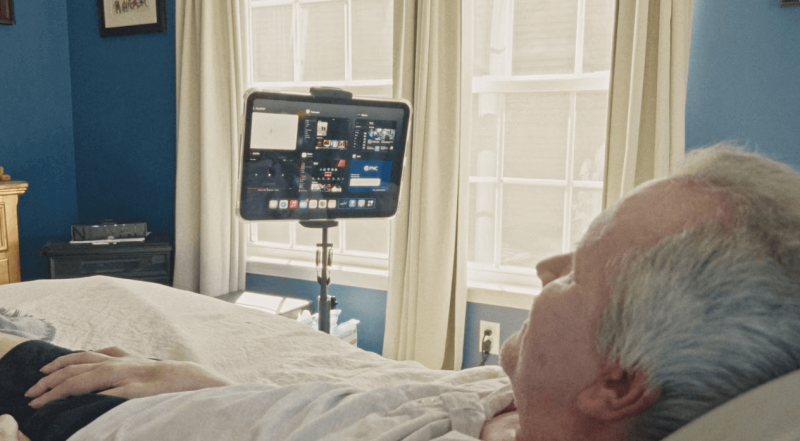
Implantable brain technology: ALS patient is first to control iPad by thought

Mark Jackson, 65, becomes first person to control an iPad via thought, using a brain computer interface (BCI). Credit: Synchron

A patient with amyotrophic lateral sclerosis (ALS) has become the first person in the world to control an iPad entirely by thought, according to neurotech company Synchron.

This means Mark Jackson, 65, from western Pennsylvania, can control the product without using his hands or voice commands. Instead, an implantable brain-computer interface (BCI) translates his thoughts into actions.

Jackson was diagnosed with ALS in 2021. Over time, he said he developed paralysis in both of his arms along with some weakness in his neck.

Years ago, this may have meant a loss of independence due to the lack of motor function. Now, Jackson said he is able to watch TV shows, listen to audiobooks, use social media and send text messages to his children.

Follow the latest news and policy debates on sustainable agriculture, biomedicine, and other ‘disruptive’ innovations. Subscribe to our newsletter.

The BCI that Jackson is using was developed by the company Synchron, which involves a device implanted into one of the veins within the brain in a minimally invasive procedure.

Dr. Leah Croll, a neurologist at Maimonides Hospital, in Brooklyn, New York … told ABC News that research into BCIs is not new but that artificial intelligence (AI) has helped it grow rapidly.


This is an excerpt. Read the original post here

{{ reviewsTotal }}{{ options.labels.singularReviewCountLabel }}
{{ reviewsTotal }}{{ options.labels.pluralReviewCountLabel }}
{{ options.labels.newReviewButton }}
{{ userData.canReview.message }}

Related Articles

Infographic: Global regulatory and health research agencies on whether glyphosate causes cancer

Infographic: Global regulatory and health research agencies on whether glyphosate causes cancer

Does glyphosate—the world's most heavily-used herbicide—pose serious harm to humans? Is it carcinogenic? Those issues are of both legal and ...

Most Popular

Screenshot 2026-05-26 at 10.15
Viewpoint: Double standard—Why does the wellness industry get a free pass while Big Healthcare is treated as morally suspect?
ChatGPT-Image-Jun-11-2026-01_15_03-PM
Selective Pressure, Selective Silence
Screenshot-2026-06-03-at-3.33.44-PM
Viewpoint: Vaccine deniers are attacking a life-saving Vitamin K shot for newborns that isn’t even a vaccine
ChatGPT Image Jun 3, 2026, 03_54_37 PM
Viewpoint: “Turn on, tune in, drop out”—Kennedy embraces the Timothy Leary psychedelic revolution
Screenshot-2026-06-05-at-1.44.09-PM
Viewpoint: Scientists have scrapped the worst-case climate scenario. Is that proof that climate change is a hoax, as Trump claims?
Screenshot-2026-06-05-at-2.12.30-PM
Some plants can poison you. So how did humans figure out what is safe to eat?
Screenshot-2026-06-11-at-3.40.06-PM
'Toxin' detox: A gastroenterologist weighs in on $71 billion health trend
Screenshot-2026-06-08-at-1.35.30-PM
Viewpoint: Social media and fake natural health propaganda fuel surge in use of mostly useless supplements
Screenshot-2026-06-11-at-4.00.17-PM
Gen Z burned by sunscreen misinformation and tanning myths
Credit: ACSH
Viewpoint: Who and what’s to blame for the surge in vaccine-preventable diseases?
ChatGPT-Image-Jun-10-2026-12_57_24-PM
Viewpoint: Why gene-editing babies is moral and certain to happen
ChatGPT-Image-May-28-2026-12_56_54-PM
Viewpoint: Vaccines' non-specific effects? The ‘shoddy’ Danish couple whose 'research’ inspires RFK, Jr.’s health delusion
Screenshot 2025-08-25 203032
Mazzenga’s 20-year old muscles: How a still-going-strong 92-year old sprinter wins every race she enters
glp menu logo outlined

Get news on human & agricultural genetics and biotechnology delivered to your inbox.