
Tearful onions? CRISPR has a solution for that

Screenshot 2026-10-12 at 12.25.03 PM

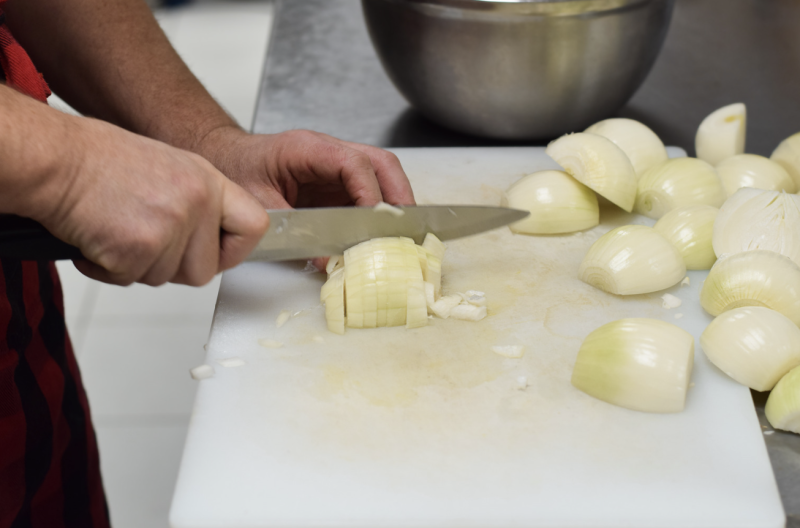
Chopping onions may one day be a dry-eyed affair. Researchers at Japan’s Chiba University and food company House Foods have used CRISPR-Cas9 gene editing to knock out the gene behind onion-induced tears, as Global Agriculture reports.

The target is lachrymatory factor synthase (LFS), an enzyme that springs into action when an onion’s cells are cut, converting sulfur compounds into the volatile gas that stings your eyes. Disable LFS, the thinking goes, and the waterworks stop.

The team, including Shoya Tamaru and Takahiro Kamoi of House Foods Group and Tomoko Igawa of Chiba University, edited onion calli (clumps of lab-grown plant tissue), using Agrobacterium to deliver the CRISPR machinery. Of 483 lines screened, 19 proved to be true mutants. In the four mutant lines tested, LFS activity in leaves fell to less than 40% of that in unedited plants.

Don’t expect tear-free onions in the produce aisle just yet. Many of the edited plants grew abnormally, none produced seed, and several died after being moved into soil. The researchers mainly blame somaclonal variation, the genetic glitches that build up during long stretches in tissue culture, rather than the edit itself.

Mis- and disinformation are distorting science and public policy. Subscribe to our Daily and Weekly Digests for incisive coverage of ‘disruptive’ innovations in AI, agricultural biotechnology, food, chemicals, nuclear energy, vaccines, and other disruptive innovations.

That makes the work, first posted as a bioRxiv preprint in July and since published in Frontiers in Plant Science, an early proof of concept. Turning it into a usable variety would require a shorter culture process or conventional breeding, and House Foods hasn’t announced a release timeline.

The stakes go beyond home kitchens. Global Agriculture notes that onion processing workers in India, the world’s second-largest onion producer, face the same irritant day in and day out. Earlier work used gene silencing to tame onion tears, and how gene-edited crops like this one are regulated still varies from country to country.


Read the original article here

Related Articles

Infographic: Global regulatory and health research agencies on whether glyphosate causes cancer

Infographic: Global regulatory and health research agencies on whether glyphosate causes cancer

Does glyphosate—the world's most heavily-used herbicide—pose serious harm to humans? Is it carcinogenic? Those issues are of both legal and ...

Most Popular

ChatGPT-Image-Mar-10-2026-01_39_01-PM
Viewpoint—“Miracle molecule” debunked: Why acemannan supplements don’t work
Personalized-Cancer-mRNA-Vaccine-Vial
Personalized mRNA vaccines are poised to revolutionize cancer treatments. Here are the barriers.
Screenshot-2026-09-22-at-12.26.15-PM
‘Forever chemical’ concerns: Separating hysteria from reasonable concern in the debate over PFAS danger
Screenshot-2026-10-05-at-11.57.44-AM
Scaremongering or legitimate safety concerns? The political dogfight over America’s food safety system
Screenshot-2026-10-11-at-10.24.21-AM
Viewpoint: RFK Jr.’s new CDC head Erica Schwartz greenlights hepatitis B vaccine study critics call “unethical and designed to cast doubts on its safety”
Deepfake Democracy Media Mosaic
31 states have passed a patchwork of laws to limit election deepfake commercials. They’re not working very well.
Screenshot 2026-10-12 at 12.25
Tearful onions? CRISPR has a solution for that
AI-Force-Uniform-Insignia-Close-Up
Trump wants an AI Force like Space Force, but that could make AI’s risks harder to manage
Screenshot-2026-10-08-at-1.23.28-PM
Countries around the world are rushing to pass teenage social media bans. Could they backfire?
AI Doctor with a Digital Neural Head
Utah becomes first state to empower AI to bypass doctors and prescribe certain drugs
Radioactive-Americana-Collage-2
The kooky logic behind the raft of spurious cancer claims from Harvard’s T.H. Chan School of Public Health
generated-1790707585414
Facts & Fallacies podcast: America's health care system is broken. A doctor explains how to fix it
Screenshot-2026-09-22-at-10.54.12-AM
‘They misunderstand science’: Research attempting to tie autism to changes in the gut microbiome comes under fire
glp menu logo outlined

Get news on human & agricultural genetics and biotechnology delivered to your inbox.





















