
Genghis Khan’s reputation as history’s most fertile father challenged by 9 mystery men

gkhan chinneeb

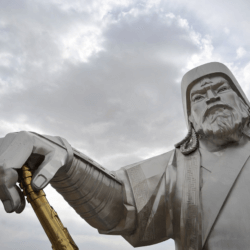
Millions of men bear the genetic legacy of Genghis Khan, the famously fertile Mongolian ruler who died in 1227. Researchers have now recognized ten other men whose fecundity has left a lasting impression on present-day populations. The team’s study points to sociopolitical factors that foster such lineages, but the identities of the men who left their genetic stamp remains unknown.

The case for Genghis Khan’s genetic legacy is strong, if circumstantial. A 2003 paper led by Chris Tyler-Smith, an evolutionary geneticist now at the Wellcome Trust Sanger Institute in Hinxton, UK, discovered that 8% of men in 16 populations spanning Asia (and 0.5% of men worldwide) shared nearly identical Y-chromosome sequences. The variation that did exist in their DNA suggested that the lineage began around 1,000 years ago in Mongolia.

In addition to Genghis Khan and his male descendants, researchers have previously identified the founders of two other highly successful Y-chromosome lineages: one that began in China with Giocangga, a Qinq Dynasty ruler who died in 15823, and another belonging to the medieval Uí Néill dynasty in Ireland.

Genghis Khan’s paternal lineage again stood out, as did Giocangga’s, Jobling’s team reports in the European Journal of Human Genetics1. The other nine lineages originated throughout Asia, from the Middle East to southeast Asia, dating to between 2100 bc and ad 700. Jobling warns that these dates come with huge margins of error, but he notes that the estimates for the lineages attributed to Khan and Giocangga are very close to those of past studies.

Read full, original article: Genghis Khan’s genetic legacy has competition

Related Articles

Infographic: Global regulatory and health research agencies on whether glyphosate causes cancer

Infographic: Global regulatory and health research agencies on whether glyphosate causes cancer

Does glyphosate—the world's most heavily-used herbicide—pose serious harm to humans? Is it carcinogenic? Those issues are of both legal and ...

Most Popular

ChatGPT-Image-Mar-10-2026-01_39_01-PM
Viewpoint—“Miracle molecule” debunked: Why acemannan supplements don’t work
Woman_Vaping_Electronic_Cigarette_50687233623
Trump administration clears the way for speedy approvals of once-restricted tobacco vapes and pouches
ChatGPT-Image-Sep-25-2026-11_36_56-AM
Now AI almost started a war with China
Screenshot-2026-09-17-at-1.07.08-PM
'We are dangerously addicted to antidepressants': Should we heed RFK Jr.’s sobering warning?
ChatGPT-Image-Sep-2-2026-02_03_32-PM
How much of a problem is AI’s water use?
Screenshot-2026-09-24-at-1.24.47-PM
80% of Americans take (mostly useless) supplements for their health
Screenshot-2026-09-16-at-10.27.33-AM
Viewpoint: SCOTUS poised to address First Amendment tension between mandatory vaccines, children’s health and religious freedom 
ChatGPT-Image-Sep-27-2026-10_00_17-AM
Current and future RFK Jr. aides criticize his science-rejectionist vaccine views
ChatGPT-Image-Sep-21-2026-11_54_00-AM
Viewpoint: Activist environmental NGOs are turning from public funding to activist billionaires to support their campaigns. It won’t end well.
ChatGPT-Image-Sep-23-2026-01_52_03-PM
Viewpoint: 4 very real AI doomsday scenarios
Screenshot-2026-09-16-at-2.26.42-PM
Viewpoint: How to ecologically damage America’s forests: Ban glyphosate
glp menu logo outlined

Get news on human & agricultural genetics and biotechnology delivered to your inbox.